
Pennsylvania in Watercolor: Revisiting Nick Ruggieri’s Bicentennial Series
Written by Curtis Miner in the Features category and the Fall 2025 issue Topics in this article: Bicentennial Commission, Harrisburg, John Baer, John H. Baum, landscape paintings, Milton J. Shapp, Nick Ruggieri, painting, Patriot-News (Harrisburg), State Museum of Pennsylvania, Sylvester K. Stevens, United States Bicentennial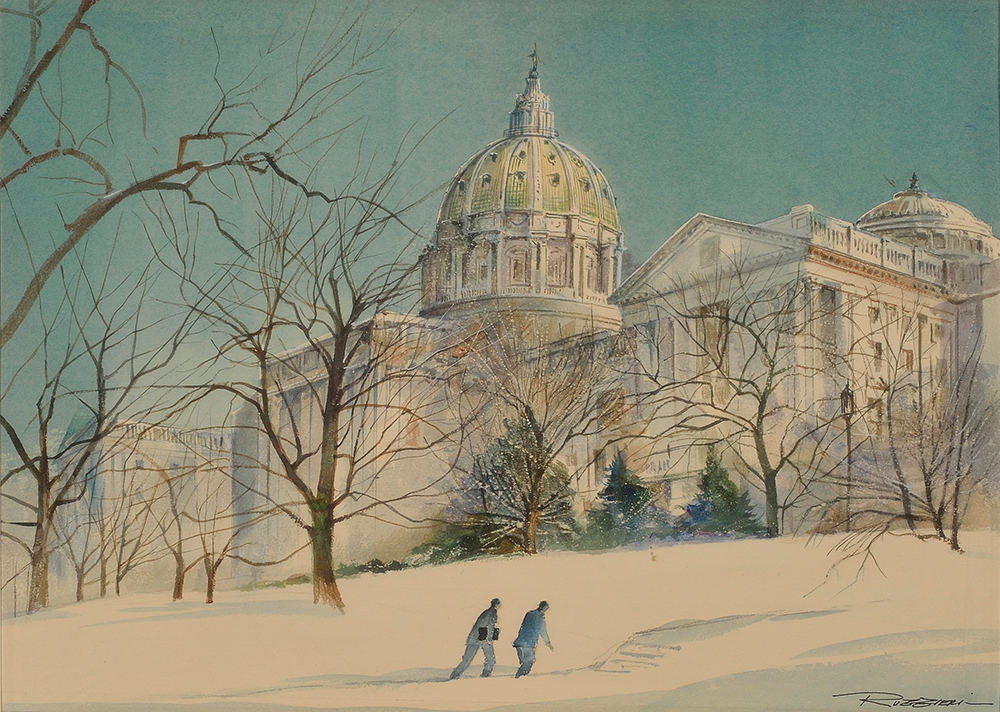
Dauphin: Capitol Dome, watercolor.
The Pennsylvania Capitol, designed by architect Joseph Huston and completed in 1906, houses the chambers of both legislative branches of the General Assembly, the capital chambers for the Supreme Court and Superior Court, and the offices of the governor and lieutenant governor.
The State Museum of Pennsylvania
In 1971, the Harrisburg Patriot-News commissioned local artist and newspaperman Nick Ruggieri (1908–96) to create a series of paintings depicting Pennsylvania scenes—both historic and contemporary — across all 67 counties. The project was intended to be the capital city newspaper’s contribution to the upcoming Bicentennial, a national celebration in which the Keystone State was expected to play a central role. As it would turn out, Ruggieri’s series, titled Pennsylvania—A Commemorative Portrait, would become one of the signature programs of the commonwealth’s year-long celebration. It also would become one of the Bicentennial’s more enduring legacies, thanks to efforts by both the Patriot-News and the William Penn Memorial Museum (now The State Museum of Pennsylvania) to preserve Ruggieri’s collection, perhaps the most geographically ambitious project ever undertaken by a Pennsylvania artist.
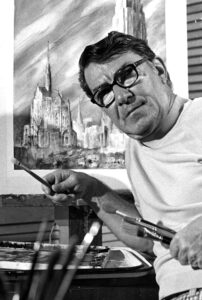
Nick Ruggieri, circa 1975.
Historical Society of Dauphin County / Allied Pix Collection
Planning for the Bicentennial began in earnest in 1968 with the creation of the Pennsylvania Bicentennial Commission. The commission was testimony to the persistence of S.K. Stevens (1904–74), longtime executive director of the Pennsylvania Historical & Museum Commission (PHMC). Recognizing the immense opportunity that the 200th anniversary provided for the promotion of both Pennsylvania history and public history, Stevens spent more than a year lobbying state officials to authorize the establishment of the Bicentennial Commission. He hoped that a planning commission based in Harrisburg would provide a counterweight to both commercial interests and an overly Philadelphia-centric celebration. Pennsylvania’s largest city had every right to be proud of landmarks such as Independence Hall, Carpenters’ Hall and the Liberty Bell, but Stevens believed any commemoration should benefit and involve all of Pennsylvania and bolster historical literacy, not just tourism revenue.
To achieve that objective, Stevens urged that the commission be placed under his department: “This is not a tourist promotion but should be a dignified historic observance utilizing to the fullest extent the resources of the historical and museum agencies of the state. I think the appropriating agency should be PHMC, the official State agency concerned with historical matters.”
Stevens lost that battle. In 1968, the bill authorizing and funding the Bicentennial Commission passed the General Assembly, but the enabling legislation directed that the commission and its appropriation be placed within the state’s Department of Commerce — the same agency that Stevens and others blamed for having “bungled” the Civil War Centennial a few years earlier. Stevens retired in 1971 and died two years before the Bicentennial commemoration he had worked so hard to shape and elevate. But he could be satisfied with having won the war: Stevens’ tireless advocacy for broad-scale participation in history related initiatives and statewide programming that touched all corners of the state did find traction.
Among those who heeded Stevens’ call were Patriot-News publisher John H. Baum (1917–81) and one of his more colorful and energetic employees, Nick Ruggieri. Baum began working at the newspaper shortly after graduating from Gettysburg College in 1939. After holding several editorial positions, he was appointed general manager in 1963 and named publisher and vice president in 1968. Baum also served as president of the Pennsylvania Newspaper Publishers Association.
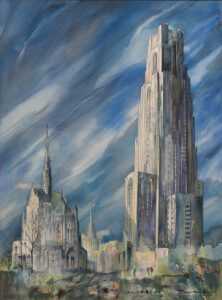
Allegheny: Cathedral of Learning, watercolor.
The Cathedral of Learning, built in 1926, is a 42-story skyscraper that towers 535 feet over the main campus of the University of Pittsburgh in the city’s Oakland neighborhood.
The State Museum of Pennsylvania
As the newspaper’s art director, Ruggieri was responsible for the graphic content of both the morning (The Patriot) and afternoon (The Evening News) editions along with the combined Sunday edition (Sunday Patriot-News). “There’s always something different to paint,” Ruggieri noted, describing his responsibilities as the chief newsroom artist. “One day a cartoon, the next day a map, perhaps the following day an advertisement.”
His work at the newspaper was not his only creative outlet. Over the course of his by then 30-year career as a professional commercial artist, Ruggieri had become a fixture in the Harrisburg arts community. In an application to one art show, he aptly described himself as “painter, teacher, illustrator.” He became especially fond of rendering scenes in and around Harrisburg. With his proposed Bicentennial project, that interest would be extended statewide to all of Pennsylvania’s 67 counties.
Ruggieri approached his depictions of Pennsylvania’s places with a curiosity and enthusiasm that only an outsider could see. Born in Trieste, Italy, in 1908, Ruggieri was just 10 years old when his family immigrated to the United States, eventually settling in Harrisburg. The family lived in the city’s uptown neighborhood, where Nick attended the local schools. He first became interested in drawing as a student at Reily Street Elementary. He continued to pursue art at Camp Curtin Junior High School and William Penn Senior High School. While still in his teens, he joined a sketch club that exhibited at Harrisburg Technical High School and shared an art studio with other local artists, including Alden Turner, the art director at the Harrisburg Telegraph.
In 1930, Ruggieri left Harrisburg to attend the Arts Students League in New York City, where he studied with Robert Brackman and over the next several years became immersed in the city’s vibrant art scene. In 1939, he traveled back to the country of his birth to study the Old Masters at the Academy of Florence. The experience proved formative for Ruggieri’s emerging aesthetic: A review from his first one-man show noted how his work “resembles the scaled under drawing of the work of many Italian Renaissance artists in portraying delicate atmospheric effects.”
In 1940, Ruggieri returned to Harrisburg and found work as an artist at the Harrisburg Telegraph alongside his fellow sketch artist Turner. A year later, Ruggieri was hired by the Harrisburg Patriot-News in what would prove to be the beginning of a 40-year career with the newspaper. He also enmeshed himself in the local art scene. He became especially active in the Art Association of Harrisburg, an organization of which he had been a charter member since 1927 and for which he also would serve as president and board member.
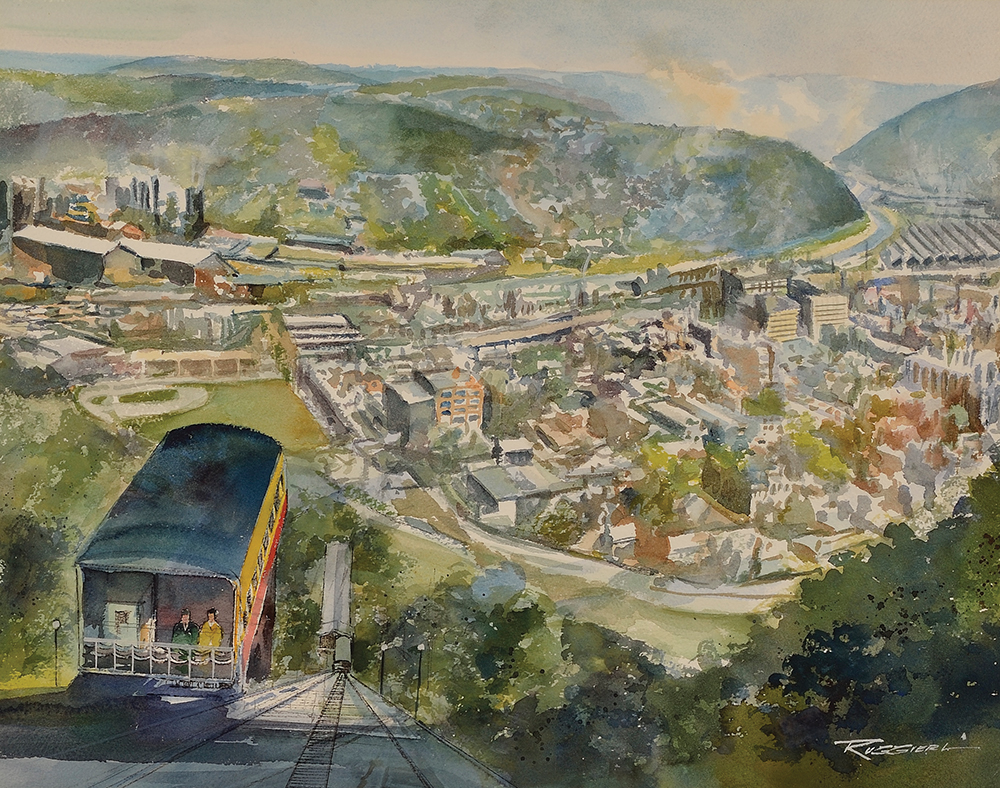
Cambria: Incline Plane, watercolor.
Completed in 1891, the Johnstown Inclined Plane is a cable railway on a steep slope, or funicular, that connects the city of Johnstown with the borough of Westmont atop Yoder Hill.
The State Museum of Pennsylvania
Working either independently or through the art association, Ruggieri shared his love for art through painting classes, lectures and tours. He also garnered numerous accolades, including the Grumbacher Award in 1964, in recognition of his talent with watercolors, and memberships in the Royal Society for the Encouragement of Arts in London, the Salmagundi Club in New York City, and Kappa Pi, a national art fraternity.
Despite the demands of his day job and his various activities on behalf of the local arts community, Ruggieri managed to complete 35 to 40 paintings a year, typically spending three five-hour sessions on each one. Although he preferred watercolor, he also worked with oils and other media. He was a proponent of speed and instinct over deliberation, an approach no doubt reinforced by the demands of working as art director for two daily newspapers. “A painting may take an hour to several weeks,” but he confessed that “often an hour will achieve the interpretation of what you want, rather than weeks of work.”
In 1967, Ruggieri’s diligence paid off when he was the first local artist invited do a solo exhibition at the newly opened William Penn Memorial Museum. The subsequent show featured 25 watercolors, 25 oils, eight acrylic polymer paintings, and six mixed media works, including one titled View from South Harrisburg.
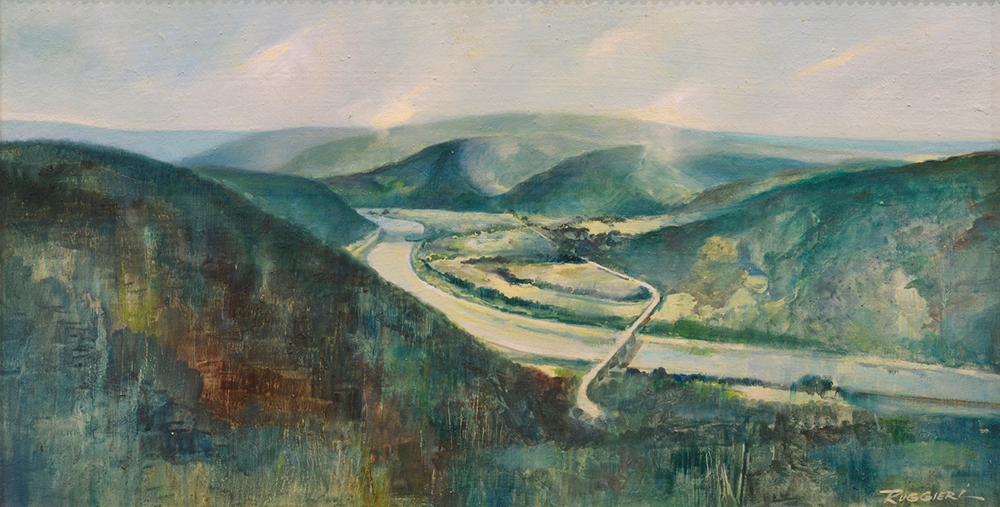
Clinton: Hyner View, gouache on board.
This scenic overlook stands at an elevation of 1,940 feet above sea level and is the highlight of Hyner View State Park, near Renovo on the West Branch of the Susquehanna River.
The State Museum of Pennsylvania
Ruggieri’s one-man show at Pennsylvania’s new state museum fortified his reputation as a versatile and accesible artist who made not just pretty pictures but ones that evoked the power of place. “It is a fascinating experience to watch Nick Ruggieri weave colors together — achieving deep tones — brilliant tones — muted ones — with slashes of white,” declared Patriot-News Community Service Director William T. Lunsford Jr. “The Ruggieri approach is sure and gradually there emerges shapes of trees, rocks, depths of sky and water — all into paintings that unloose new horizons. . . . Each picture is the result of something to which he has reacted strongly. If a Ruggieri painting must be labeled, surely it must be called modern realism.”
During a time when many younger painters were using art to address social issues of the day, Ruggieri’s realism was unabashedly committed to putting his subject matter in the best possible light: “A painting should bring pleasure. There’s so much tragedy in the world. I see no need to paint such sadness, since it’s so prevalent anyway. I want my paintings to bring pleasure as they portray the good things, the beautiful things in life.”
In setting out his vision for a “Portrait of Pennsylvania,” Ruggieri chose to follow a similar tack. The result would be “representative paintings, historical, scenic, contemporary — even provocative.” The objective would be at least one artwork for each of Pennsylvania’s 67 counties. To accomplish that, he committed all his free time to field research in each county, a process that involved scouting potential locations, taking photographs, and developing preliminary sketches — about 200 of the latter.
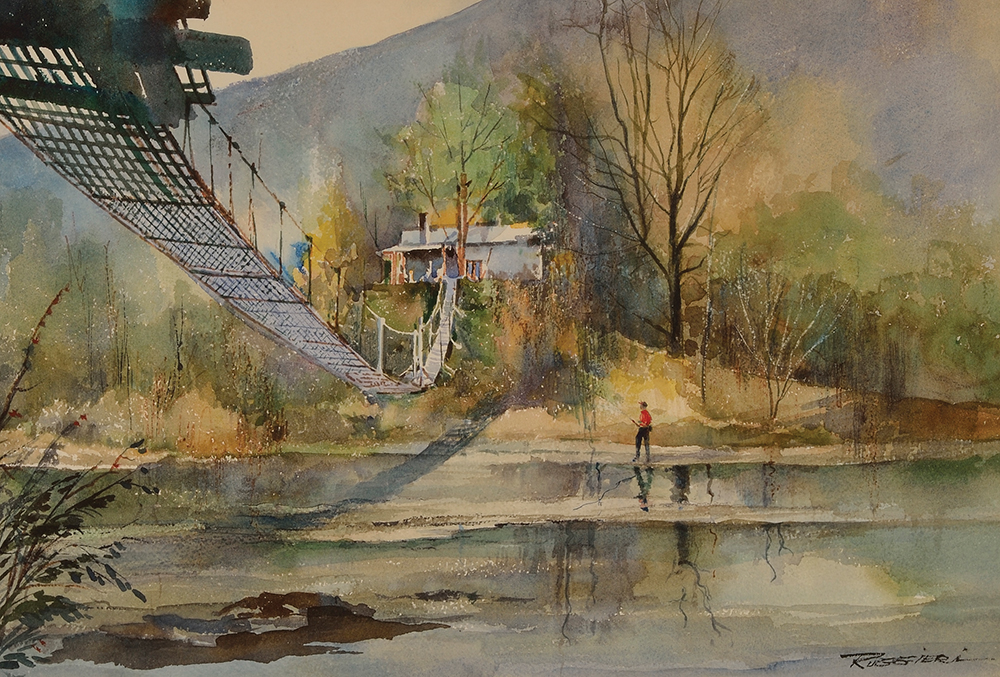
Elk: Swinging Bridge, watercolor.
In the Pennsylvania—A Commemorative Portrait exhibition catalog, journalist John Baer wrote of this painting, “Elk County residents used to rely on swinging bridges such as this one to cross difficult terrain.”
The State Museum of Pennsylvania
The ambitious project was the perfect match for a seasoned artist with a boundless supply of energy. During the unveiling, columnist Paul Beers quipped, “If Ruggieri hadn’t been spending evenings, weekends and vacations on this Bicentennial project, he would have been a pain in the neck at home and around the office.”
There were setbacks. Ruggieri was about a year or so into the project when Tropical Storm Agnes struck central Pennsylvania in June 1972. The widespread flooding caused by Agnes destroyed all of the work he had completed to that point. Disappointed but undeterred, Ruggieri started over with the same level of enthusiasm and energy, determined to meet the project deadline for an unveiling in the fall of 1975. “Ruggieri has more horsepower today than he had 10 years ago,” Beers remarked. “Artists are more like poets than novelists or mathematicise. From Michelangelo on down, artists have a compulsion to defy Father Time.”
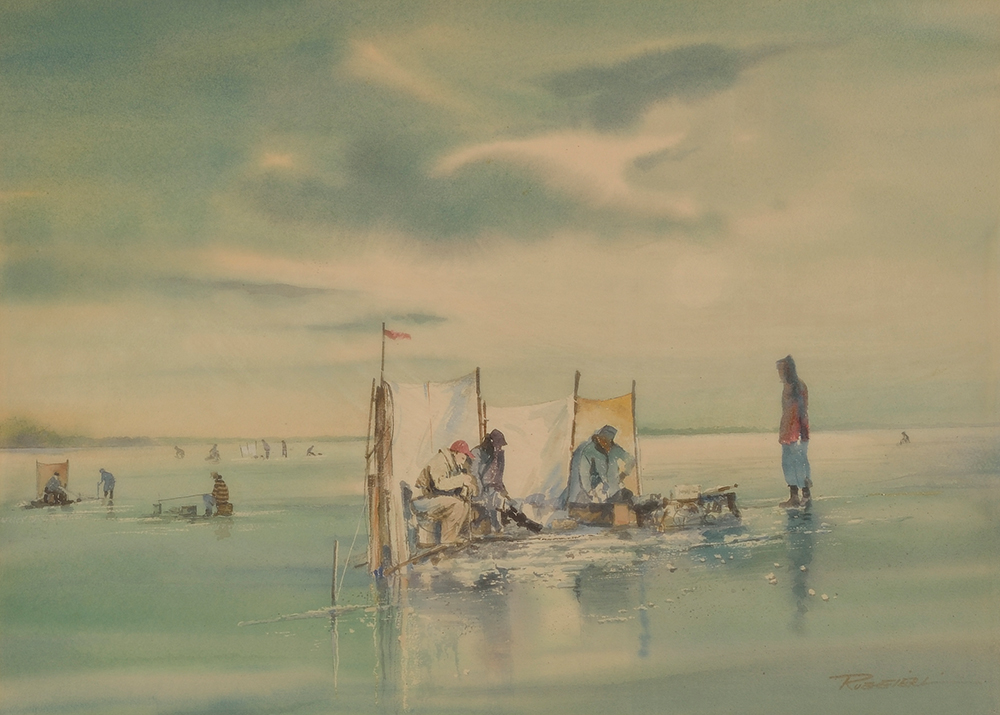
Erie: Ice Fishing, watercolor.
Erie has long been a popular ice fishing destination, especially in Presque Isle Bay, where anglers raise huts and drill holes in the ice to fish for walleye and perch in the winter months.
The State Museum of Pennsylvania
By the time the Bicentennial Project was rounding completion, Ruggieri, just shy of 67, had turned out 105 original works of art, most but not all in watercolor, and at least one for each county, with some, such as Philadelphia and Allegheny, receiving two or three. In addition, he painted state symbols such as the state flower (mountain laurel), tree (eastern hemlock), animal (white-tailed deer) and bird (ruffed grouse). Ruggieri also created an illustrated map of the state in mixed media that helped viewers understand the regional activities that the individual paintings documented.
Pennsylvania—A Commemorative Portrait debuted at the William Penn Memorial Museum in September 1975 and featured, appropriately, 76 works of art. Gov. Milton Shapp, who attended the opening at the invitation of PHMC chair Ferne Hetrick, issued a proclamation declaring September 24 — the day the exhibition opened to the public — Nick Ruggieri Day across the commonwealth. In addition to occupying the entire Fine Arts Gallery, the collection was also featured in a color catalog published and underwritten by the Patriot-News, with text supplied by the artist’s son-in-law and future Philadelphia Daily News columnist John Baer. A second catalog, titled Pennsylvania Sketchbook,
was also published to share the preliminary sketches Ruggieri used for the final versions.
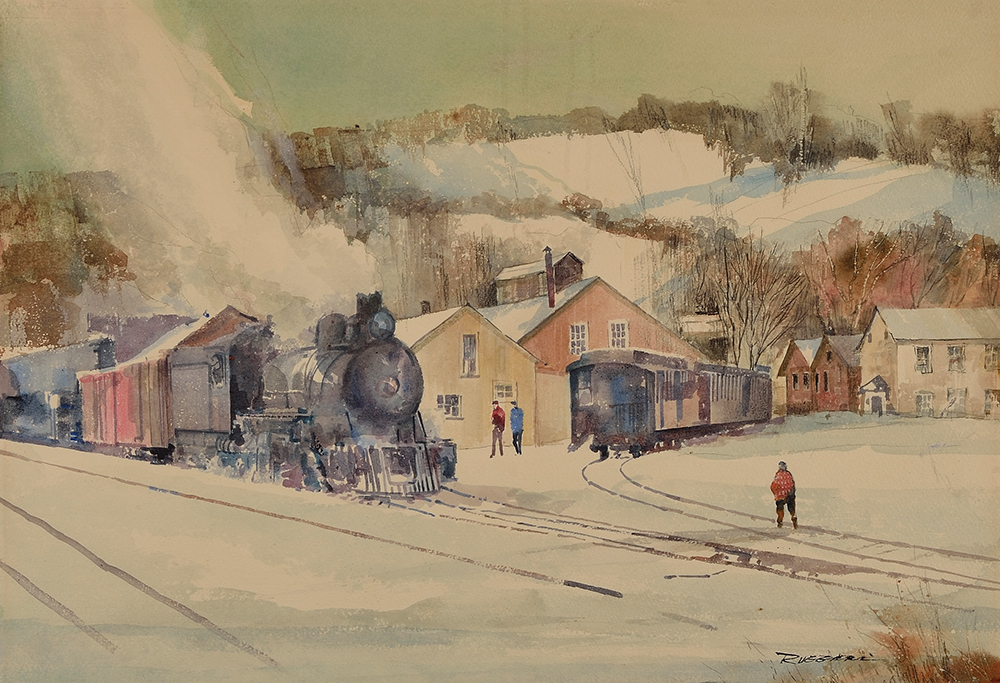
Huntingdon: East Broad Top Railroad, watercolor.
The East Broad Top Railroad, headquartered in Rockhill Furnace, originally operated from 1871 to 1956. The 3-foot narrow-gauge railroad became a heritage railway in 1960 and was designated a National Historic Landmark in 1964.
The State Museum of Pennsylvania
Approximately 6,000 visitors filed in the museum to see the exhibition over the next few months. What they saw was exactly the kind of diversity that Ruggieri had seen as he traveled across the state — a mix of old and new, contemporary and historic, raw beauty and rugged industry. Many scenes testified to Pennsylvania’s role in the story of the nation, such as the Gettysburg Battlefield (Adams County), Independence Hall (Philadelphia), George Washington’s Valley Forge headquarters (Montgomery County), President James Buchanan’s birthplace (Franklin County), and Flagship Niagara (Erie County). Others conveyed themes of innovations in transportation, industry and architecture, including Drake’s Well (Venango County), Horseshoe Curve (Blair County), Delaware Canal at New Hope (Bucks County), Frank Lloyd Wright’s Fallingwater (Fayette County) and the University of Pittsburgh’s Cathedral of Learning (Allegheny County).
There were just as many, if not more, scenes of ordinary but significant landscapes, many the outgrowth of regionally specific industries that put Pennsylvania on the map: steel mills and coal barges (Allegheny County), an anthracite colliery (Lackawanna County), an open-pit mine (Schuylkill County), Eckley Miners’ Village (Luzerne County), oil pumps (McKean County), a slate quarry (Northampton County), dairy cows (Bedford County), sheep (Greene County), tobacco (Lancaster County) and logging (Lycoming County).
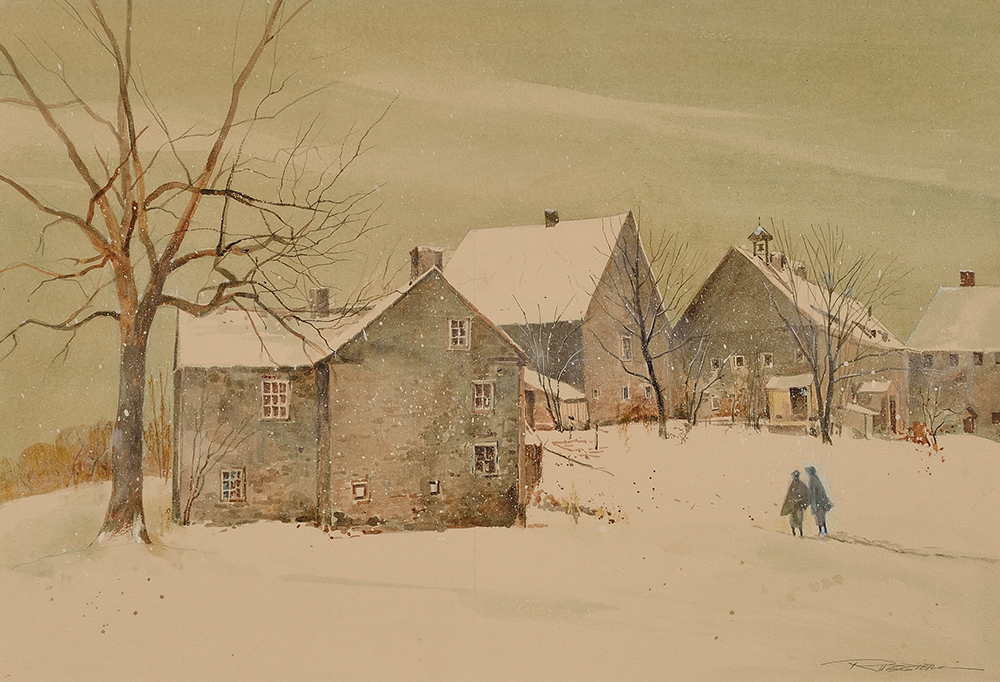
Lancaster: Cloisters, watercolor.
Ephrata Cloister was the home of an 18th-century religious community known for its original music and fraktur, distinctive medieval-style architecture, prolific publishing center, and lifestyle of discipline and self-deprivation. A state historic site since 1947, it reflects a model of William Penn’s Holy Experiment in religious freedom.
The State Museum of Pennsylvania
Ruggieri also presciently captured an emerging economy based on the countless opportunities for enjoying the state’s great outdoors: ice fishing (Erie County), canoeing (Clearfield County), hiking (Elk County), waterfalls (Sullivan County), skiing (Wayne County), camping (Mercer County), and breathtaking mountain views at Pine Creek Gorge (Tioga County) and Hyner View State Park (Clinton County). In capturing the full range of Pennsylvania’s regional diversity, past and present, the exhibition was a tour de force. “Pennsylvania is a big and varied state, with a multitude of different people and a kaleidoscope of wonders,” Paul Beers wrote approvingly in the foreword to the show’s catalog. “It is to Ruggieri, as it was to William Penn, a special part of ‘God’s great fat earth.'”
After Pennsylvania—A Commemorative Portrait closed in Harrisburg, it went on the road to fulfill an ambitious traveling exhibition schedule that included more than 3 dozen stops at a wide variety of venues across the state. Packed into a travel trailer sponsored by The Patriot-News, it was estimated that the show was seen by more than 300,000 visitors over the next nine months, before its final exhibition in Valley Forge in 1976. That concluding exhibition was at the Freedoms Foundation, near Washington’s Headquarters, over the weekend of July 4. The show’s creator was awarded the Freedoms Foundation’s George Washinton Medal, a fitting honor.
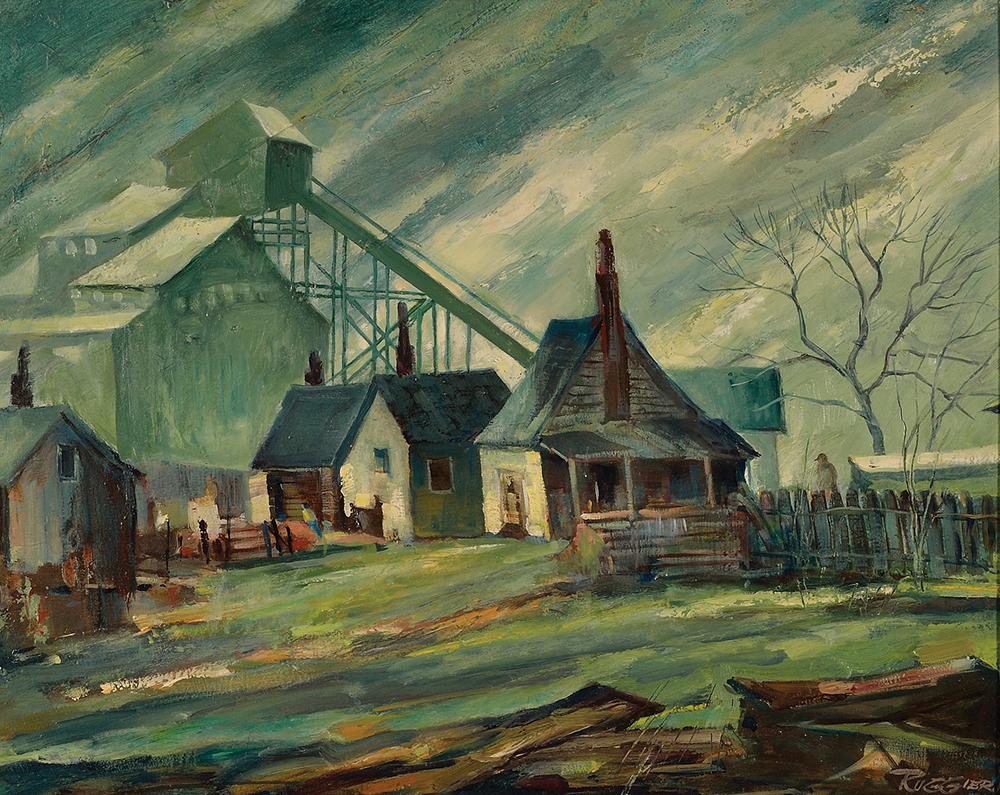
Luzerne: Coal Village of Eckley, oil on Masonite.
Opened in 1854, Eckley was a company town, or “coal patch,” like many others in the region, built around a colliery to serve as the home for mine workers and their families. Eckley Miners’ Village has been a state historic site since 1970.
The State Museum of Pennsylvania
At the conclusion of the traveling exhibition, the collection returned to its owner and sponsor, the Harrisburg Patriot-News. In 1980, Ruggieri retired from his position at the newspaper, which he had held for the last 40 years, but he did not give up his paintbrush and continued to work at his easel right up to his death in 1996.
As for the collection Ruggieri had painted 20 years earlier, it hung, more or less together, in the newspaper’s offices at 812 Market Street. Most of the collection was still there in 2010 when the paper’s owners announced plans to relocate its printing and editorial offices to a new state-of-the-art facility in nearby Mechanicsburg. For a while, the fate of the artworks hung in the balance.
Then, at the suggestion of Heather Long, a former Patriot-News reporter (now with The Washington Post), State Museum curators made a pitch to the paper’s then publisher, John Kirkpatrick, to transfer the collection to the museum. Understanding the collection’s importance to Pennsylvania, Kirkpatrick agreed. In 2011, 82 artworks, many of which had been first presented to the public at the museum in 1975, now returned there, where they continued to be shared with the public.
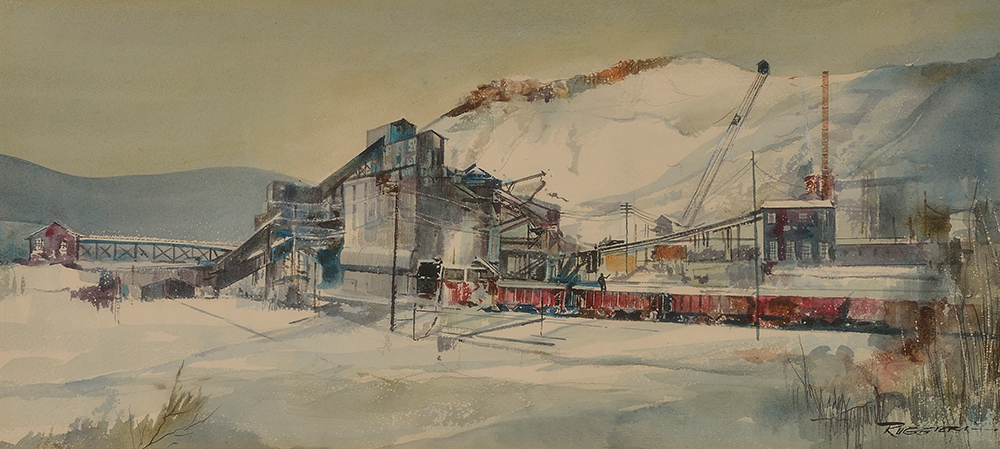
Lackawanna: Anthracite Colliery, watercolor.
Approximately 75 percent of mineable anthracite deposits in the world are found in northeastern Pennsylvania. The colliery, a complex that includes the mine and its associated buildings, was where mining and processing of the coal takes place.
The State Museum of Pennsylvania
“We see these now not just as art, but as historical documents,” a museum curator said at the time of the donation. “Many of the historical landmarks he memorialized are part of the state’s collection of historic
sites. There’s a wonderful synergy between Ruggieri’s vision and what we continue to do.” Ruggieri’s daughter Rosemary spoke on her late father’s behalf: “My father would be thrilled to have them here.”
But perhaps the best articulation of the artworks’ collective meaning came from the artist himself. Writing in the foreword to Pennsylvania Sketchbook, Ruggieri opined: “States, like people, have distinct personalities that are the result of long years of hard labor and human ingenuity. . . . I have tried to capture the spirit of this unique state in a sense that evokes the memories of its past and the promise of its future. . . . Rich as it in in heritage, I have tried in the main to sketch Pennsylvania as it is today and hopefully will continue to be tomorrow.”
Curtis Miner, Ph.D., is chief of interpretation at The State Museum of Pennsylvania. He writes widely on Pennsylvania social and cultural history. This article emerged from an exhibition at The State Museum of Pennsylvania on Ruggieri’s Bicentennial project organized by Miner and the museum’s Curator of Cultural History Amy S. Hammond in Spring 2024. The author wishes to acknowledge her assistance.