
Pennsylvania and the American Revolution: An Interview with Gordon S. Wood
Written by William Kashatus in the Features category and the Spring 2025 issue Topics in this article: Act for the Gradual Abolition of Slavery (1780), American Revolution, Benjamin Franklin, Benjamin Latrobe, Benjamin Rush, Bernard Bailyn, Common Sense, Deborah Read Franklin, Declaration of Independence, democracy, disinterestedness, George Clymer, Gordon S. Wood, James Cannon, James Wilson, John Dickinson, Pennsylvania Assembly, Pennsylvania Constitution of 1776, Quakers, Robert Morris, Second Continental Congress, Simon Snyder, Thomas Paine, Timothy Matlack, U. S. Constitution, virtue, William Franklin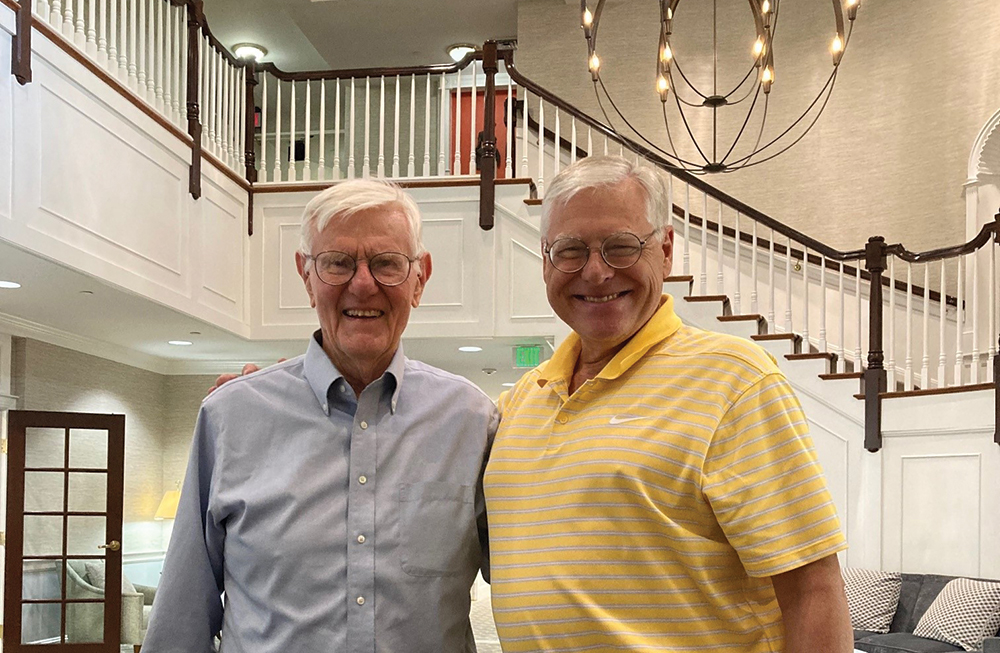
Pulitzer Prize–winning historian Gordon S. Wood met with author William C. Kashatus in Providence, Rhode Island, to discuss Pennsylvania and the American Revolution for this article.
Courtesy William C. Kashatus
The American Revolution was the most significant event in our country’s history. Independence from Great Britain not only resulted in the birth of a new nation but also one dedicated to a uniquely democratic form of government unknown to the world in the 18th century. It also forged a national identity, rooted in the principles of liberty, equality and republicanism, that has endured for nearly 250 years.
Pennsylvania was both a catalyst and product of that movement. William Penn, the Quaker founder, first governor and proprietor of the colony, laid the foundations for liberty of conscience and democratic government as early as 1682 in his Frame of Government and later in his 1701 Charter of Privileges, the last of the proprietary’s constitutions. Inspired by those same principles, among others, the Founding Fathers, meeting in the Pennsylvania State House in 1776, threw off the yoke of British authority to create a sovereign nation. Eleven years later in the same location, delegates of the original states institutionalized popular sovereignty in our federal constitution.
At first, Pennsylvania lingered behind the other 12 colonies in resisting British control. The prosperous and conservative Quakers and Anglicans who dominated the Assembly tried to thwart the patriot cause by failing to respond to the first battles at Lexington and Concord in the spring of 1775. The following year, the Assembly instructed Pennsylvania’s delegates to a Second Continental Congress to oppose independence. But their efforts were in vain.
Pennsylvania’s farmers, merchants and laborers rallied to the patriot cause in the spring of 1776, inspired by Thomas Paine’s incendiary pamphlet, Common Sense. Using simple facts and plain arguments understandable to the common people, Paine convinced his readers of the necessity of separation and forced Congress to act.
On July 2, 1776, Pennsylvania’s delegation to the Continental Congress, led by Benjamin Franklin, voted along with the other colonies in favor of independence from Great Britain. Having committed to separation, the Pennsylvania Assembly, in September, created one of the most radical state constitutions in America. It not only allowed non-landholders to vote and hold political office but also shifted power away from the executive to a strong legislature, giving more control directly to the new voters. In so doing, Pennsylvania transformed a hierarchical colonial society entrenched in the proprietary rule of the Penn family and governed by the British monarchy into a much more egalitarian one, vesting political authority in the people themselves.
Gordon S. Wood, widely considered the “Dean of Early American Historians,” has devoted half a century to researching and writing about the American Revolution and the creation of the American republic.
Wood is the Alva O. Way professor emeritus of history at Brown University and a board member of the Museum of the American Revolution. He was involved in the creation of the National Constitution Center and is the author of many highly acclaimed books, including The Creation of the American Republic, 1776–1787 (1969), which won the 1970 Bancroft Prize; The Radicalism of the American Revolution (1992), which won the 1993 Pulitzer Prize for History; and Empire of Liberty: A History of the Early Republic, 1789–1815 (2009), a volume in the Oxford History of the United States series and finalist for the Pulitzer Prize. He was awarded the National Humanities Medal by President Barack Obama in 2010.
In this interview, Wood discusses Pennsylvania’s unique role in the American Revolution and in the creation of the federal constitution.
Why did you choose to study the American Revolution?
The bigger question is why I ended up doing history in graduate school. Originally, I had planned to become a foreign service officer. I did my undergraduate degree in history at Tufts and went into the Air Force because of a ROTC commitment. But my military experience was so strange and arbitrary that I decided I didn’t want to work for the federal government. So, I applied to graduate school at Columbia and Harvard. Harvard offered me a little bit more money, so I went there.
When I arrived in 1959, I took a seminar with this young professor, Bernard Bailyn, who had been recently given tenure. Bailyn was best known for his work on the political ideas that inspired the American Revolution. When I took his seminar, I fell in love with early American history, a field I hadn’t even considered before that time. In one of his lectures, Bailyn mentioned that there hadn’t been much research done on state constitution-making in 1776. That topic interested me. I ended up writing my dissertation on state constitution-making and its impact on the Framers in drafting the federal constitution of 1787. That work became my first book, The Creation of the American Republic, 1776–1787, published in 1969.
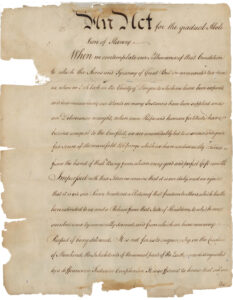
Pennsylvania’s 1780 Act for the Gradual Abolition of Slavery was the first legislative enactment of its kind in America.
Pennsylvania State Archives, RG-26.57
Pennsylvania was an early leader in the antislavery movement passing the Gradual Abolition Law in 1780. Why did the colony take the lead in abolitionism?
The Quaker influence was great. Ironically, Quakers were among the most prominent slave traders in the 17th and early 18th centuries. But there were those Friends who began to point out the inconsistency of slaveholding with the Quaker belief in equality.
As early as 1688, for example, Germantown Friends Meeting near Philadelphia issued the first antislavery petition in North America. Then, in the late 1750s, Philadelphia Yearly Meeting disowned any member who was engaged in the slave trade. By 1776 the Yearly Meeting made slaveholding itself a cause for disownment.
While these actions were taking place within the Society of Friends, individual Quakers were introducing abolitionism to the larger non-Quaker society. For example, in 1775 Anthony Benezet became a founder of the first antislavery society in the world. Soon similar societies were being organized elsewhere. Individual Quakers also lobbied the Pennsylvania Assembly to pass the 1780 Gradual Abolition Law.
What’s not fully appreciated is the significant effect the American Revolution had on slavery. Slavery existed around the world for thousands of years without substantial criticism. All the American colonies had slavery, and it was legal. While the bulk of the slaves were located in the South, there were some 50,000 slaves in the North by 1776. But with the Revolution, there is for the first time public criticism of slavery, even in southern states like Virginia. Then, after Pennsylvania passed its abolition law in 1780, other northern states began to do the same. I find this to be an extraordinary moment in history.
During the early 1770s, Pennsylvania was more conservative than most of the other North American colonies, having larger numbers of loyalists than any other colony except New York. In fact, the Pennsylvania Assembly slowed the speed of the independence movement by restricting their delegates’ ability to vote in favor of separation in the Second Continental Congress. Why did the delegation eventually vote for independence?
Pennsylvania was unique in that the Revolution took place in a very awkward way. In all of the other colonies, the legislature took the lead and became the instrument of Revolution. In Pennsylvania, the legislature, which was dominated by Quakers and Anglicans, was part of the establishment
being opposed by the revolutionaries.
Part of the awkwardness was that Pennsylvania was fighting two revolutions in the mid-1770s. On one hand Benjamin Franklin and his Scots Irish Presbyterian allies were leading a movement in the Assembly to overthrow the Penn family proprietors. On the other hand, there was the wider movement for American independence. As the political crisis with Britain unfolded, these two movements coincided.
By the spring of 1776, the most influential parties in the Pennsylvania Assembly were the moderates, who wanted a reconciliation with Great Britain, and the radicals, who wanted independence. The moderates, led by John Dickinson, Robert Morris and Benjamin Rush, were supported by a majority of the electorate. The radicals, led by Ben Franklin, Timothy Matlack and James Cannon, had the support of a growing number of converts intent on independence. Although the moderates retained their majority in the Assembly in the elections that year, they were outmaneuvered by the radicals, who persuaded the Continental Congress to resolve that all governments deriving their authority from the Crown should be “totally suppressed.” This resolution undermined the proprietary’s 1701 Charter of Privileges, as well as the authority of the moderates in the Pennsylvania Assembly, and sealed the fate of British control in the United States.
In your book The Americanization of Benjamin Franklin, you write that Franklin, Pennsylvania’s most prominent citizen, “might easily be described as the least American and the most European of the nation’s early leaders.” You point out that he had a longtime loyalty to the Crown, commercial and intellectual ties with London, and an aristocratic view of human affairs. You also point out that Franklin came relatively late (1774) to the cause of American independence. What changed his mind?
Ben Franklin originally saw himself as British and his future success tied to the British Empire. For nearly 16 years, between 1757 and 1775, Franklin lived in London as a colonial agent. In fact, he was considered by some American radicals as a spy for the British government because of his attachment to that country. I think that’s going a bit too far. Whatever Franklin did during these years, he did to affect a reconciliation between Britain and the colonies. There’s no doubt that he would’ve accepted a royal office if it had been offered to him.
During the 18th century, the colonies were managed in England by a nobleman who served as the “secretary of state.” For whatever reason, the British government decided in 1767 that they needed a new office for the American colonies. Of course, Franklin did not expect to be secretary because he wasn’t a nobleman, but he jumped at the prospect of being an undersecretary. He certainly had the talent for the position, and he was friendly with all the other undersecretaries.
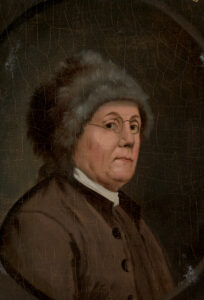
Benjamin Franklin as “the symbol of rustic democracy.” John Trumbull copied the image of Franklin in his famous fur cap from a black-and-white French print for this oil-on-wood color portrait in 1778.
Yale University Art Gallery, John Hill Morgan Fund
Instead, Lord Hillsborough became the secretary of state for the American Department. Hillsborough would go on to have a heavy-handed approach to colonial affairs. He also hated Franklin who was involved in land schemes on the American frontier. Those schemes attracted tenant farmers from Hillsborough’s Irish estates to America and was costing him large sums of rent money. There was no way Hillsborough was going to hire Franklin as an undersecretary. Still, Franklin continued to curry favor with the British government.
In 1773 Franklin, who was serving as postmaster of the colonies and agent for Massachusetts, leaked correspondence from Massachusetts governor Thomas Hutchinson and lieutenant governor Andrew Oliver to English authorities advocating repressive measures against Boston’s radicals. The letters were published in the Boston Gazette, provoking fierce protest in that city. I think Franklin believed naively that leaking the letters would shift the blame for the political crisis that was unfolding in the colonies from British officials to native-born Americans, like Hutchinson. He couldn’t have been more wrong.
When the British Privy Council discovered that Franklin leaked the letters, they accused him of treason. On January 29, 1774, Solicitor General Alexander Wedderburn excoriated him for more than an hour before the Privy Council. Throughout the diatribe, Franklin remained silent. But when he learned the next day that he had been removed as postmaster, he was furious. His character had been attacked and his work for conciliation ignored. It was at that point that Franklin began to work for American independence.
Franklin consciously cultivated so many images — ideal citizen, gentleman, renowned scientist, American frontiersman, and Quaker — that it’s difficult to know the actual person. Who was Benjamin Franklin as a human being?
That’s a difficult question to answer. Franklin was obviously a brilliant man with a wonderful sense of humor. He was an entertaining conversationalist, someone who had a great deal of confidence in himself and someone who was looking for the best opportunities to advance himself. It’s one of the reasons he cultivated some of the images you mention.
For example, the French had an image of America as the land of plain Quakers, who were celebrated for their equality, pacifism and religious freedom. Many of the French philosophes, like Voltaire, were attracted by that Quaker image because they were struggling to reform the luxury and corruption of their own government and society. As a result, the French helped to create Franklin the symbolic American and the images we today are familiar with — the Poor Richard moralist, the symbol of rustic democracy, and the simple backwards philosopher. Of course, Franklin did not disappoint them either. He dressed the part with his plain clothing and coonskin hat whenever he was presented to the king or dined at the French court.
But Franklin was not a very compassionate man when it came to his family. He treated his wife [Deborah Read] horribly. She was dying in 1774 when she wrote to him begging him to return home so she could see him one last time. But he ignored her plea. Of course, he had a surrogate woman he was living with in London, Mrs. Stevenson, who was his landlady on Craven Street. She also had a daughter, Polly. So, Franklin had his own surrogate family in England.
Franklin had been very close to his son, William, who shared his father’s dreams for the British Empire and his hopes of a fortune in land speculation in America. And like his father, William had become a royal officeholder as governor of New Jersey. But their intimacy came to an end after Franklin was humiliated by the Privy Council. He expected his son to join him in the patriot cause. When William refused, Franklin cut his communication with his son to the barest minimum. It was so bad that when William was arrested in 1776 for being the only royal governor still in office in America, his father refused to lift a finger to aid him.
Franklin was a very complicated man. There’s no denying he was a genius. He was a hard worker and a self-made aristocrat. As soon as he made enough money, he retired from his printing business so he could devote himself to politics and science. And his autobiography, which was never published during his lifetime, became the blueprint for the Protestant work ethic and capitalism itself. It is the most popular autobiography in the history of the world.
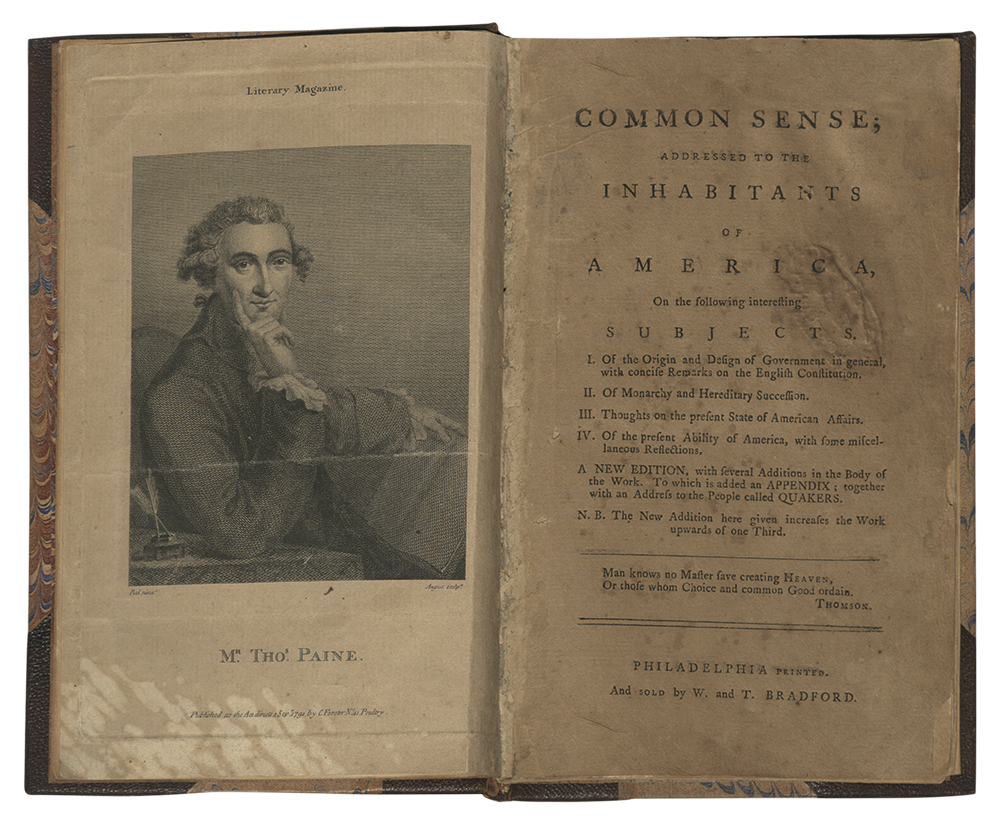
Thomas Paine helped galvanize the movement for independence in America with the January 1776 publication of his 47-page pamphlet, Common Sense. Pictured here are the frontispiece and title page of an edition published in Philadelphia on February 14, 1776.
Pennsylvania State Archives, MG-8
You’ve written that Thomas Paine’s Common Sense, published in Philadelphia on January 10, 1776, was “the most important pamphlet written in the American Revolution.” Other historians credit Paine with mobilizing public support for the Revolution. One might even argue that the Declaration of Independence would have been meaningless had Paine not rallied public support behind the movement earlier. What exactly was the impact of Common Sense on the American Revolution? Why was Paine not accorded the same respect as other Founding Fathers?
Common Sense is the most radical and important pamphlet written in the American Revolution and one of the most brilliant ever written in the English language. It went through dozens of editions and sold at least 150,000 copies at a time when most pamphlets sold in the hundreds or a few thousand at best.
Although the pamphlet did not cause Americans to think of declaring independence, it did express more boldly and eloquently than any other writing what many of them had already come to think about America’s tie to the British Crown. Paine dismissed King George III as the “Royal Brute” and called for American independence immediately. You just didn’t insult the king that way, especially in the press.
There is no doubt that the effects of Paine’s pamphlet were immediate and extensive. Nearly everyone who read or heard it knew Common Sense was a work of genius, and it made Paine an instant American celebrity. I call him America’s first public intellectual. He lived by his pen. And he was certainly on the side of the Revolution, writing arguably the best expression of what constituted radical, enlightened, Anglo-American thinking during the last quarter of the 18th century.
But Paine was never accorded the same respect as the other Founding Fathers because he was a lower-class person. He drank heavily and had an unkempt appearance. But I think what really did him in was attacking George Washington’s presidency in 1790 in a vicious essay. Then, in 1794, he wrote The Age of Reason, which not only attacked Christianity but mocked it. That work, in particular, isolated Paine because Americans were appalled by his anti-Christian thinking. Only in recent times has Paine been given credit for his role in the American Revolution.
In Creation of the American Republic, you analyze the debates over the state constitutions of the 1770s and how the Whigs who created those constitutions struggled with the basic issues of suffrage, representation, sovereignty and separation of powers. How did the Framers view Pennsylvania’s 1776 constitution?
Pennsylvania’s 1776 state constitution was quite radical. Not only did the constitution give personal liberties, including the right to vote to all tax-paying men, but it had a unicameral legislature elected annually. All bills would be referred to the public at large before they became law. The constitution also lacked a provision for a state governor. Instead, voters elected judges and a 12-member council to serve as the executive branch. There was no clear system of checks and balances between the branches of government, either.
The Framers considered Pennsylvania’s constitution a political monster and one that deserved to be put to death because the theory of mixed government had been flagrantly violated by an extremely powerful legislature. Fortunately, the constitution was marked for revision in the 1780s by a group of Pennsylvanians calling themselves “Republicans.” They were based in Philadelphia and led by James Wilson and Robert Morris, both of whom sat on the Pennsylvania delegation to the Federal Convention of 1787, which drafted the United States Constitution.
The Republicans created the 1790 Pennsylvania constitution that reflected the mixed government of the other 12 states. There was a bicameral legislature consisting of a lower house with 100 members and an upper house with 50 members. No longer would bills be referred to the people-at-large before they became law. The Executive Council of 12 was replaced by a single governor elected directly by the people for a three-year term. Judges were no longer elected but were to hold office during good behavior. The new Pennsylvania constitution bore a strong resemblance to many of the other state constitutions, which featured a separation of powers between three branches and a system of checks and balances. These were the same features that the Framers created in our federal constitution.
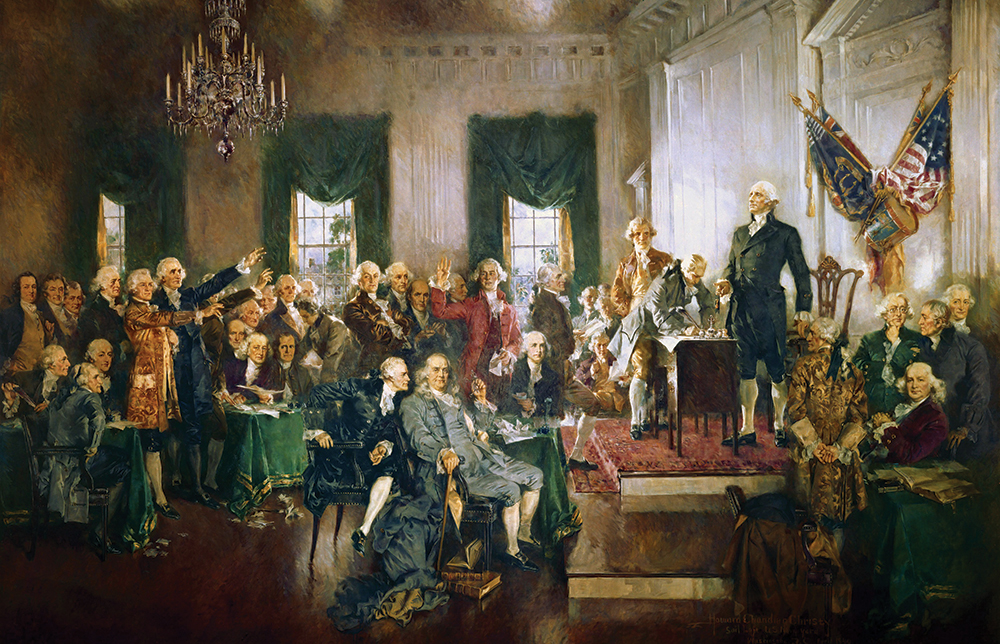
Set inside Independence Hall in Philadelphia on September 17, 1787, Howard Chandler Christy’s massive 20-by-30-foot oil painting Scene at the Signing of the Constitution of the United States, completed in 1940, imaginatively recreates one of the most momentous events in American history.
United States Capitol
Founding Fathers like George Washington and Pennsylvanians Benjamin Franklin, James Wilson and George Clymer, all of whom served as delegates to both the Second Continental Congress in 1776 and the Constitutional Convention in 1787, placed great emphasis on “virtue.” What did they mean by that term? How did the structure of the federal constitution preserve virtue among the executive, legislative and judicial branches of government?
First, I think it’s important to remember that the Founding Fathers were human beings not demigods. But they were products of a peculiar moment in our history. It was a moment when democratic and aristocratic values were in balance, so we had the best of both. The Founders knew they were living in an enlightened age, and they were quite self-conscious about that. They wanted to absorb the new values related to the Enlightenment, specifically learned and acquired attributes at the expense of heredity. Who your father was or who you married were not as important to them as what kind of person you were and what kind of character you had.
Essentially, the Founders were concerned with civility and the values it represented, like impartiality or disinterestedness. Disinterestedness, in the 18th century, meant that you were able to rise above your own interests and act impartially. George Washington used that term as a synonym for virtue. He wrestled with all the various interests that were impinging on him and tried to rise above them. He wasn’t the only Founder who felt that way, either.
Franklin, Wilson and Clymer, who you mention, were also self-conscious about their character and placed a strong emphasis on virtue. While they were unabashed elitists who knew they were superior to the common people, they had no contempt for those people. They knew that the source of their authority came from the electorate, and they wanted those people and each other to judge them by their character.
How the structure of the federal constitution preserved virtue is a more complicated issue. The Framers believed that virtue was the lifeblood of the republic and were convinced that a popularly based government could not be supported without virtue and the self-sacrifice of a public-spirited people. To preserve that virtue in both the state and federal governments, the Framers adopted many of the features of mixed government, like the separation of powers between three branches as well as a system of checks and balances. But they also introduced several features like the modern idea of a constitution as a written document, the device of a convention for creating and amending constitutions, the process of popular ratification, and the practice of judicial review by which judges have the authority to determine the constitutionality of acts of the state and federal legislatures.
Not until the American Revolution had anyone ever developed such institutions, not only for controlling government and protecting the rights of individuals but also for changing the very framework by which government operated. Americans in 1787 and in numerous state constitutional conventions thereafter demonstrated to the world how a people could fundamentally and yet peaceably alter their forms of government. In effect, they had institutionalized and legitimized the American Revolution.
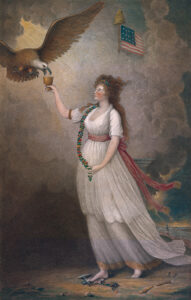
The allegorical print Liberty in the Form of the Goddess of Youth, Giving Support to the Bald Eagle, engraved by Edward Savage in 1796, depicts Liberty as a manifestation of Hebe, Greek goddess of youth and cupbearer to the gods, offering a chalice to a bald eagle, as she tramples on regalia of monarchical Great Britain. Behind her, the flag of the United States rises above the clouds. The image was reproduced on the cover of Gordon S. Wood’s 2009 volume Empire of Liberty: A History of the Early Republic, 1789–1815.
Yale University Art Gallery, Mabel Brady Garvan Collection
In your book Empire of Liberty, you identify several dramatic changes that led to the democratization of American society, especially in northern states like Pennsylvania, between 1789 and 1815. What were those changes and how did they manifest themselves in Pennsylvania society?
The period between the American Revolution and the second decade of the 19th century was marked by tumultuous change in all aspects of American life. The Founding Fathers had high hopes for the future, but few of their hopes worked out quite as they expected. They hated political parties, but parties nonetheless emerged during the presidency of George Washington when Philadelphia served as the national capital in the 1790s. There were other changes, too, especially in the northern states where politics became democratized far beyond what the Founders could have ever imagined.
Politics were marked by the emergence of new men. They were men who lacked the social and moral credentials that the Founders had had. There’s an extraordinary letter written in 1806 by Benjamin Latrobe, the great neoclassical architect who was Jefferson’s surveyor of public buildings. He’s writing to the Italian patriot Philip Mazzei complaining about the kinds of men who are being elected to Congress from Pennsylvania where he lived. He wrote that these legislators were ignorant, unlearned men, that they were not gentleman. Among them were mechanics and even a butcher who abused his franking privileges by mailing home his dirty linen to have it washed. Of course, Latrobe points out that it wasn’t much of an abuse, because the butcher wore the same shirt every day! It must have been hard for Latrobe to criticize the government because he was a good Republican. But these were the kinds of ordinary people who were legislating in Congress. Nor were these anti-intellectuals limited to the federal government.
Simon Snyder, the son of a mechanic from Lancaster and a self-made man with no education, worked his way up from state representative to speaker of the state’s house of representatives to eventually become governor of Pennsylvania. He wore his simplicity and lack of sophistication as badges of honor. When he ran for governor in 1808, his opponents mocked his humble origins and called his followers “clodhoppers.” Snyder proudly used the insult as a campaign slogan calling himself, “a clodhopper in a society of clodhoppers.”
There were also economic changes. Although most Americans in 1815 remained farmers living in rural areas, they also became one of the most highly commercialized people in the world. They were not only busy buying and selling with the rest of the world but increasingly with each other. In the process they not only increased their own wealth but also the wealth of the state in which they lived. It was counterintuitive, for example, that a person in Philadelphia selling a product to another person in Lancaster could actually increase the wealth of the entire state of Pennsylvania. Most people at this time believed that you could only increase their wealth by selling more abroad than they bought. They had a mercantilist conception of commerce, but they came to appreciate that an exchange between two people within the same state could actually enhance the prosperity of the whole state.
These were just some of the political and economic changes that took place, but democratization pervaded all aspects of American society and culture. Children were leaving their parents’ homes in droves to make their own way in the world elsewhere. Colleges were beset by unruly students on a scale never seen before or since in American history. Americans were drinking more than at any other time in our history; the homicide rate increased, as did promiscuity and extramarital pregnancy. At the same time, Americans became committed to moral reform and moral causes like abolitionism. The Second Great Awakening also began and reflected this new popular, egalitarian morality.
What does history in general, and the American Revolution in particular, teach us about being American?
One of the things that history teaches is prudence, the ability to act with caution to avoid the unexpected consequences that happen all the time. To trust your own eyes and ears, not to simply act on what someone else tells you. Prudence, and wisdom for that matter, allow you to foresee all the possibilities before you act on a roller coaster of emotions. Of course, those qualities also come with experience and age.
As far as the Revolution is concerned, I believe that it is the most important event in our nation’s history. Not only did the American Revolution create the United States, legally, it also infused into our culture everything that we value: liberty, equality, the well-being of ordinary people. These are the ideas that give us as Americans our national identity. We are not a nation in the usual sense of the term. To be an American is not to belong to a specific ethnicity or race but rather to believe in the ideas that came out of the Revolution.
Books by Gordon S. Wood
The Creation of the American Republic, 1776–1787. Chapel Hill: University of North Carolina Press, 1969.
Social Radicalism and the Idea of Equality in the American Revolution (with J.R. Pole). Houston: University of St. Thomas, 1976.
The Radicalism of the American Revolution. New York: Alfred A. Knopf, 1992.
The American Revolution: A History. New York: Modern Library, 2001.
The Americanization of Benjamin Franklin. New York: Penguin Press, 2004.
Revolutionary Characters: What Made the Founders Different. New York: Penguin Press, 2006.
The Purpose of the Past: Reflections on the Uses of History. New York: Penguin Press, 2008.
Empire of Liberty: A History of the Early Republic, 1789–1815. New York: Oxford University Press, 2010.
The Idea of America: Reflections on the Birth of the United States. New York: Penguin, 2011.
Friends Divided: John Adams and Thomas Jefferson. New York: Penguin, 2017.
Power and Liberty: Constitutionalism in the American Revolution. New York: Oxford University Press, 2021.
William C. Kashatus is the author of more than two dozen books on sports, biography and Pennsylvania history.