
Outstanding Perseverance and Courage: Pennsylvania’s Thomas Mosley and the Montford Point Marines in World War II
Written by Robert Hill in the Features category and the Summer 2024 issue Topics in this article: African Americans, American Civil War, American Revolution, Bobby Troup, Camp Montford Point, Congressional Gold Medal, Dauphin County, Executive Order 8802, Executive Order 9279, Executive Order 9981, Gilbert H. Johnson, Montford Point Marine Association, Philadelphia, Steelton, Thomas Mosley, United States Army, United States Marine Corps, United States Navy, World War I, World War II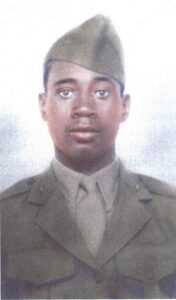
Thomas Mosley of Steelton enlisted in the U.S. Marine Corps in November 1943.
Eugene S. Mosley Collection
In November 1943, a young Black man sat in a military recruiting office in Philadelphia. At first, joining the Marines seemed like a good idea, but with the paperwork completed, he thought of a relative who had been in the Navy and decided he might like that service better. “Sir, I would like to be exchanged into the Navy instead of the Marines.” It was a simple statement, said in a respectful manner, and surely not the first time that someone had second-guessed himself when making an important decision. After a momentary perplexed stare, the recruiting officer responded bluntly, “Get back over there and sit down! What do you think this is, an exchange store?” It was young Thomas Mosley’s first order from a Marine Corps officer and a clear indicator of what lay ahead for him.
Born in Steelton, Dauphin County, in 1924, Thomas was one of 13 children born to Henry and Lula Mae Mosley. During his formative years in this large family, Thomas learned important lessons about loyalty and caring for others that coincided with the difficult time of the Great Depression. While the economic problems of the 1930s were widespread, and about one-third of white workers lost their jobs, unemployment among African Americans hovered at about 50 percent.
Although the Great Depression moved the Black vote from Republican to Democrat, with roughly 75 percent of Black voters supporting President Franklin D. Roosevelt’s reelection in 1936, many still felt that they had not benefited as much as they should have from his administration’s programs. This sentiment was particularly prevalent among those in Black leadership who began to agitate for more tangible results. With the beginning of World War II in Europe and a shift in government policies from New Deal work-creation programs to rearmament and support for England, Black leaders began making more forceful demands for the elimination of race as a consideration for government-related employment. The result was the issuance of Executive Order 8802 in June 1941, prohibiting racial discrimination in government and defense industry hiring.
This change in policy, followed six months later by the entry of the United States into World War II, brought new opportunities that Thomas Mosley eagerly accepted. Enrolling in the Pennsylvania School of Aeronautics, he learned the craft of sheet metal fabrication and joined the civilian workforce at the nearby Middletown Air Depot. MAD, as it was abbreviated, was a major repair facility for the U.S. Army Air Forces, and Mosley advanced quickly to a master sheet metal mechanic.
As required, Mosley registered with Selective Service after his 18th birthday in 1942. Later that year, another executive order, number 9279, provided for the blanket conscription of all men between the ages of 18 and 38. Although he was already doing important work for the military, Mosley would now be joining one of the armed services. Consistent with policy, inductees could request entry to a particular service branch, but the final assignment was strictly based on military necessity. As Mosley found out, an approved request was not subject to reconsideration. With his initial request granted, Thomas Mosley became the first Black Marine from his hometown of Steelton.
Black Sailors and Soldiers
Prior to 1942, there had been no Black Marines since the American Revolution. The U.S. Navy, the Marine Corps’ parent organization, had been open to Black crewmen since its inception during the conflict. In part, this was due to the need for experienced sailors who had served on merchant ships. Merchant captains could add crewmen as needed in foreign ports, with race or ethnicity being lesser considerations. The Navy continued to accept Black crewmen through the early 19th century during times of both war and peace, and they often made up the difference in deficient white enlistment. This was particularly true during the Civil War when recruiting bounties and the nature of the conflict drew most young white men into the Army. About 30,000 Black sailors served during that war, and six were awarded the Medal of Honor for valor in battle.
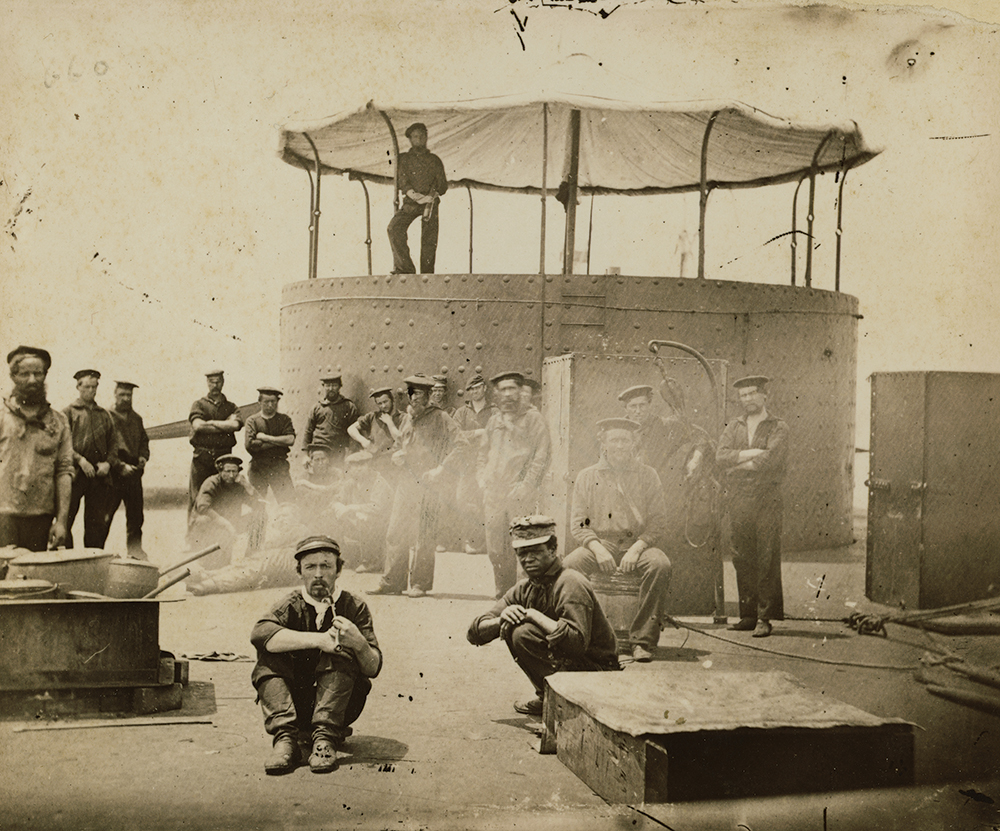
At least eight Black men, but probably more, are known to have served on the USS Monitor during the Civil War. In May 1862, Siah Hulett Carter, front right, escaped from slavery by boat, met up with the Union Navy’s ironclad warship, and joined the crew.
The Mariners’ Museum and Park, Newport News, Virginia
During the late 19th century, the Navy transformed from a fleet of wooden sailing ships to one of steel vessels powered by steam. As the technical complexity of the ships increased, the Navy limited the rates, or type of jobs that Black sailors could occupy, concentrating them in the gallies or boiler rooms of the ships. Between the Spanish–American War and World War II, the preference for mess attendants shifted to Filipinos, further reducing the opportunities for African Americans.
Black enlistment in the U.S. Army also dated back to the American Revolution. As the insurrection spread, the British attempted to institute a rebellion within the revolution by offering freedom to enslaved Blacks who joined the king’s troops. To avoid the economic loss of labor and coincidental strengthening of the enemy, the Americans made similar counteroffers. Although the rules varied by state, free Blacks could enlist or the enslaved could be enlisted as substitutes for their owners with the promise of freedom after victory. Black and white soldiers were integrated together or in segregated units depending upon the policy of their state.
The Continental Army disbursed after the American victory. The subsequent re-establishment of a small standing army was limited to whites. During the War of 1812, two “Battalions of Freed Colored Men” served with distinction at the Battle of New Orleans, but most Black participation went to the other side, again the result of British offers of freedom in exchange for service. Based in part on fear of slave uprisings, arming Black men for military service was prohibited during most of the early 1800s.
The Civil War was a significant turning point for the U.S. Army. As a response to the formation of the Confederacy and the initial act of open rebellion at Fort Sumter in 1861, tens of thousands of white men in the Northern states volunteered for service in the Federal Army. Enslaved Blacks who escaped to that army were put to work on labor details. As the objective of the conflict advanced from suppressing the rebellion and preserving the union of states to also eliminating the institution of slavery, President Lincoln authorized the induction of liberated Blacks into the Army.
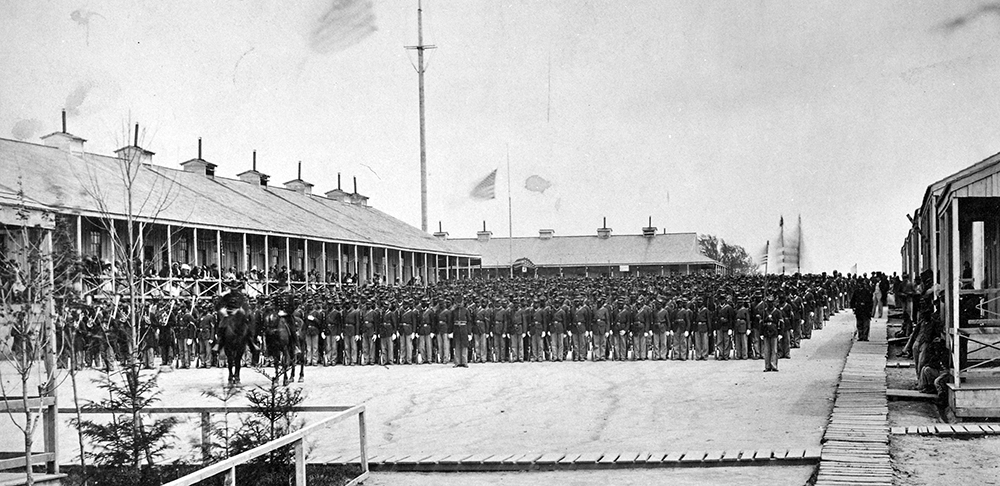
From 1863 to the end of the Civil War, about 11,000 free Black men, including 8,612 from Pennsylvania, trained for the Union Army at Camp William Penn in Cheltenham Township, north of Philadelphia.
National Archives and Records Administration
While a few New England states organized Black soldiers into regiments under the existing state recruiting system, the War Department took control of the process by creating the Bureau of Colored Troops. The bureau, in turn, set about organizing the Black recruits into numbered federal regiments with the designation United States Colored Troops (USCT). These were segregated regiments commanded by white officers with experience or training to warrant their promotion to higher rank. Eighteen camps for training and organization were set up across the country for this purpose, the largest of which, Camp William Penn, was erected just north of Philadelphia on land leased from the abolitionist Mott family. The camp produced 11 USCT regiments manned by roughly 1,000 soldiers each. Additional education was also available to the officers and selected Black soldiers promoted to noncommissioned officers (NCOs) as corporals or sergeants.
Approximately 186,000 Black soldiers served in the Federal Army during the Civil War, participating in battles scattered across the conflict, perhaps most famously during the campaign to retake Fort Sumter. Sixteen were awarded the Medal of Honor for valor in battle.
With the end of the Civil War, the state-recruited regiments were mustered out and the regular army was expanded to cover the occupation of the southern states and to patrol the western territories. The USCT regiments were also dissolved, but four of the new regiments — the 9th and 10th Cavalry and the 24th and 25th Infantry — were organized along the same lines, with Black troops and NCOs and white commissioned officers commanding. These units would come to be known as “Buffalo Soldiers,” the respected name bestowed on them by their Native American opponents. Seventeen Medals of Honor were awarded to these troops during the Native conflicts.
In 1898 all four regiments were included in the invasion force sent to liberate Cuba from Spain. They participated in the battle for the San Juan Heights, earning five Medals of Honor and other commendations including the praise of future general John Pershing, an officer of the 10th Cavalry, and future president Col. Theodore Roosevelt of the 1st Volunteer “Rough Riders” Cavalry. During the postwar period, all four regiments were sent to the Philippines, where they saw action against the Filipino nationalists. The units remained in the service throughout World War I with the 9th Cavalry stationed in the Philippines while the other regiments returned to the western states, particularly along the troublesome border with Mexico.
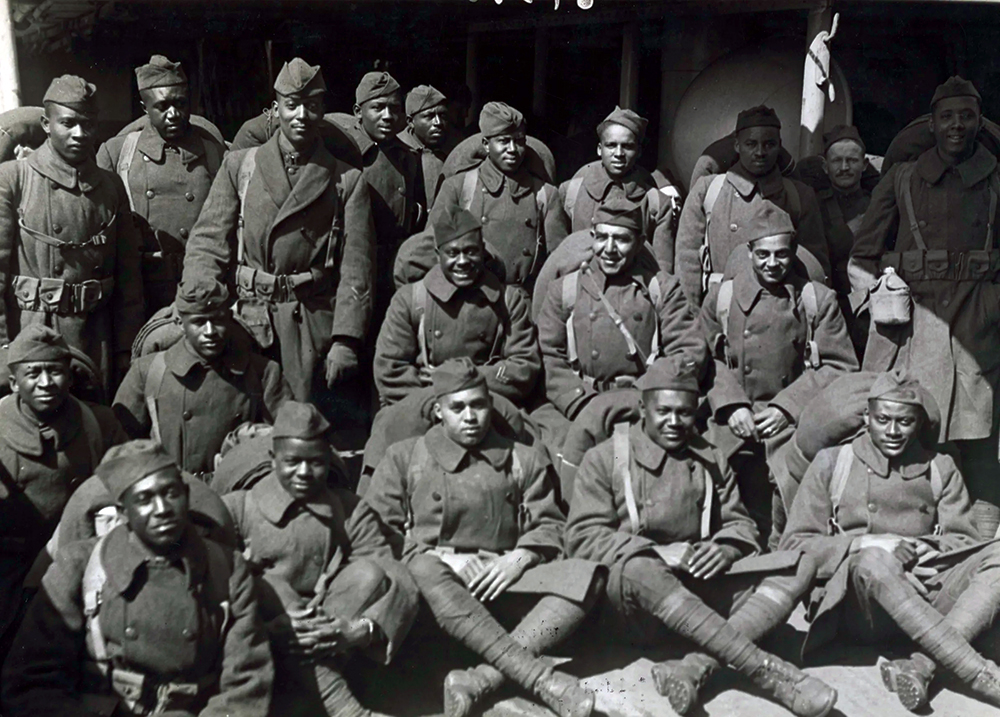
During World War I, more than 380,000 African Americans served in the Army, with 200,000 dispatched to Europe. Here, Black Philadelphians gather for a photograph aboard the Italian liner SS Giuseppe Verdi on the trip back to America, 1919.
National Archives and Records Administration
The beginning of World War I required the largest mobilization of manpower since the Civil War. The “National Army” was created by federalizing the state National Guard units, directly recruiting volunteers and conscripting the less enthusiastic. Segregation was still part of the structure, but it was revised upward to the division level with the 92nd and 93rd Infantry divisions being allocated for African Americans. This afforded additional opportunities in artillery and related units, and the entry-level officer (lieutenant) grades were opened in greater numbers to Black soldiers. That said, a proportionally higher number of Black soldiers were assigned to the supporting service and supply functions rather than to combat units. Although this work was not glamorous, and usually went unrecognized, it was extremely vital to the operations of the combat units and the overall maintenance of the Army.
At the request of the depleted French army, American commander Gen. John Pershing assigned the 93rd Infantry Division to the French 4th Army. Based on their own combat experience, the French provided the division with additional training. The soldiers performed well and were highly decorated with two American Medals of Honor, 75 Distinguished Service Crosses, and 527 French Croix de Guerre medals. The division’s 369th Regiment from Harlem, New York, and 370th Regiment from Illinois, like their Buffalo Soldier predecessors, were awarded the names “Hellfighters” and “Black Devils” respectively, by the Germans reflecting their prowess in battle.
The 92nd Infantry Division was assigned to the American 2nd Army and did not receive the benefit of the experienced training the 93rd Division had from the French. That, along with inadequate equipment and leadership, produced mixed results on the battlefield. Nevertheless, the division was commended by both Pershing and the French, and numerous individual soldiers were decorated for distinguished service.
During the period between the world wars, the Army reverted to its previous policies restricting opportunities for Black soldiers and thereby making enlistment undesirable. The specialized corps of each service, the Air Corps for the Army and the Marine Corps for the Navy, continued their racial exclusivity until the Roosevelt administration ordered the change in policy.
The First Black Marines
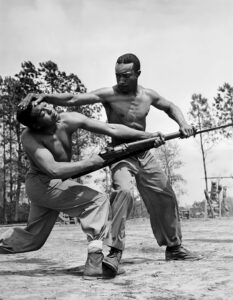
Marine Corps combat training at Montford Point included judo instruction. In this photograph, Cpl. Arvin Lou Ghazlo and Pvt. Ernest C. Jones demonstrate the technique to deflect a bayonet thrust.
National Archives and Records Administration, 127-GC-404-5334
Despite the presidential order, the foot-dragging started at the very top. Maj. Gen. Thomas Holcomb, commandant of the Corps, cited loss of efficiency as the primary justification for resistance to the change. Appealing to the Navy Board, the governing body charged with implementing the policy, Holcomb stated, “If it were a question of having a Marine Corps of 5,000 whites or 250,000 Negroes, I would rather have the whites.” In addition, falling back on interservice rivalry, he included his own opinion that “the Negro race has every opportunity now to satisfy its aspirations for combat, in the Army — a very much larger organization than the Navy or Marine Corps — and their desire to enter the naval service is largely, I think, to break into a club that doesn’t want them.”
Nevertheless, the order stood, and the policy had to be implemented. Segregation would also be the order of the day, and Holcomb issued a directive that prohibited Black NCOs from commanding white Marines.
Initially, Marine recruiters used high standards of education and physical fitness as a means of limiting the number of Blacks accepted. Some of the initial recruits had previous military service in other branches. On June 1, 1942, Alfred Masters was sworn in as the first Black U.S. Marine. Montford Point Camp on the North Carolina coast was a part of the Camp Lejeune complex, but physically separated, and would provide a segregated training facility.
Conditions at the camp were primitive, with tents as shelters and crude buildings. These were gradually replaced by Quonset huts and better structures. Initially, there were few recreational facilities on-site, but this was also improved over time. The Black Marines were forbidden from entering the main facility at Camp Lejeune unless they were accompanied by a white officer. Recreational opportunities off-base in the nearby town of Jacksonville, North Carolina, were also very limited by rules of racial segregation.
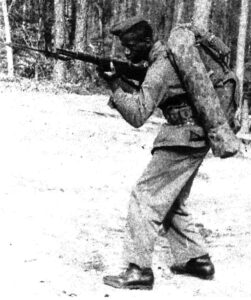
Thomas Mosley began training at Montford Point in 1944, earning a Sharpshooter Badge and selection as guidon bearer for the 365th Platoon.
Eugene S. Mosley Collection
Of necessity, the first drill instructors (DIs) were white. They were traditional Marines who intended to impress the newcomers with their bearing and firmness of manner. In the memory of one of the recruits who had had prior experience in the armed forces, Gilbert H. Johnson, these DIs “set about from the very beginning to get us thoroughly indoctrinated into the habits and the thinking and the actions of the Marine Corps. Discipline seemed to be their lone stock in trade, and they applied it with a vengeance, very much to our later benefit.”
Experienced and talented Black recruits in the first group were promoted upon completion of training to become the new DIs. Gilbert Johnson, known as “Hashmark” for his service stripes from six years in the Army and nine years in the Navy, was one of them. Rising to the rank of sergeant major over a career of 17 years in the Marines, Johnson and the Black DIs forged a continuous chain of disciplined Marines. In 1974 the Marine Corps posthumously acknowledged this service by renaming Montford Point to Camp Gilbert Johnson.
The recruits received basic, combat and specialized training at Montford Point. Thomas Mosley did very well in training, earning the Sharpshooter Badge. He was selected as guidon bearer for his platoon, a recognition of his progress that usually resulted in promotion to the rank of corporal. Mosley, however, was passed over.
Nearly 20,000 African Americans were trained at Montford Point. Over the course of the war, they staffed two Antiaircraft Artillery Defense Battalions, 12 Ammunition Companies, and 51 Depot Companies. Thomas Mosley was assigned to the 365th Platoon of the 5th Marine Ammunition Company in the 5th Marine Division. Other fellow Pennsylvanians in the platoon included Leonard Mayo of Morton, Randall Nelson of Doylestown, William Martin of Philadelphia, and Mosley’s good friend Walter Studevent of Bethlehem.
Mosley was trained as a master ammunition technician, with the knowledge to handle, store and transport ammunition for safety and efficiency. This could be dangerous work if not done properly. In 1944 an explosion at the Port Chicago naval magazine in San Francisco Bay destroyed two transport ships, killed 320 sailors and civilian employees, and injured 390 others.
During May 1944, Mosley and the 5th Ammo Company embarked on the USS Lamar and were shipped to Hawaii. Arriving on June 1, they were assigned to Camp Catlin, where they would become part of the vital supply chain handling ammunition for the invasions of the Pacific Islands approaching Japan. Also during this period, Mosley’s training and experience were finally recognized with a long-overdue promotion to the rank of corporal.
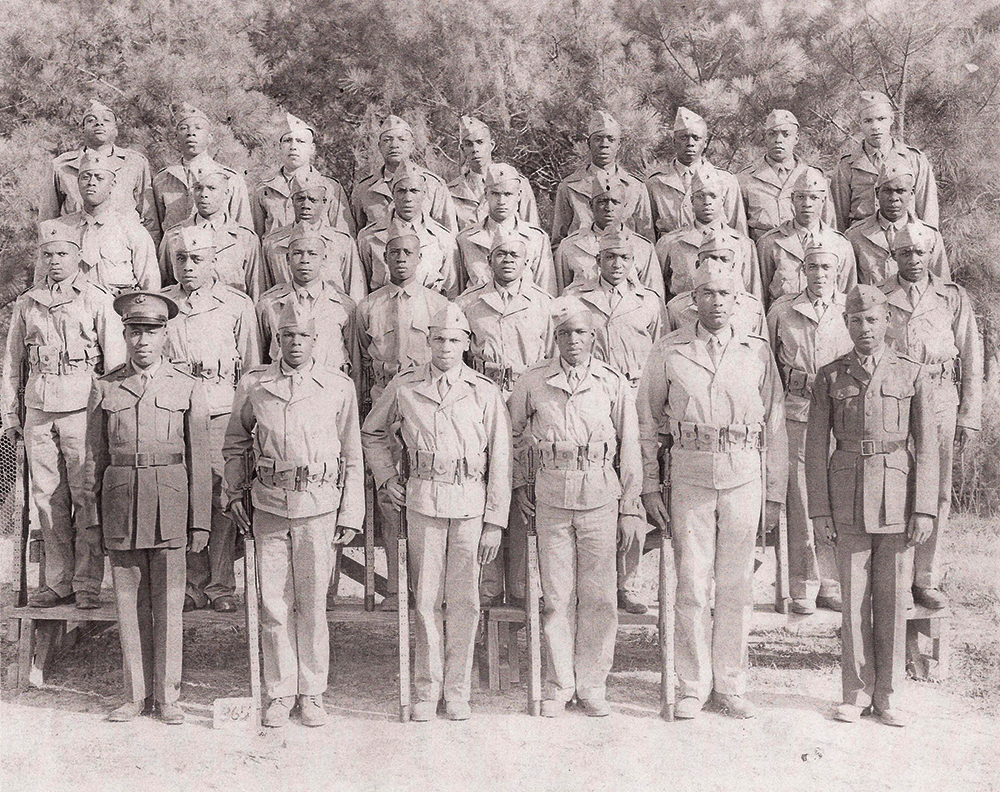
Thomas Mosley, second row, fourth from left, was assigned to the 365th Platoon, 5th Marine Ammunition Company, 5th Marine Division. Other Pennsylvanians in the platoon included Leonard Mayo of Morton, second row, second from right; Randall Nelson of Doylestown, third row, third from left; William Martin of Philadelphia, third row, second from right; and Walter Studevent of Bethlehem, fourth row, fifth from left.
Eugene S. Mosley Collection
While the 5th Ammo Company remained at Camp Catlin until the end of the war, other Montford Point units participated in the Pacific Campaign. Although not designated as combat units both the Depot Companies, which unloaded and distributed general supplies to frontline troops, and the Ammo Companies, which unloaded, bunkered and distributed ammunition, often performed these duties under enemy fire.
On March 2, 1945, the main ammunition dump on Iwo Jima was hit by a Japanese mortar round. Fires and, eventually, a massive explosion resulted as 25 percent of the stockpile was set off. Much of it had to be left to burn out on its own, while some areas were saved by smothering the fires with sand pushed by bulldozers. Black Marines of the 8th Ammo and 36th Depot companies were also drawn into the defense against the last banzai charge in the Pacific Theater. The two units lost three dead and several wounded. A number were decorated for heroism in action.
More than 2,000 Black Marines participated in the final battle of the Pacific for the island of Okinawa. As they had in the other invasions, they risked their lives to bring supplies and ammunition to the front lines and to carry the wounded to the rear on their return trip. Japan’s surrender in August 1945 voided the plans for the invasion of the country and saved thousands of lives—Japanese and American, Black and white.
At the beginning of the war, Marine Commandant Holcomb had disparaged the enlistment of Black Marines. His successor, Gen. Alexander Vandergrift, the combat commander who had defeated the Japanese at Guadalcanal, rendered a succinct evaluation of the Black Marines’ performance, stating that they were “no longer on trial. They are Marines, period.”
With the war over, Thomas Mosley returned home to Pennsylvania and went back to work for his old employer, the soon to be independent Air Force. In total, his career spanned 42 years of civilian service in aircraft design and administration. He also married and had seven children.
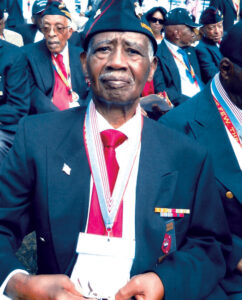
In June 2012, Thomas Mosley and the Montford Point Marines received the Congressional Gold Medal at the Marine Barracks in Washington, D.C.
Eugene S. Mosley Collection
Executive Order 9981, issued by President Harry S. Truman in 1948, built upon the previous presidential directives by ending the policy of segregation within the armed services. The order was not implemented overnight and, as before, there was some resistance, but by 1954 formerly segregated units had been integrated or disbanded.
In 1965 more than 400 former Marines gathered in Philadelphia and formed the Montford Point Marine Association to preserve their legacy. A five-year effort led by association president and retired Master Gunnery Sergeant Joseph H. Geeter III, culminated in 2011 with the unanimous approval by Congress for the issue of a Gold Medal to the Montford Point Marines “in recognition of their personal sacrifice and service to their country.” On June 28, 2012, Thomas Mosley and 400 of his fellow Montford Point Marine Associates received their own medals from Commandant James F. Amos, and other general officers of the Marine Corps.
Thomas Mosley passed away in 2016. To honor him in his native area, the Mosley family donated his Montford Point Marine Association cap, jacket and other effects to The State Museum of Pennsylvania.
Further Reading
Fischer, Perry E., Brooks E. Gray, and Vincent W. Mirko. Blacks and Whites—Together Through Hell: U.S. Marines in World War II. Turlock, CA: Millsmont Publishing, 1993. / McLaurin, Melton A. The Marines of Montford Point: America’s First Black Marines. Chapel Hill: University of North Carolina Press, 2007. / Mosley, Eugene S., with Thomas Mosley. Footprints of the Montford Point Marines: A Narrative of the Epic Strides in Overcoming the Racial Disparities of the United States Marine Corps. Los Angeles: Dagmar Miura, 2022. / Smith, Steven, and James Zeidler. A Historic Context for the African American Military Experience. Washington, D.C.: Department of Defense, 1998.
Sidebar: Take Me Away from Jacksonville on Route 66
Thomas Mosley wasn’t the only Dauphin County native at Montford Point. One of the first white officers assigned to the camp was Harrisburg native Robert W. “Bobby” Troup Jr. (1918–99). A third-generation member of a family that composed, published and sold music and instruments at their stores in several central Pennsylvania cities, Troup had a number one hit song in early 1941, about the same time he graduated from the Wharton School of the University of Pennsylvania with a degree in economics. After completing officer training in the Marine Corps, Troup was assigned as recreation officer at Montford Point.
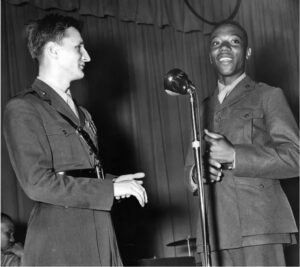
Pianist, singer and songwriter Bobby Troup, a native of Harrisburg, Pennsylvania, served in the Marine Corps at Montford Point and staged shows there. Here, he joins singer Finis Henderson at the microphone.
Department of Defense (USMC) 6797
Faced with the camp’s primitive conditions, Troup set about making it more livable, coordinating the construction of a recreation hall, theater and various athletic facilities including a miniature golf course that he obtained by donation from Armstrong Cork of Lancaster, Pennsylvania. Still a musician at heart, he wrote a song for the Black Marines, describing the inhospitable nature of the nearby town, called “Take Me Away from Jacksonville.” He also organized the first African American band in the Marine Corps, with fellow Pennsylvanian and future jazz trumpeter Sgt. Joe Wilder as his assistant director. Several Black athletes and musicians maintained or developed their talents at Montford Point and enjoyed successful postwar careers.
Promoted to captain during his tenure at Montford Point, Troup was placed in command of the 6th Marine Depot Company, which deployed to Saipan in early 1945 and remained there until the end of the war. Upon returning to the United States, Troup visited his family in Pennsylvania and then headed west for California, later memorializing the trip in the hit song “(Get Your Kicks on) Route 66.” He enjoyed a long career in music, film and television. A life member of the Montford Point Marine Association, he was remembered after his death as a man who “didn’t recognize color, only soul.”
The author and the editor would like to thank Eugene S. Mosley, son of Thomas Mosley, for providing information and images for this article.
Robert D. Hill is senior curator of the Military, Political and Industrial History Collections of The State Museum of Pennsylvania. His previous articles for Pennsylvania Heritage include “From the Susquehanna to the Rhine: The Military Career of Daniel Strickler in Two World Wars” (Summer 2020) and “Stockings, Cap Braids and Bomber Turrets: Wyomissing Industries Mobilizes for World War II” (Fall 2018).