
The Making of a Leader: George C. Marshall
Written by Don Sarvey in the Features category and the Spring 2023 issue Topics in this article: American Red Cross, Fayette County, Franklin Delano Roosevelt, George C. Marshall, George C. Marshall Memorial Plaza, Harry S. Truman, Henry H. "Hap" Arnold, John J. Pershing, Marshall Plan, Meuse-Argonne Offensive, military, Nobel Peace Prize, Uniontown, United States Army, United States Army War College, Virginia Military Institute, World War I, World War II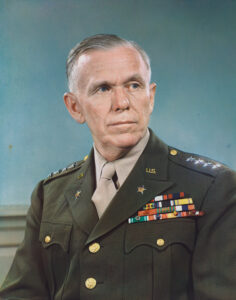
Gen. George C. Marshall in a 1944 photograph by Harry Warnecke (1900–84).
National Portrait Gallery, Smithsonian Institution
During the second weekend of September 1939, Gen. George C. Marshall, the newly elevated chief of staff of the U.S. Army, made an official “homecoming” visit to his place of birth, Uniontown, Pennsylvania. As a result, two strands of history stood adjacent on the front page of the local newspaper, the Uniontown Daily News Standard. One headline announced the Nazi invasion of Poland with the account “Warsaw Fights Germans.” A second headline proclaimed, “Gen. Marshall Hailed” atop a story extolling Marshall’s reception.
The passage of time ultimately wrote the endings for both stories. Nazi Germany would go down to complete, devastating defeat in World War II. In the same duration of time, Marshall would be revealed as a strategic genius in military planning and organizing, a man who not only helped win the war but also helped to shape the landscape of the postwar world.
Uniontown today is a city of some 10,000 residents in Fayette County in the southwest corner of the commonwealth. It was founded on the historically significant day of July 4, 1776, and was situated near the site of Fort Necessity, which was built by George Washington in the pre-Revolution days of the French and Indian War.
For a place of such modest size, Uniontown boasts a rather large roster of notables who came from the city—internationally known mystery writer John Dickson Carr, Ziggy comic strip artist Tom Wilson, a few actors, assorted politicians, several professional football and basketball stars, and the creator of the McDonald’s Big Mac, Jim Delligatti. But the name that stands out is George C. Marshall, whose contributions were vitally important not only to the United States but to the wider world as well.
***
On April 3, 2023, the United States celebrates the 75th anniversary of the formal start of the Marshall Plan, otherwise known as the European Recovery Program, which is credited with rescuing and stabilizing the economies of European countries in the aftermath of the destruction of World War II. Over four years it provided some $13 billion in aid, the rough equivalent of $160 billion in today’s dollars.
It was a monumental undertaking shepherded by Marshall, Army chief of staff during World War II, U.S. secretary of state after the war, and later U.S. secretary of defense. For his achievements in these capacities, Marshall was awarded the Nobel Peace Prize in 1953.
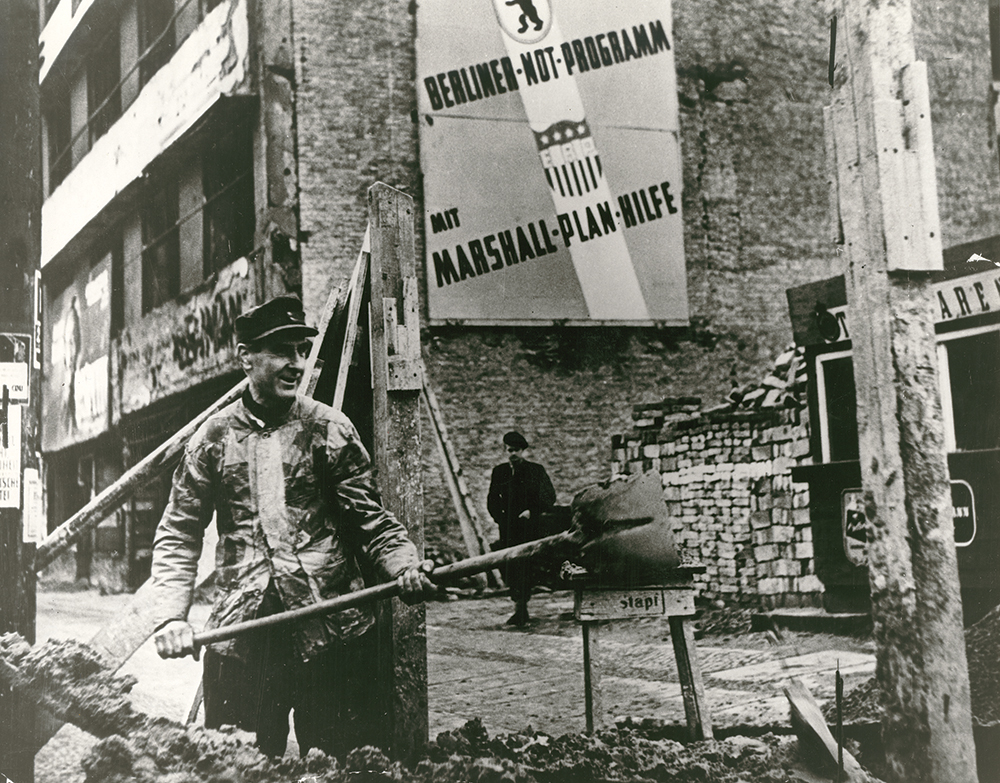
Low-cost housing was one the projects financed by the Marshall Plan. In this photograph, a German worker assists in laying a house foundation in Berlin.
Courtesy of the George C. Marshall Foundation, Lexington, Virginia
Marshall was never noted as a battlefield leader like George Patton or Douglas MacArthur, but in his long career he climbed an administrative ladder of many rungs, accreting a wide variety of military experiences that he later applied to great benefit.
In my recent interview with Michael S. Neiberg, chair of war studies in the Department of National Security and Strategy at the U.S. Army War College in Carlisle, he called Marshall “the epitome of a strategic leader — which is what we teach here.”
Marshall’s biographer, the late Forrest C. Pogue, wrote, “Marshall’s education came primarily from constant study of his trade. He learned what made the Army work and then sought to improve the way in which it accomplished its purposes.”
Marshall became the ultimate planner and organizer. Even if he were not remembered for the Marshall Plan, his reputation would find sturdy repose in what he achieved as chief of staff of the Army, starting in 1939. He played a key role in helping President Franklin D. Roosevelt build up the country’s military resources and strength in the days leading up to the United States’ entry into World War II. Marshall and Secretary of War Henry Stimson were credited with the then-largest-ever military expansion in U.S. history. As Pogue wrote, Marshall’s “most pressing task was to begin to remedy deficiencies so numerous and various that . . . nearly all of which in light of world conditions in 1938–39 were desperate.”
According to historian Doris Kearns Goodwin in her book No Ordinary Time, Roosevelt originally considered Marshall for commander of the Allied invasion of Europe, but Roosevelt ultimately concluded that Marshall was so valuable where he was that “to break it up . . . seemed too risky.” Many breathed a sigh of relief that Marshall remained in the job that he was doing superbly well.
“It’s hard to imagine anyone with greater impact on World War II,” Neiberg said. “I don’t think anybody compares to Marshall.”
***
Marshall was born in Uniontown on New Year’s Eve 1880. Uniontown’s population then was 3,265. Marshall was the youngest of three children; he had an older brother, Stuart, and an older sister, Marie. His father, George Sr., would suffer a reversal of fortunes later in life, but at the time of George Jr.’s birth, he was a successful entrepreneur dealing in coke, the fossil fuel used in the production of steel. Both his father and mother, Laura, had come from Augusta, Georgia, and both had southern family roots in Kentucky and Virginia. At birth, George Jr. belonged to a small-town, rural, circumscribed world. By the time he died on October 16, 1959, he was known and lauded worldwide.
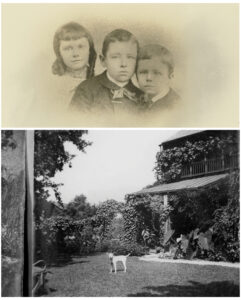
Top, George Marshall at about age 3, right, with sister Marie and brother Stuart. Bottom, Marshall was raised in this house in Uniontown, Pennsylvania, pictured here in 1902. In the yard is the family dog, “Danny.”
Courtesy of the George C. Marshall Foundation, Lexington, Virginia
The stories recounted in the book Growing Up, By George by Mary Sutton Skutt paint Marshall’s childhood as rather idyllic. The family lived in a comfortable rented brick house on the edge of town. (The building was torn down in 1909. The spot is now occupied by a Veterans of Foreign Wars post.) Marshall as a boy hunted and fished with his father, played in a local creek, did odd jobs, ran with pals and helped them come up with ever-promising moneymaking schemes, went sledding in the winter, and explored the countryside on foot and on bicycle in the summer. He did not distinguish himself as a student when his parents enrolled him in a local private school. But he did like history, especially local history, and enjoyed listening to his father read the tales of James Fenimore Cooper and other stories of an earlier age.
His first leap toward his eventual career came with his admission to the Virginia Military Institute (VMI), based more on family background than scholastic achievement, of which his was only average. His interest in VMI apparently sprang in part from the fact that his brother, Stuart, had attended the college and that the father of one of his young Uniontown friends was an ardent admirer of the school and had sent a son there. Ironically, Stuart opposed the idea of George going to VMI, apparently because he felt George would not do well and feared, according to Pogue, that he would “disgrace the family.” Stuart’s opposition only stiffened George’s resolve to go, and go he did, enrolling in 1897 at age 16.
Pogue wrote that VMI’s traditions were “linked to the Confederate past,” and Marshall the Pennsylvanian was hazed and made fun of for his “Pennsylvania twang.” But he eventually did well in the military studies part of the curriculum and graduated in the Class of 1901 and made first captain, a cadet’s highest rank.
Marshall won a commission as a second lieutenant in the U.S. Army after graduation. Even though his father was a locally prominent Democrat, Marshall’s application had somehow gained the endorsement of Pennsylvania’s two Republican senators, the historically infamous Boies Penrose and Matthew Quay. Marshall throughout his career typically avoided identifying himself politically, once saying his father was a Democrat, his mother was a Republican, and he was an Episcopalian. He said he didn’t vote.
In February 1902 Marshall’s first posting was to the Philippines, but before he left, he got married to a young woman named Elizabeth Carter Coles, who lived in Lexington, Virginia, and whom he had met and courted while attending VMI. The marriage added to the rift between the Marshall brothers, as the young woman had earlier rejected a marriage proposal from Stuart.
The young Mrs. Marshall suffered from heart problems and would die an untimely death in 1927. The couple did not have any children. In 1930 Marshall married Katherine Boyce Tupper, a widow from Baltimore with three children, whom he had met while at Fort Benning, Georgia. Marshall never had any biological children of his own.
A string of assignments led Marshall to a role as a planner of training and operations in World War I. He was part of the first wave of American soldiers to arrive in France. When he spoke up about logistical and administrative problems, he came to the attention of the commanding general, John J. Pershing. Pershing would remain a lifelong mentor, even serving as Marshall’s best man at his second wedding.
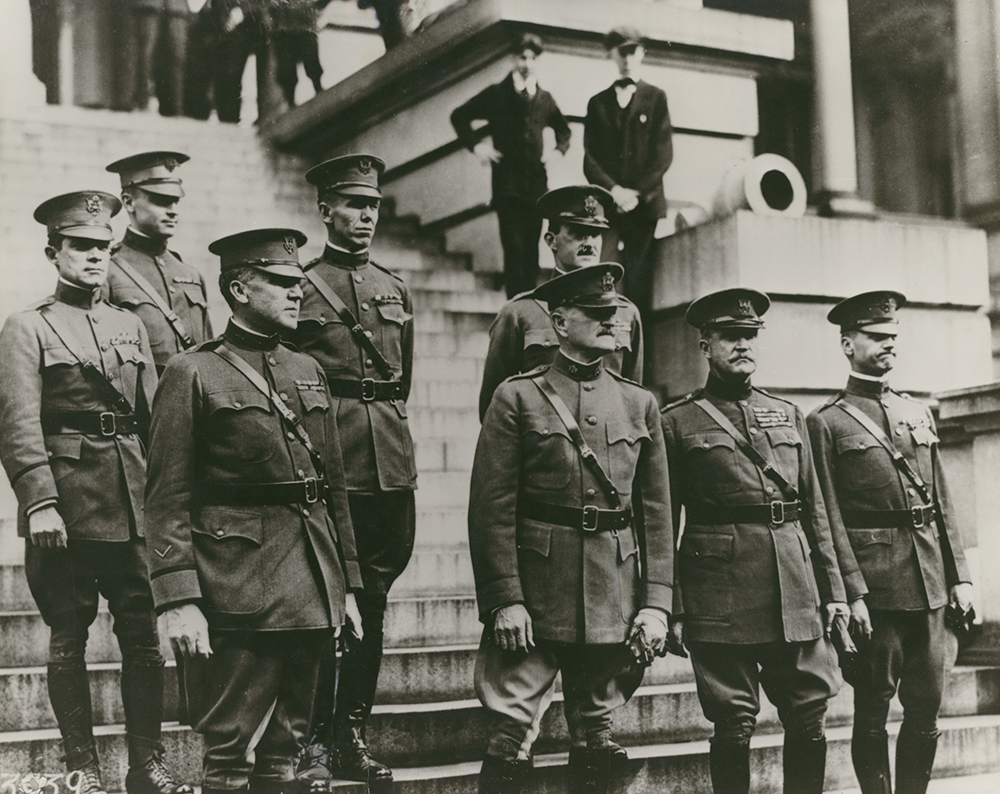
Marshall became aide-de-camp to General Pershing in 1919. In this photo of Pershing’s staff at the State, War and Navy Building in Washington, D.C., Marshall stands third from the left in the back row. Pershing is second from the left in the front row.
Courtesy of the George C. Marshall Foundation, Lexington, Virginia
Marshall added to his reputation with successful pre-attack planning of a battle that was considered one of the first important American victories. Pershing added Marshall to his staff thereafter, and Marshall was subsequently credited with playing a role in planning and coordinating the Meuse-Argonne Offensive, which helped defeat the Germans on the Western Front.
After reaching the rank of captain by the end of World War I, Marshall moved through a variety of assignments, benefiting from the fact General Pershing had become Army chief of staff. Among other things, Marshall taught at the Army War College when it was in Washington, D.C.; served with an infantry regiment in China; and held the post of assistant commandant of the Infantry School at Fort Benning, where he gained experience in modernizing military procedures. In 1936 he was promoted to general and, in 1938, he was put in charge of the War Plans Division and took on the job of deputy chief of staff of the Army.
Neiberg believes Marshall benefitted from having attended VMI rather than West Point, inasmuch as “he was not limited by a West Point mindset” — the idea of an expected way of military thinking. “He was never afraid to speak his mind,” Neiberg said, and “he had a wider ability to understand context beyond the military.” He read a lot, and he understood politics and economics in the real world. He thought about things outside his own area of expertise, Neiberg said, and saw the connections among a wide variety of subjects. Neiberg said the closest comparison to a Marshall in recent times would have been Army Gen. Colin Powell, who served as chairman of the Joint Chiefs of Staff and later became secretary of state.
Marshall built a professional rapport with President Roosevelt, and in July 1939 Roosevelt named him acting chief of staff of the Army. He was elevated to permanent chief of staff in September 1939, just as the Germans were invading Poland. And it was also just at that moment that Marshall’s past and future intersected in his old hometown of Uniontown.
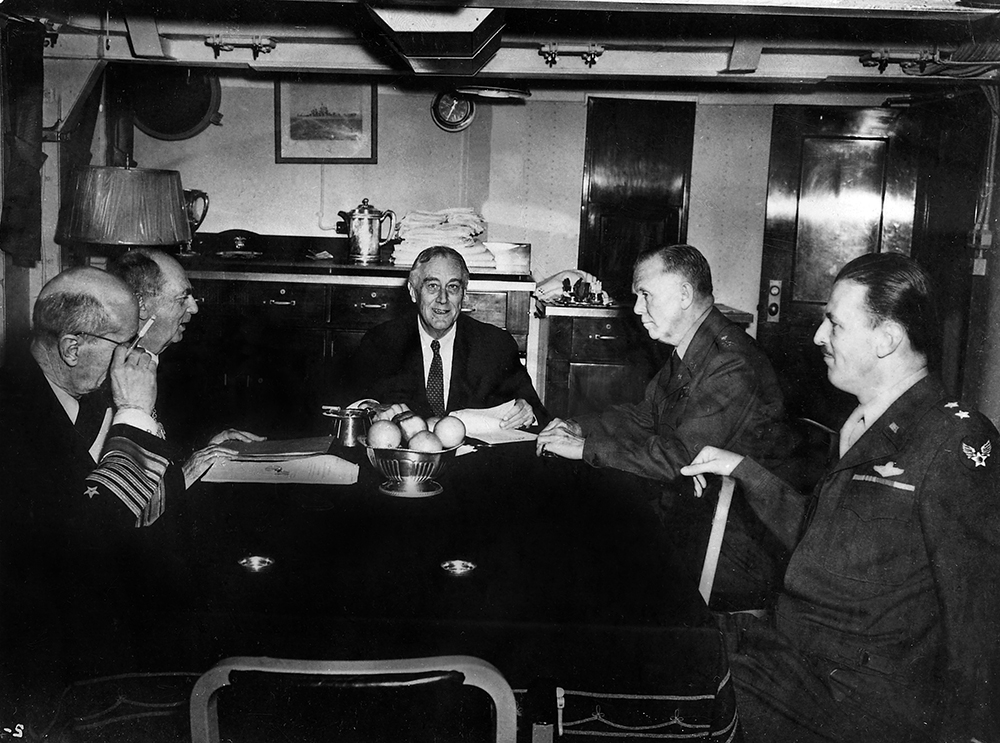
As chief of staff of the U.S. Army, Marshall worked closely with President Franklin D. Roosevelt during World War II. Here, FDR meets with the Joint Chiefs of Staff on the USS Quincy in Malta, February 2, 1945. To the left are Adm. William D. Leahy, chief of staff to the commander in chief, and Adm. Ernest J. King, commander in chief of the United States Fleet and chief of Naval operations. On the far right is Gen. Laurence S. Kuter, representing Gen. Henry H. Arnold, chief of the Army Air Forces.
National Archives and Records Administration
***
According to newspaper accounts, an estimated 10,000 people were on hand for Marshall’s arrival from Washington, D.C., that September weekend for what was billed as an official homecoming. It took place slightly more than four decades after he had gone off to VMI, and it was described as his “first visit . . . in many years.” After joining the Army, Marshall never lived in Uniontown again. (He established a home in Leesburg, Virginia, and later retired to Pinehurst, North Carolina.)
The multitude on hand to welcome the man they called the “distinguished son of Uniontown” included a host of civic organizations, politicians, veterans groups, high school bands, and active military units. He got a 17-gun salute and a receiving line, and the community put on a fancy banquet for him in a local hotel.
The Uniontown Daily News Standard heaped warm praise on him: “George Marshall revealed himself first and foremost as a human being, a man with a keen sense of humor, a lively recollection of the formative days of youth in Uniontown, and with that fine ‘humanness’ that distinguishes all truly great men even more than their rank or honors.”
***
When Marshall returned to Washington at the conclusion of the events, he took up his mission to trumpet the need for preparedness with zeal. He was not shy about speechmaking to influential audiences and making radio broadcasts to propel the message and to counter the isolationist sentiment that existed in the country.
A few months after the Nazi entry into Poland, in one typical speech, he pointed out that “the implications of the past few weeks have indicated that war is a sudden and terrible business, with the accent on sudden.” He emphasized that “no matter how many billions of dollars Congress places at our disposal on the day [a] war is declared, they will not buy 10 cents’ worth of war materiel for delivery [in] under 12 months.”
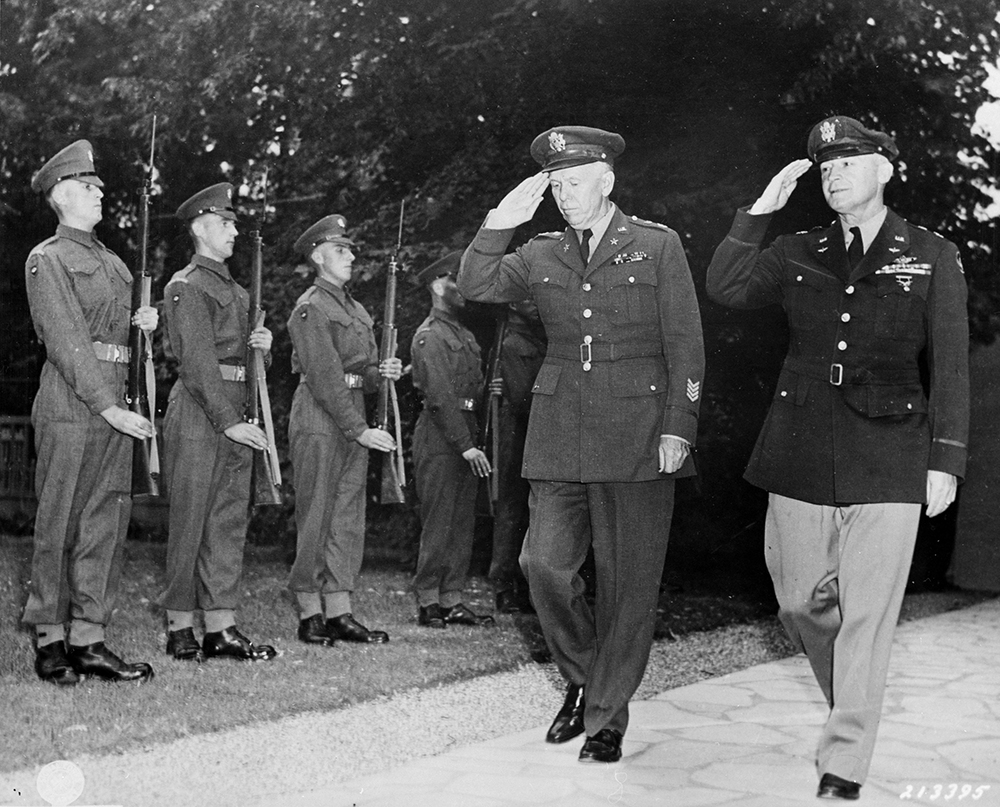
Marshall and fellow Pennsylvania native Gen. Henry H. Arnold return a salute to a line of Scots Guards of the British Brigade of Foot Guards as they arrive at a dinner at Winston Churchill’s residence, July 23, 1945.
National Archives and Records Administration
On the occasion of a radio address, he said, “Until the world is a much more peaceful place . . . the military necessities for our security must be carefully weighed and then created in fact and not in theory.” Historian Gordon A. Craig wrote in The New York Times in 1973 that “it would be difficult to think of another soldier who could have done as good a job as Marshall in maintaining the kind of public and Congressional support that the armed forces needed in the critical years of the war.”
Despite his great responsibilities and the pressure that went with them, Marshall apparently maintained a certain equanimity during the war years. Neiberg said Marshall’s goal was always to give his commander-in-chief his “best military advice” and then recognize that “the decisions were not his to make.” Neiberg said Marshall usually went horseback riding in the mornings before work and tried to leave his office no later than 5 p.m.
When the war ended, President Harry S. Truman, Roosevelt’s successor, asked Marshall to serve as a special envoy to China. That assignment lasted for two years, and then in January 1947 Truman named Marshall as his secretary of state. It was in that post that Marshall advocated the plan to rebuild Europe, which, according to Neiberg, relied in part on many of the ideas put forward by George F. Kennan. Kennan served as director of policy planning in the State Department at the time and became known as the author of the “containment strategy” during the Cold War. (Kennan also had a Pennsylvania connection: He owned a farm in East Berlin, Adams County, which he used as a weekend getaway when he served in Washington, D.C.)
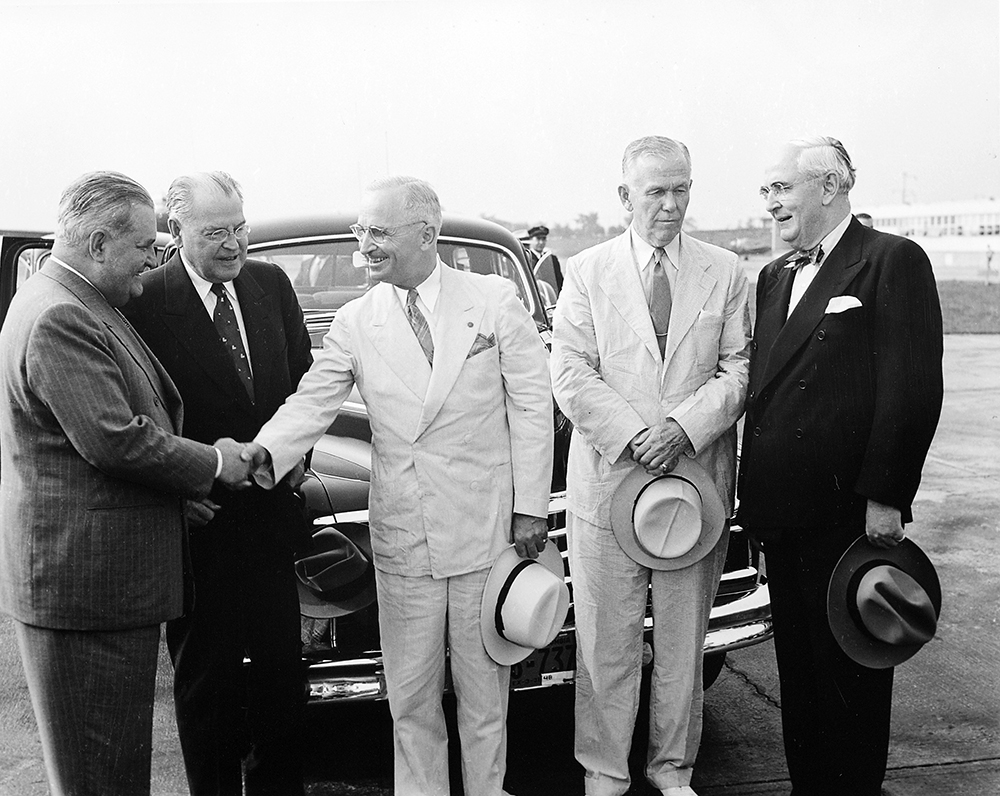
Marshall served as secretary of state under President Harry S. Truman from January 21, 1947, to January 20, 1949. Here, on August 13, 1947, Truman meets with Marshall and others at the National Airport in Washington, D.C., before their trip to Brazil for the Rio de Janeiro Conference of Foreign Ministers. Truman is shaking hands with Brazilian Ambassador to the U.S. Carlos Martins, with U.S. Representative to the United Nations Warren Austin between them. Marshall chats with Sen. Arthur Vandenberg, to the far right.
National Archives and Records Administration
The aid plan grew from a commencement speech that Marshall gave at Harvard in June 1947 in which he underscored the need to address the economic crisis in Europe. It led to an international follow-up conference in Paris that started a debate and set the wheels in motion for cooperation between and with the nations of Europe. The plan was officially enacted on April 3, 1948. Neiberg said the “monumental impact” of Marshall’s strategic thinking was that it recognized the use of the economic aid as “an instrument of power” in the Cold War equation.
***
After resigning as secretary of state in 1949, Marshall served as chairman of the American Battle Monuments Commission and as president of the American Red Cross. Truman brought him back into government in 1950 as secretary of the recently established Department of Defense, a post he held until the fall of 1951, when he retired.
When the Nobel Prizes were announced for 1953, the text simply declared that the Peace Prize was being awarded to Marshall “for proposing and supervising the plan for the economic recovery of Europe.” Marshall died in 1959 and was buried in Arlington National Cemetery. He was praised by President Dwight D. Eisenhower and former President Truman, among many others. Marshall’s widow died in 1978 at the age of 96.
Uniontown did not forget about Marshall in the years after his death. The people of the city still regard him as “theirs . . . a beloved native son,” said Richard Robbins, a columnist for the Uniontown Herald-Standard and the author of Grand Salute: Stories of the World War II Generation, among other books.
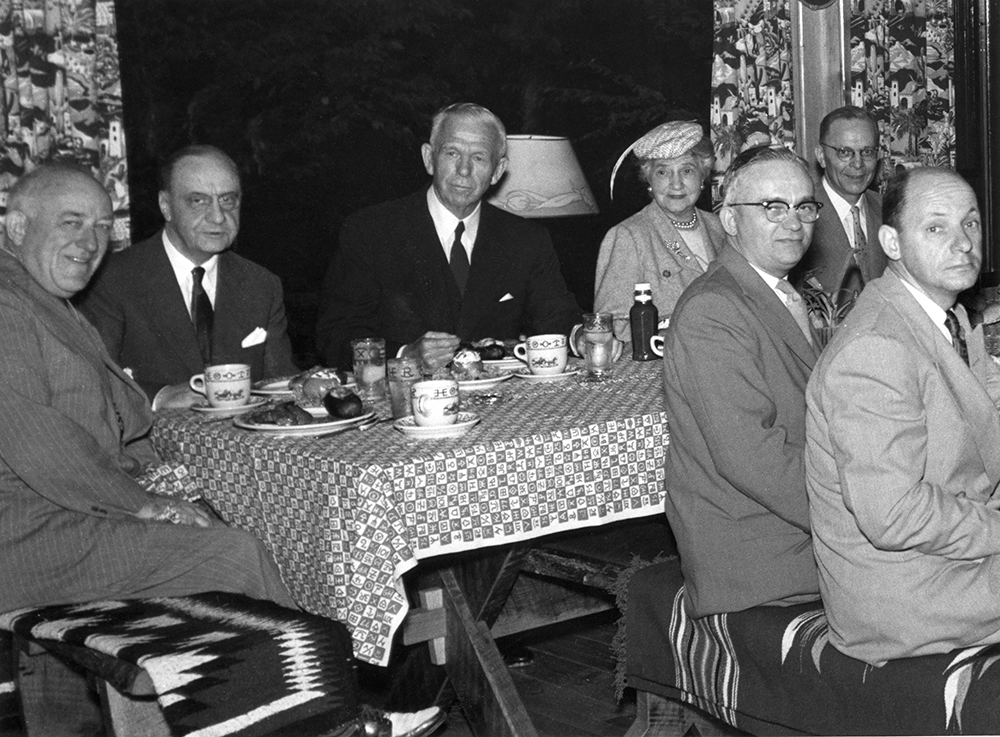
Marshall maintained ties to Uniontown throughout his life. In this photo, he attends a luncheon in his honor in his hometown on September 21, 1953. His wife, Katherine, is at his right.
Courtesy of the George C. Marshall Foundation, Lexington, Virginia
Robbins served as president of the Friends of Marshall, a volunteer organization that raised funds to help build Uniontown’s George C. Marshall Memorial Plaza. The plaza opened in 1999 to honor the general’s legacy.
Robbins has a letter he received in 1989 from Forrest C. Pogue in which Pogue confirmed the lasting strength of the ties that Marshall felt for his hometown. Pogue said that though Marshall “traveled far afield” in his life after Uniontown, the general “never ceased to recall his boyhood home” and that he made sure he was always identified as a Pennsylvanian.
Further Reading
Goodwin, Doris Kearns. No Ordinary Time: Franklin and Eleanor Roosevelt: The Home Front in World War II. New York: Simon & Schuster, 1994 / Pogue, Forrest C. George C. Marshall: Education of a General, 1880–1939. New York: Viking Press, 1963. / —. George C. Marshall: Ordeal and Hope, 1939–1943. New York: Viking Press, 1966. / —. George C. Marshall: Organizer of Victory, 1943–1945. New York: Viking Press, 1973. / —. George C. Marshall: Statesman, 1945–1959. New York: Viking Press, 1987. / Roll, David L. George Marshall: Defender of the Republic. New York: Dutton Caliber, 2019.
Don Sarvey, a former newspaper reporter and magazine editor, is a freelance writer who lives in Harrisburg. His previous articles for Pennsylvania Heritage include “Agnes: Pennsylvania’s Most Devastating Natural Disaster” (Summer 2022) and “Ahead of Her Time: Pennsylvania Aviator Helen Richey” (Spring 2020).