
Louis Kahn Receives a Pennsylvania Historical Marker — in Estonia
Written by Nancy Moses and William Lewis in the PHMC Highlights category and the Spring 2023 issue Topics in this article: architecture and architects, Estonia, Louis Kahn, Louis Kahn Estonia Foundation, Pennsylvania Historical and Museum Commission, Pennsylvania Historical Marker Program
Estonian-born American architect Louis Kahn in his office in Philadelphia in the early 1970s.
Louis I. Kahn Collection, University of Pennsylvania and Pennsylvania Historical & Museum Commission
We stood on a grassy knoll in Kuressaare among ambassadors, Estonian cultural officials, members of the Louis Kahn Estonia Foundation, and locals. Behind us was a 14th-century stone castle with battlements and towers and behind that, the Baltic Sea. In front of us was a tall pole topped by an official Pennsylvania Historical Marker honoring architect Louis I. Kahn (1901–74).
A men’s choir began, their harmonies soaring into the chilled May air. Madis Kallas, mayor of Saaremaa Municipality, spoke first, followed by Else Berit Eikeland, Norwegian ambassador to Estonia, and then Brian Roraff, chargé d’affaires, the senior U.S. official in Estonia. The year 2022 marked the 100th anniversary of Estonian–U.S. diplomatic relations, and the Louis Kahn marker was an important part of the celebration.
Pennsylvania Historical & Museum Commission Chair Nancy Moses approached the microphone, along with an interpreter. She spoke about Louis Kahn — widely regarded as the greatest architect of mid-20th-century America — who had been born in the town of Kuressaare on the island of Saaremaa and whose distinctive aesthetic derived from the light and monumentality of Estonia. Moses told how, after Kahn’s tragic and unexpected death, his family and friends had sought a permanent home for his papers and models; how the Pennsylvania legislature had authorized $500,000 to purchase them for the Pennsylvania Historical & Museum Commission; and how the commission had placed them on permanent loan at the University of Pennsylvania Architectural Archives in Philadelphia in the same building where Louis Kahn taught.
This ceremony, held on May 5, 2022, was the dream of the Louis Kahn Estonia Foundation. Its chairman Toivo Tammik, executive director Ott Rätsep, and other members first envisioned the marker dedication in 2006, after seeing the Pennsylvania Historical Marker for Kahn in front of his architecture office in Philadelphia and had imagined a marker of their own. In 2021 they contacted the Pennsylvania Historical & Museum Commission with the novel request for an official marker for Kahn to be installed in Estonia. At that point there were no Pennsylvania Historical Markers outside of the state, let alone the U.S. In the spirit of cultural solidarity and educational advancement, the commission happily agreed to manufacture a new Kahn marker identical to the existing one, but with one important difference — one side is in English, the other in Estonian.
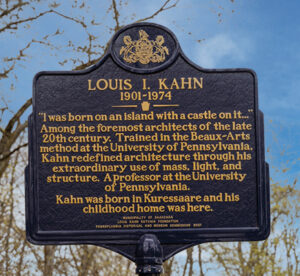
The English-language side of the Louis I. Kahn historical marker.
Photo, Gunnar Laak / Louis Kahn Estonia Foundation
Following the marker ceremony, local Estonian women proudly served up homemade pickled fish, potato and vegetable salads, and other traditional food. That was followed by a film screening, a seminar, and the opening of an exhibition, Silence and Light, about Kahn’s work and influence.
The festive day ended with a concert in the small Baroque Laurentius Church, with faux painted walls evoking marble and swag draperies and windows depicting subtle waves, fog and bubbles, created by Urmo Raus, a glass designer and Kahn Foundation board member who was seated in the row behind us. The packed audience fell silent as 70 members of the Estonian National Male Choir entered the nave, their ethereal voices flooding the space. The internationally acclaimed bass Ain Anger joined the ensemble, returning home after performing at the Metropolitan Opera in New York City.
The choral members wore blue and yellow ribbons to show support for Ukraine, which Russia had invaded a few months before. Estonia had regained its independence from the Soviet Union in 1991; most of the Estonians we met had lived under the heavy hand of Soviet rule. During our visit, Estonian families were hosting more than 50,000 refugees, a significant influx for a country of only 1.3 million people. Estonia is a member of NATO and the European Union, with 15,000 American troops on alert. It holds itself as safe and lucky, but nevertheless watchful. The eastern border of Estonia abuts a large lake on the other side of which is St. Petersburg, Russia.
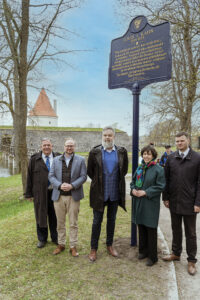
From left to right, William V. Lewis Jr., PHMC commissioner; Brian Roraff, chargé d’affaires, U.S. Embassy, Tallinn; Ott Rätsep, Louis Kahn Foundation; Nancy Moses, PHMC chair; and Madis Kallas, mayor of Saaremaa, stand at the Estonian- language side of the Kahn historical marker shortly after the unveiling.
Photo, Gunnar Laak / Louis Kahn Estonia Foundation
Our Estonian hosts were well prepared. They knew about Pennsylvania’s rich history and the commission’s work in preserving and sharing it. As a token of appreciation for the friendship of our Estonian hosts, Commissioner William V. Lewis Jr. of the Pennsylvania Historical & Museum Commission presented dignitaries with donated antique Pennsylvania “Liberty Bowls” and state seal plates, and he spoke about how these gifts also celebrate the freedom both of our countries enjoy.
Our delegation included Per-Olaf Fjeld, a Norwegian architect who was a student of Kahn, and his wife Emily Randall Fjeld; Janina Flückiger, a Swiss educator; and Jeff Reuben, a New York–based writer. Together we experienced contemporary art at the all-Estonian art collection of Kadi Polli, one of the country’s leading entrepreneurs; toured the national art collection at Kumu Art Museum; and stopped by preserved mansions where Russian nobility had once summered. In Estonia’s capital city, Tallinn, we watched an archaeology crew unearth a newly discovered Hanseatic League–era shipwreck and walked through its large, well-preserved old city.
This is a country of remarkable contrasts. It is a cutting-edge society and incubator for startups, where residents use digital ID cards to seamlessly pay taxes, vote and bank. It is also a nation that cherishes its rich past. One day we visited an abandoned church in the process of restoration, a cemetery that reaches back before the Vikings, and a historic farm where sheep shared a thatched roof barn with a sauna. Fields are interspersed with woods that are much like those in Western Europe before the Industrial Revolution, with wolves and brown bears, though happily we didn’t see them.
Ott Rätsep proudly reports that visitors to Kuressaare stop and read the Louis Kahn historical marker. We’re grateful that the Pennsylvania Historical & Museum Commission helped realize this dream.
Nancy Moses is an author and chair of the Pennsylvania Historical & Museum Commission.
William V. Lewis Jr. is managing principal of Lewis, Litwinsky & Associates of the Wells Fargo Advisors Financial Network and a commissioner of the Pennsylvania Historical & Museum Commission, for which he also serves as chair of the review panel for the Pennsylvania Historical Marker Program.