
Late Bloomer to Soaring Eagle: An Interview with Football Hall of Famer Harold Carmichael
Written by William Kashatus in the Features category and the Fall 2023 issue Topics in this article: Charlie Young, Dick Vermeil, Don Zimmerman, football, Harold Carmichael, Mel Blount, National Football League, Philadelphia Eagles, Ray Didinger, Roman Gabriel, Ron Jaworski, Wade Jones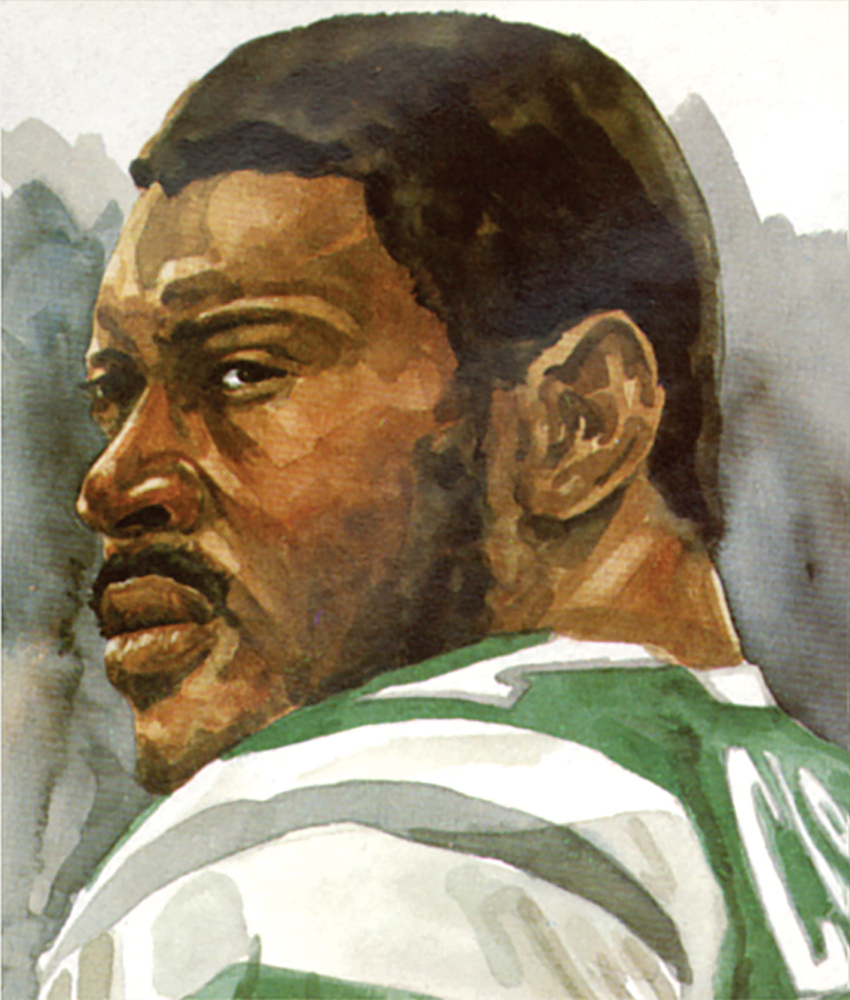
Harold Carmichael by sports artist Dick Perez.
Courtesy of Dick Perez
On November 4, 1979, the Philadelphia Eagles faced the Cleveland Browns before a packed house of 69,000 die-hard fans at Veterans Stadium. Although both teams boasted 6–3 win–loss records and were vying for their seventh victory of the season, everyone’s mind was on Harold Carmichael’s streak of consecutive games with at least one pass reception.
Carmichael, the Birds’ gangly wide receiver, did not even know that he had a streak until two years earlier, when a local television sportscaster told him that he was closing in on Danny Abramowicz of the New Orleans Saints, who at the time held the record with 105 consecutive games.
Carmichael’s streak began seven years earlier in the fourth week of the 1972 season with a single catch against the Washington Redskins. At the time, the Eagles were a lousy team completing the ’72 campaign with a 2–11–1 win–loss record. But by 1979 Philadelphia had developed into a Super Bowl contender and Carmichael, one of their key playmakers.
Now on this beautiful sunny autumn afternoon, Eagles’ fans would be treated with a memory for the history books. On the fifth play of the game, with the Eagles second and 4 on their own 32-yard line, quarterback Ron Jaworski took the snap from center. Dropping back, Jaworski saw Carmichael open on the right flank and hit him with a perfect pass to set a new record of 106 consecutive games with at least one reception. Harold carried the ball 5 yards before he was tackled by a Browns’ defender. Before he could get to his feet, he was mobbed by his Eagles’ teammates who dogpiled on top of him.
The referee stopped the game for a brief ceremony as a golf cart buzzed onto the gridiron carrying Carmichael’s wife, with their infant son, and Eagles owner Leonard Tose. Tose presented the receiver with a 23-foot, 9-inch trophy — another record, breaking the previous mark of 15 feet, according to the Guinness Book of World Records.
After kissing his wife and son, Carmichael thanked the crowd and expressed his happiness at setting the new record. Placing his helmet back on his head, Harold, humbled by the moment, buckled the chin strap and went back to work. He would go on to record four more catches in the game for a total of 95 yards and score a touchdown. It would have been a perfect day for him if the Eagles had not blown a nine-point lead in the fourth quarter to lose the game, 24–19.
Harold Carmichael spent 14 years in the National Football League, 13 of them in the City of Brotherly Love. Selected by the Philadelphia Eagles out of Southern University in the seventh round of the 1971 NFL draft, Carmichael was a self-confessed “late bloomer.”
His breakout season came in 1973 when he recorded a career-high 67 catches for 1,116 yards to lead the NFL in receptions and receiving yardage. Although Carmichael did not possess great speed, he was difficult to tackle in the open field and was willing to catch a ball thrown across the middle of the gridiron. At 6 feet, 8 inches and 225 pounds, Harold redefined the position of wide receiver with his ability to catch “alley-oop” passes over smaller defenders. These assets made him a valuable playmaker for head coach Dick Vermeil.
Carmichael registered 40 or more catches in nine straight seasons, eclipsed the 1,000-yard mark three times, and had 20 games with 100 or more receiving yards during his career. He also led the Eagles in receptions and receiving yardage seven times, scored a career-best 11 touchdown receptions in 1979, and established a then NFL record of 127 straight games with at least one reception from 1972 to 1980.
A soft-spoken individual with a deepseated Christian faith, Carmichael led by example. He was a key member of the Eagles teams that earned four straight playoff appearances between 1978 and 1981 and a National Football Conference Eastern Division title and Super Bowl appearance in 1980. He completed his NFL playing career in 1984 with the hated Dallas Cowboys. At the time of his retirement, Carmichael was the Eagles’ all-time leader in consecutive games played (162), touchdowns scored (79), receptions (589), receiving yards (8,978) and touchdown receptions (79).
Carmichael was also a four-time Pro Bowl selection (1973, 1978, 1979, 1980), two-time All-Pro selection (1973 and 1979), and six-time All-Conference selection (1973, 1974, 1977, 1978, 1979, 1980). Named to NFL’s All-Decade Team of the 1970s, Carmichael was chosen as the NFL Man of the Year in 1980. He was inducted into the Eagles’ Hall of Fame in 1987 and elected to the Pro Football Hall of Fame in Canton, Ohio, in 2020.
In this interview, Harold Carmichael discusses his boyhood growing up in Jacksonville, Florida; his college football career at Southern University; and the trials and tribulations he experienced as a Philadelphia Eagle.
Religion was an important part of your upbringing in Jacksonville, Florida. How did your parents and your faith influence you as a youngster?
I grew up and was baptized in the Baptist church. My mother took me to church on Sundays. When I was older, I became an usher. I didn’t read the Bible as much as I probably should have, but I listened to the minister’s sermons and learned a lot from them as well as from the examples of my parents. Many of my friends grew up in the same environment. Religion was an important part of their lives, too. I was surrounded by the Gospel each and every day.
Where did you get your love of sports and athletic competition?
I credit my competitive drive to three close friends: Andrew Edwards, Billy Wells and Winchell Hightower. We all grew up together in the same neighborhood. While our fathers were in our lives, they were not able to be around as much as we would have liked. Instead, we learned a lot from each other. Each one of us had a different personality, too. We were good kids, who tried to look out for each other.
We walked to school together, came home together, and spent the afternoons together. We also had backyards that were connected to each other, so we started a neighborhood softball team called the “Baby Robbins.” It was the best peewee softball team in the City of Jacksonville. Other kids were jealous of us because we were not only the most competitive team, but also because we were so close with each other. In fact, there are people down in Jacksonville who still talk about that Baby Robbins softball team.
Those guys were also much better than me in sandlot football. They did not play in high school, but they were fast and they were good. On the other hand, I doubted my abilities because I didn’t have the speed. But everyone knew that if I could get open, I was going to catch the football. I had real good hands and at an early age, too.
You attended Jacksonville’s William M. Raines High School, a football powerhouse that has produced several NFL players, including All-Pro receiver Kenny Burrough of the Houston Oilers, receiver Ron Gardner of the Washington Redskins, and Hall of Fame safety Brian Dawkins of the Eagles. But you began your career there playing trombone in the school band, not football. Why?
It goes back to my three close friends. They were excellent musicians. One played the drums, the other one played the trombone, and the third played trumpet. I started out on the trumpet, but I wasn’t coordinated enough for that, so I went to the trombone.
Our high school band was divided into four sections. I sat in the very last seat in the fourth section and was easily the worst trombone player. Every time I played a bad note, the band leader would come around and hit me on top of the head with his baton. I got hit so many times, I quit the band and joined the junior varsity basketball team. Within a week, I was promoted to varsity as a freshman. That was the beginning of my scholastic sports career.
You played both wide receiver and quarterback in high school. Were the college recruiters interested in you for both positions?
I didn’t think I was a good enough athlete to even get a scholarship to college. The first positive sign I got was from a scout who came to our school in my junior year to recruit Kenny Burrough. Kenny was a year ahead of me. He was also a wide receiver, and I played behind him. The scout spoke with us at the same time. Before he left, he promised to come back and recruit me the next year. I don’t know if he was just saying it to be nice, because I never heard from him again. But that’s when I began thinking seriously about college football.
I switched to quarterback my senior year, because our team needed someone to play the position. Since I could throw pretty well and our offensive line was not that good, I ended up under center. But the college scouts didn’t come to see me. There was no eye contact with any of them.
Why did you choose to attend Southern University, a historically Black college in Baton Rouge, Louisiana?
In high school I was being heavily recruited for basketball. The only letter I received for football came from Southern University. I didn’t know much about Southern. But one of my teammates had a sister who was a student there. One day, we were over at his house and his sister brought out her yearbook. I started looking at the pretty girls in that yearbook, and right then and there I decided I was going to Southern.
At Southern, you were a three-sport athlete. You made All Southwestern Conference as a wide receiver in your senior year. You also played center on the basketball team and threw the javelin and discus for the track and field team. Why were you able to excel at football?
When I went to Southern University, I was a walk-on who began as a third string quarterback. I just didn’t have the speed to compete. But I watched and learned from my teammates. Kenny Ellis, a wide receiver who was later drafted by the Green Bay Packers — he was very good at getting open, and it wasn’t just with his speed. Kenny had some great moves. He knew how to run patterns and how to position himself between the defensive back and the ball. I also learned from our defensive backs, Mel Blount and Wade Jones. Blount, who went on to star with the Pittsburgh Steelers, had size, speed and quickness, as well as the toughness and mental ability to adjust his coverage tactics. Jones, who got drafted by the Eagles the year before I did, was a fierce tackler. I went against these guys in practice every day for three-and-a-half years. They groomed me for pro ball. When I was drafted by the Eagles, I had all the confidence I needed to play in the NFL.
You were selected by the Philadelphia Eagles in the seventh round (161st overall) of the 1971 NFL draft as a defensive back who could also play wide receiver. As a rookie, you played wide receiver and tight end starting in six out of the nine games. You had just 20 receptions for 288 yards and no touchdowns before missing the final five games with a knee injury. Your numbers weren’t much better in 1972 when you returned to wide receiver. You completed that season with 20 catches for 276 yards and just two touchdowns. Why the difficult start?
I really don’t know. Jerry Williams was the head coach when I came to the Eagles, and he played me at wide receiver. But Williams was fired in mid-season and replaced by an assistant, Ed Khayat. Khayat used me at tight end and at wide receiver. Sometimes, I wouldn’t know where I was playing until the day of the game, and that was part of the problem. Another problem was my size. I think the offensive coordinator, John Rauch, had never worked with a 6-foot, 8-inch receiver and really didn’t know how to use me. But the bigger reason I had trouble adjusting to the NFL was because I was playing behind two exceptionally gifted receivers — Ben Hawkins and Harold Jackson. Although I learned a lot from those guys and I loved them like brothers, I also knew that I couldn’t run the same routes because they were much smaller than me.
Philadelphia had an infamous reputation as a racist city in the 1960s and early 1970s. Did you experience any racial animosity on the Eagles, who only carried 10 Black players on their roster when you arrived in 1971?
Growing up in Jacksonville, Florida, I had never been around a lot of white people. We had whites come into our neighborhood — the mailman, the insurance man, the garbage man, people like that. But I really didn’t know any white people growing up. We never played against any white schools when I was in high school. At Southern it was all Black. So, when I went to the Eagles first full team meeting in July 1971, I was in awe of being in a room with that many white people. As you said, there couldn’t have been more than eight to 10 Black players on the team in 1971. The majority of players were white.
The only time I heard any discriminatory remark was in training camp that first year. I was passing by a dormitory room, and I overheard two players talking about “shooting Blacks.” I just kept walking. To this day, I don’t know who said it. But that was the only incident I can recall.
[Wide Receiver] Harold Jackson took me under his wing, though. He let me live in his apartment. We’d go out to eat together or stay at home and cook. Harold also taught me how to deal with people off the field.
Whenever my white teammates had a party, I was always invited. I was like a fly in a bowl of milk, the only Black there. But I always had a great time. I always felt that my white teammates genuinely liked and respected me. In fact, [defensive back] Bill Bradley got all the single guys who lived in the city together on Monday nights at a disco club. He called it “Harold Carmichael Night,” because I loved to dance. I have to admit that Billy was the first white boy I saw who could really dance. I mean this guy was good. We had some of the greatest times on those Monday nights.
To this day, so many of my teammates — white and Black — are among my best friends. Now I’m not saying that racism didn’t exist back then, because it still exists today. But it was — and still is — subtle or closeted.
Your breakout year was 1973. You earned Pro Bowl and Second-Team All-Pro honors by leading the NFL with 67 receptions for 1,116 yards and tied for fourth in the league with nine receiving touchdowns. Why were you able to put it all together that season?
In 1973 the Eagles hired a new head coach, Mike McCormack. McCormack brought in Boyd Dowler to be the receivers’ coach. Dowler, who was 6 foot, 6 inches, had played the position for the Green Bay Packers in the 1960s when they were the dominant team in the NFL. He understood how to use his height to his advantage, and he taught me how to do the same thing. Dowler and McCormack also changed the offense to get me more involved. They introduced 6-yard-out passes, which allowed me to smooth out my stride. They also introduced bubble screen passes, which increased the number of catches I had. Those changes were the reasons I was able to lead the league in receptions and receiving yardage that year.
During the 1973 season, you were part of a flashy receiver corps called the “Fire High Gang.” Who were the other players in that group, and why were you given that nickname?
The guys in that group were myself, wideout Don Zimmerman, and tight end Charlie Young. I was 6 foot, 8 inches. Young was 6 foot, 5 inches, and Zimmerman was 6 foot, 4 inches. With that kind of height, we were pretty easy targets for our quarterback, Roman Gabriel, who said, “All I have to do, is fire [the ball] high.” The name stuck after that. We had more than height going for us, though. Zimmerman had speed. Young could go deep. And I could pull a high pass down. Opposing defenses really had trouble covering us that season.
Gabriel was the perfect veteran quarterback for us, too. He came over from the Los Angeles Rams where he had been the NFL’s Most Valuable Player in 1969. He had a great arm. He was smart. And he was accurate. We really lit it up that season. Every time we scored, Gabe would join the three of us in the endzone to celebrate. It was a great receiving group, and Roman was the NFL’s Comeback Player of the Year that season.
Philadelphia is a football town. The Eagles enjoy a stronger and more enduring grip on the hearts of the fans than the Phillies, Sixers or Flyers. That can be a blessing and a curse. Not only are Birds fans among the most passionate in the NFL, but they can also be unreasonably demanding. Between 1974 and 1976, your offensive production declined. Only once you made as many as 50 catches, failed to record more than 649 receiving yards, though you somehow managed to score a total of 20 touchdowns during those three seasons. And for the first time you felt the wrath of the Philly fans who booed you. What did that adversity teach you about yourself and about the sports culture in the City of Philadelphia?
In 1975 I really didn’t have a good season. I dropped the ball at critical times. I’d see where I could make a big play and then run before I actually caught and secured the ball. I was trying to win the games by myself, because we weren’t very good as a team that year. I learned that I cannot carry the team on my shoulders, only do what I can do to help the team win. That season I learned that football is the ultimate team sport.
But Philadelphia is one of the greatest towns for pro football. I love Eagles fans. They are extremely loyal. A lot of them will actually travel to away games. But you gotta be good. You can’t make a lot of mistakes. The fans know football, and they will call you on it. They are also passionate, and they want you to be a good player. I think they helped make me a better player.
I also think that Eagles fans get a bad rap. Of the 70,000 fans who sit in the stands each week, you have maybe 20 to 25 knuckleheads. Unfortunately, the knuckleheads give the entire fan base a bad reputation, nationally. But like I said, Philly fans are the greatest in the NFL.
What about the Philly press? How did they treat you?
Sometimes they didn’t treat me very well. But when they were hard on me there was usually a reason for it. What bothered me more is when they criticized my teammates unfairly. When that happened, I refused to talk with them. I think that was one of the reasons I waited so long to get into the Hall of Fame.
The one writer who always treated me fairly was Ray Didinger of the Philadelphia Evening Bulletin. Ray was special. When I first came to Philly our teams were terrible. I can’t imagine it was much fun writing about them. But Ray was always fair and insightful. I’d read his articles on Monday morning, and I’d actually learn what I did wrong on the field. At first it bothered me,
but I quickly realized that he was just being honest. His articles helped me improve as a player.
Dick Vermeil recalled that when he arrived in Philadelphia, you were “beaten down emotionally” and “needed someone to believe in you so you could believe in yourself.” How did Vermeil inspire that self-confidence?
We didn’t know what we were getting when Dick came in. He was a young guy from UCLA. We felt he was cocky at first and that he didn’t know what he was doing in the NFL. At training camp, we were doing grass drills plus two-and-a-half to three-hour sessions on the field twice a day. We thought he was crazy. But after the first two weeks, we all understood what he was trying to do. He was commanding respect. He let us know that he was the boss.
Dick was demanding. He was big on accountability. But he needed to be that way to build mental and physical toughness on our team. He found out pretty quickly who wanted to win and cut or traded those who didn’t. I have so much respect for Dick, because he taught me to do a job better than anyone else. He inspired me by challenging me and by surrounding me with good people, people who held me responsible for the way I played.
Whatever Vermeil did, it worked. In 1978 you had one of your very best seasons when you caught 55 passes for 1,072 yards with a 19.5-yard average. You also scored eight touchdowns, and the Eagles finished second in the NFC East with a 9–7 record. It was their first winning season in 12 years. The 1979 season was another successful one for you and the Eagles. You had a career-high 11 touchdowns, including two in a 31–21 win over Dallas at Dallas on November 12. What were the keys to your success?
I didn’t have the speed, so I had to find a way to get open. For example, in the late 1970s we had great running backs like Wilbert Montgomery and Tom Sullivan. We also had a strong offensive line. Those two assets allowed us to run play passes, which in turn helped me to get open.
I also developed a good relationship with quarterback Ron Jaworski by making him look good. You know a quarterback can’t always place the ball with precision in a receiver’s hands. There were times I had to pull in bad throws. Because of that, Ron trusted me and threw the ball to me more than any other receiver. I think we helped each other to get better. My teammates were a big part of my success, especially in the latter part of my career.
According to quarterback Ron Jaworski, you were “never given credit for being the great athlete you were.” He said you “had good hands, ran great patterns, blocked and caught a lot of balls around your ankles and high in the air.” That’s high praise coming from Jaworski, who rifled the ball to his receivers. Didn’t you risk serious injury by making yourself vulnerable as a receiver?
That’s being a professional. There were times I heard footsteps. I knew I was going to get hit and hit hard when I went across the middle. To be honest, I really didn’t like those high throws. One of those times I might be up in the air and a linebacker or a defensive back would get a good shot on me. At 6 foot, 8 inches, I was a pretty big target, too.
But Ron and I practiced and played enough together that we knew each other. He had to throw the ball hard to get it to me, especially when I was going across the middle. If the ball was lofted and I was stationary, I could get hit hard and possibly injured. But when Ron hit me with a pass, I could cut up field and add yards after the catch.
Besides, there were times I’d get hit hard even when I wasn’t going up for a high pass. It wasn’t like today where there are rules that favor receivers. Back in those days defenders could hit you before the ball was thrown. Sometimes I got hit and I wasn’t even involved in the play. I’d be on the other side of the field and I’d get clotheslined. Other times I’d get chopped down at the line of scrimmage. I never knew who it was coming from, either. It could be the defensive back or the linebacker who would try to chop me down.
On January 11, 1981, the Eagles defeated the Dallas Cowboys, 20–7, in the NFC Championship game at the Vet. You were the longest-tenured player on the team. How did it feel winning that championship after you had suffered through eight losing seasons with the Eagles?
I’ll never forget beating the Cowboys for the NFC Championship. It was an awesome feeling. You know, over the years, there were times when we were leading against Dallas, and I’d look up at the clock to see how much time was remaining. You just wanted those seconds to tick off as quickly as possible, because you knew that [quarterback Roger] Staubach would throw a touchdown or run to get a first down and keep the drive going. But after Vermeil came to Philadelphia, Dallas had to worry about us. We would fight to the end, and win. Beating them for the NFC championship that year was for many of us the most memorable victory we ever had.
The Eagles faced the Oakland Raiders in Super Bowl XV in New Orleans on January 25, 1981. Going into that game, Philadelphia had 12 regular season wins, including one over the Raiders. It also had the number one–ranked defense in the NFL. The Eagles were favored to win the Super Bowl by three points over the Raiders who were a wild card team. But Philadelphia lost, 27–10. What happened?
I felt bad, personally, about that game because we scored early, but it didn’t count because I was called for illegal procedure. To this day, I hate that call, because I am haunted by it.
We had run that particular play so many times before in practice. I was supposed to run to a certain spot, and the ball was supposed to be snapped when I got there. But I moved my shoulders towards the line of scrimmage and was called for it.
After the touchdown was called back, we could not get back on track. I don’t know whether the penalty took the air out of our guys or not, but it still haunts me because I think we should have won that football game.
You were released by the Eagles after the 1983 season, and you signed with Dallas. Why did you do that, especially since you knew how much Eagles fans hated the Cowboys?
You know, I thought I could play one more year in Philadelphia. But Marion Campbell, the new head coach, brought in Kenny Jackson, a first-round pick drafted out of Penn State. I was told that they were going in a different direction. After the Eagles released me, I really didn’t want to play anymore.
But my agent, Jim Solano, got me a tryout with the [New York] Jets. I went up there for two weeks and sprained my ankle. I never caught on and I was glad, because I hated driving from my home in Jersey to Long Island.
A few weeks later, Solano called again. “Hey, Harold,” he said. “I got you a tryout with Dallas!”
What followed was dead silence.
“Harold? You still there?” asked Solano.
“Jim, I can’t go to Dallas after all the things I’ve said about them,” I said. “I talked a lot of trash about their parents, wives and girlfriends. And that’s beside the things I did to beat them on the playing field. There’s no telling what would happen to me if I went to Dallas.”
Two days later, I got on a plane and flew to Texas. It quickly became clear that I was only there to be on the scouting team. I only played one game and I’ll always remember it. [Ed] “Too-Tall” Jones, one of the Cowboys defensive ends and a nemesis of mine, had a publicist and friend who started to chant from the seats behind the bench, “We want Carmichael! We want Carmichael!”
The row of fans behind the Dallas bench started chanting. Then the whole section started chanting. Eventually, the whole stadium was chanting my name.
I was standing there on the sidelines with my helmet, ready to go. [Cowboys head coach] Tom Landry turned to me and said, “Get in there.”
When I went in, I caught a pass and again, the whole stadium started to chant my name. It was one of the greatest receptions I’d ever had away from Vet Stadium.
Two weeks later, Dallas was scheduled to play the Eagles in Philadelphia. The Cowboys’ coaches asked me what plays the Eagles ran. “I don’t know,” I told them. “It’s a different coaching staff. I never played for them.”
Shortly after, Landry called me into his office and released me. I was so happy that I wanted to hug him! Instead, I just thanked him for the opportunity and said, “Coach, I’m glad you released me. I couldn’t go back to Philadelphia in a Cowboys uniform!”
I had a great time in Dallas. I wouldn’t want to live there, but I enjoyed the brief time I was there.
You were first eligible for the Pro Football Hall of Fame in 1989, five years after you retired. Despite your exceptional career, you had to wait three decades until 2020 to be elected. With all your achievements, why did it take 30 years to get into the Hall of Fame?
I didn’t get the same exposure receivers get today. When I played, we ran the ball a lot. Offenses didn’t throw the ball as much as they do today. I’d make 12 catches a game at the very most. I might have been targeted more, but 12 catches was about the most I’d get in a game. You also have to remember that when I played, you’d get cut down at the line of scrimmage. That limits the opportunity to catch a pass. Today, receivers get off the line without being touched because of the rule changes.
Do you still hold the NFL record for most consecutive games with at least one pass reception?
My streak extended to 127 games, the last one coming in December 1980. That record stood until 1986 when Steve Largent of the Seattle Seahawks broke it. Jerry Rice of the [San Francisco] 49ers holds the current record with 274 consecutive games.
Why did you go back to work for the Eagles in 1998, first as the director of player development and alumni and later, in 2014, as a fan engagement liaison, before retiring for good in 2015?
Those responsibilities gave me an opportunity to get back into the NFL as part of the Eagles’ organization. I did my fair share of coaching, too. I served as a receivers’ coach for Ray Rhodes in the 1990s and Andy Reid in the 2000s, though I wasn’t paid to do that. It was just exciting for me to be around the team and get to know the players.
Of all the team records you hold and all of your NFL achievements, which one means the most and why?
All of my achievements mean a lot to me. Each one was a blessing. One achievement led to the next, and all of them together resulted in my election to the Hall of Fame. You eliminate any one of them and I probably would not have gotten in.
Further Reading
Cohen, Robert W. The 50 Greatest Players in Philadelphia Eagles History. Guilford, CT: Lyons Press, 2019. / Cushman, Tom. “A Sad Ending to Harold’s Day.” Philadelphia Daily News, November 5, 1979, 87–88. / Didinger, Ray, with Robert S. Lyons. The Eagles Encyclopedia: Champions Edition. Philadelphia: Temple University Press, 2018. / Domowitch, Paul. “Eagles Great Harold Carmichael Finally Gets His Hall of Fame Enshrinement.” The Philadelphia Inquirer, August 6, 2021, 1, 6. / Kennedy, Ray. “And the Streak Goes On. Often Working at Dizzying Heights, the Eagles’ 6’ 8” Harold Carmichael Has Caught at Least One Pass in 126 Games Over a 10-year Span.” Sports Illustrated 53, no. 25 (December 15, 1980): 42-44, 47-48.
William C. Kashatus is the author of more than two dozen books on baseball, biography and Pennsylvania history.