
Lancaster Gunsmiths of the Early Republic
Written by Shawn Gladden in the Trailheads category and the Spring 2026 issue Topics in this article: American Revolution, firearms, gunsmiths, hunting, Lancaster County, Landis Valley Village and Farm Museum, Pennsylvania Dutch (Pennsylvania German), Pennsylvania Rifles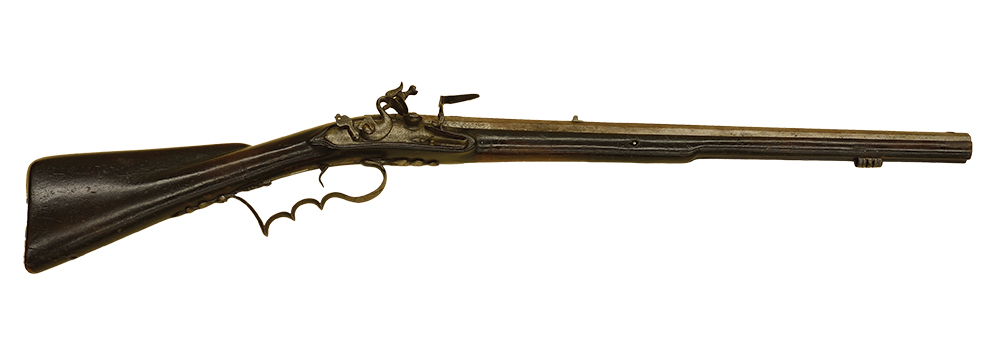
In August 2026, as the nation marks the 250th anniversary of American independence, Landis Valley Village & Farm Museum will open Lancaster Gunsmiths of the Early Republic, a major exhibition exploring the artistry, innovation and historical significance of Lancaster County firearms during the Revolutionary era and the early years of the United States. Presented as part of the national America 250 commemoration, the exhibition will be accompanied by a robust lecture series that situates Lancaster’s gunsmiths within the broader political, economic and cultural transformations of the 18th and early 19th centuries.
At its core, Lancaster Gunsmiths of the Early Republic is a story about craft — about the hands, tools and traditions that shaped some of the most distinctive firearms produced in early America. Long before industrialized arms manufacturing, Lancaster’s gunsmiths worked as independent artisans, forging barrels, carving stocks, engraving brass and assembling rifles one piece at a time. The resulting firearms were not merely weapons; they were functional works of art, objects that reflected the values, aesthetics and practical needs of a rapidly changing society on the colonial frontier and in the expanding American hinterland.
Lancaster County and the Rise of an American Craft Tradition
During the mid-18th century, Lancaster County emerged as one of the most important centers of gunmaking in British North America. Home to a large and diverse population of German-speaking immigrants — often referred to collectively as Pennsylvania Germans — the region brought together Old World craft traditions and New World demands. Many of Lancaster’s gunsmiths were trained in European metalworking and woodworking techniques, yet they quickly adapted their skills to the realities of life in North America: long distances, rugged terrain, reliance on hunting for subsistence, and the growing need for defense amid imperial conflict and frontier warfare. This convergence of skill and necessity gave rise to a distinctly American firearm tradition. Lancaster rifles were typically lighter, longer and more accurate than their European counterparts. Their long, rifled barrels — cut with spiral grooves — imparted a stabilizing spin to the bullet, dramatically improving accuracy over smoothbore muskets. While the rifle’s military limitations were real, especially in terms of rate of fire, its precision made it indispensable for hunting and for certain forms of irregular warfare during the Revolutionary era.
Artistry in Wood, Iron and Brass
What distinguishes Lancaster firearms most clearly is their extraordinary level of artistic refinement. Far from being utilitarian objects alone, these rifles were canvases for personal expression and regional style. Curly maple stocks were carefully shaped and often finished to highlight dramatic grain patterns. Patch boxes — functional compartments built into the buttstock — were crafted from brass and engraved with intricate geometric or foliate designs. Carving along the forestock and cheek piece added visual balance and movement, while engraved barrels and lock plates demonstrated the gunsmith’s technical mastery. The exhibition highlights the work of prominent Lancaster-area makers such as Jacob Dickert, Henry Gibbs, Melchior Fordney, Nicholas Beyer and others whose rifles survive today as both historical documents and works of art. Each maker developed subtle stylistic signatures, whether in stock architecture, engraving patterns or construction techniques. Collectively, their work established what is now recognized as the “Lancaster School” of riflemaking — an influential design tradition that would shape American firearms for generations.
From Local Workshops to National Influence
The influence of Lancaster gunsmiths extended far beyond the county’s borders. As settlers moved south and west, they carried Lancaster-made rifles and Lancaster-trained techniques with them. These forms and methods helped shape later, more widely known styles, including what would come to be popularly called the “Kentucky long rifle.” Although the term itself is a 19th-century invention, the rifle’s origins lie firmly in Pennsylvania — particularly in Lancaster County.
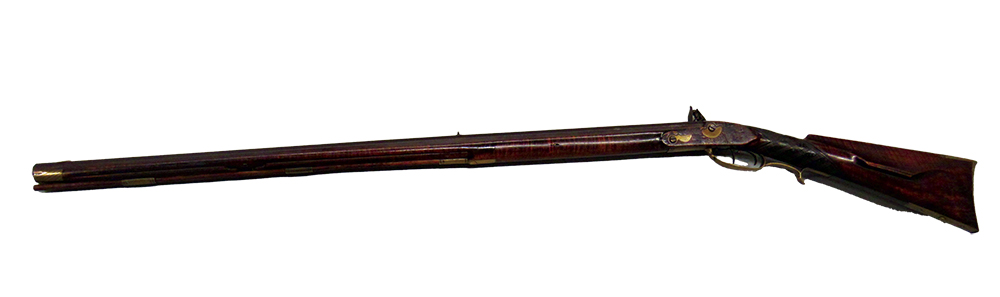 By tracing these connections, the exhibition demonstrates how local craftsmanship contributed directly to the development of a national material culture. Lancaster rifles became models for later makers in Virginia, the Carolinas, Kentucky and beyond. Their balance of accuracy, durability and beauty established a standard that defined the American rifle well into the 19th century.
Firearms and the Founding of America
Lancaster Gunsmiths of the Early Republic also situates these objects within the larger historical moment of the American Revolution and the founding of the United States. Firearms played a critical role in the conflict — not only as tools of war, but as symbols of independence, self-reliance and civic responsibility. In a society where militias were composed of citizen-soldiers, locally made rifles embodied the connection between community, craftsmanship and resistance to imperial authority.
Lancaster’s gunsmiths operated at the intersection of politics and production. Their workshops supplied arms to local militias, individual soldiers and civilians during periods of conflict and uncertainty. At the same time, they were small business owners responding to market demand, balancing artistry with efficiency in an era before standardized parts or mass production. Through these lenses, the exhibition invites visitors to consider how everyday objects — crafted by local hands — became part of the larger machinery of revolution and nation-building.
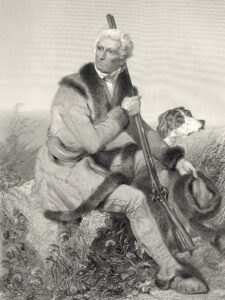
Legends and stories about Pennsylvania-born pioneer Daniel Boone and his exploration and settlement of Kentucky typically portray him with his trusty long rifle.
Wikimedia Commons
Tools of Survival on the Frontier
Beyond their military associations, Lancaster rifles were essential tools of daily life on the colonial frontier. For farmers, hunters and settlers, a rifle meant food on the table, protection from predators, and a degree of security in an unpredictable environment. The exhibition emphasizes this dual identity: rifles as both refined artistic objects and practical necessities. Their elegance did not detract from their function; rather, it reflected the pride of ownership and the value placed on wellmade tools in early American society.
By examining wear patterns, repairs and modifications, the exhibition reveals how these firearms were used, maintained and passed down through generations. Such evidence underscores their role as long-term investments — objects meant to endure, adapt and serve families and communities over decades.
America 250 and a Continuing Conversation
Opening during the America 250 commemorative period, Lancaster Gunsmiths of the Early Republic is designed not as a static display, but as a platform for ongoing interpretation and dialogue. The companion America 250 lecture series will bring scholars, curators and craftspeople to Landis Valley to explore themes such as Revolutionary-era industry, Pennsylvania German material culture, frontier life, and the evolution of American firearms design.
Together, the exhibition and lecture series invite visitors to reconsider familiar narratives of the American founding through the lens of craftsmanship. They highlight the ways in which independence was built through not only ideas and documents but also labor, skill and material culture — through the forged barrels, carved stocks and engraved brass of Lancaster’s gunsmiths.
A Legacy Forged in Lancaster
Ultimately, Lancaster Gunsmiths of the Early Republic tells a story of place and people. It affirms Lancaster County’s central role in the development of American firearms and underscores the broader significance of early American artisanship. These rifles — beautiful, precise and purposeful — stand as enduring reminders that the founding of the United States was shaped as much by craftsmen at their benches as by statesmen at their desks.
As visitors move through the exhibition, they encounter not only historic firearms but also the legacy of a community whose skill and ingenuity helped define a nation at a transformative moment in its history.
Lancaster Gunsmiths of the Early Republic will be on exhibit at Landis Valley Village & Farm Museum from August 2026 through December 2027. For more information on hours, admission, tours and lectures, visit landisvalleymuseum.org.
Shawn Gladden is site administrator at Landis Valley Village & Farm Museum.