Jacob M. Koehler and the Education of Deaf and Hard of Hearing Children
Written by Alli Davis in the Marking Time category and the Fall 2023 issue Topics in this article: American Sign Language (ASL), deaf, deaf children, Jacob M. Koehler, lipreading, Pennsylvania Oral School for Deaf Mutes, Scranton, Scranton School for Deaf and Hard of Hearing Children, Scranton State School for the Deaf, York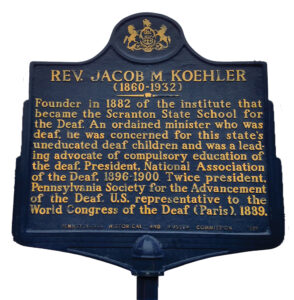 The current Scranton School for Deaf & Hard of Hearing Children got its start in 1880, thanks to Rev. Jacob M. Koehler (1860–1932). He established the school at a time when an expanding network of specialized institutions across the state and nation were created to educate young children with disabilities and provide them with necessary life skills. This network included the Pennsylvania Institution for the Instruction of the Blind in 1832 (later the Overbrook School for the Blind in 1946) and the Western Pennsylvania School for the Deaf in 1869.
Born in York in 1860, Koehler lost his hearing at the age of 12 from spinal meningitis. He was fortunate to continue his education in Philadelphia at the Pennsylvania School for the Deaf, the only facility in the state for deaf and hard of hearing individuals at that time. The school emphasized mastery of spoken English usually through speechreading, or lipreading. At the time, American Sign Language (ASL) was criticized, mostly by the hearing community, as socially ostracizing and a hindrance to a productive life. Later, Koehler and others in the deaf community would advocate for both methods.
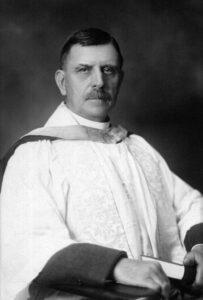
Rev. Jacob M. Koehler, founder of the Pennsylvania Oral School for Deaf Mutes, now the Scranton School for Deaf & Hard of Hearing Children.
Scranton School for Deaf & Hard of Hearing Children
In 1877 Koehler, determined to become a minister, entered the National Deaf-Mute College (now Gallaudet University, a leading institute of higher education for deaf and hard of hearing individuals) in Washington, D.C. There he studied multiple languages in spoken form and learned ASL. After only two years at the college, he was forced to leave because of family and financial troubles. His time there, however, strongly influenced his concern for uneducated deaf children and his decision to open the Pennsylvania Oral School for Deaf Mutes out of a church basement in Scranton.
Eventually the school moved to a 10-acre site donated by a local coal company. Koehler pushed for teaching sign language at his school, but the school board fundamentally opposed it, leading Koehler to resign in 1881.
Koehler then became a roving teacher and completed his ordination to the Episcopal priesthood. He evangelized to a growing deaf community in the Episcopal Diocese of Central Pennsylvania and eventually rose to international prominence as a priest and disabilities advocate.
Koehler became one of the most effective interpreters of Deaf culture to a larger hearing audience. In 1884 he submitted a resolution to the Pennsylvania Society for the Advancement of the Deaf (PSAD) for compulsory education of deaf children. PSAD presented the resolution to the Pennsylvania legislature, resulting in a bill to mandate education for deaf children.
Koehler was twice president of PSAD and president of the National Association of the Deaf from 1896 to 1900. In 1889 he represented the U.S. at the World Congress of the Deaf in Paris.
By 1913 the school for the deaf in Scranton that Koehler founded came under state control and was renamed the Pennsylvania State Oral School for the Deaf (in 1976 it was renamed the Scranton State School for the Deaf). In 2009 the state transferred the rights to administer the school to the Western Pennsylvania School of the Deaf and it was renamed again to the Scranton School for Deaf & Hard of Hearing Children.
The Pennsylvania Historical Marker for Rev. Jacob M. Koehler was dedicated on June 10, 1999, and was installed at the school on 1800 North Washington Avenue in Scranton.
Alli Davis is the coordinator of the Pennsylvania Historical Marker Program.