
Haym Salomon, Financier Who Helped Fund a Revolution
Written by Alli Davis in the Marking Time category and the Winter 2026 issue Topics in this article: American Revolution, finance, Haym Salomon, Jews, Mikveh Israel, Pennsylvania Constitution of 1790, Pennsylvania Historical Marker Program, Philadelphia, Robert Morris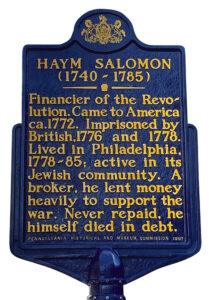 The story of Haym Salomon (1740–85) is both inspiring and deeply bittersweet. One of the most successful financiers of the American Revolution, he directly supported the final victories of the Continental Army, yet he died in poverty.
Born in Leszno, Poland–Lithuania, to a Jewish family, Salomon traveled across Western Europe in his early adulthood, learning multiple languages and acquiring skills in finance. By 1775, he had moved to New York City, where he quickly established himself as a commission merchant and financier aligned with the Patriot cause. These activities attracted the attention of the British authorities, and in 1776 he was arrested on charges of espionage.
Salomon was further detained on a ship to serve as an interpreter for German mercenaries fighting for the British; however, he used this as an opportunity to help fellow prisoners escape and to persuade some of the German troops to abandon the British and join the American cause. He was eventually released but arrested again in 1778 for his involvement in a plot to burn the British Royal fleet in the New York Harbor. This time he escaped, avoiding a death sentence.
Salomon then fled to Philadelphia, where he opened a brokerage office. Quickly recognized for his abilities, he was appointed a financial agent of the French consul and paymaster for French forces in America. Beginning in 1781, Salomon began working closely with Robert Morris (1734–1806), the newly appointed superintendent of finance for the Continental Congress. At this point in the war, soldiers had gone months without pay, morale was collapsing, and the government’s credit was exhausted. At a critical moment, Salomon raised $20,000 through the sale of bills of exchange. This infusion of funds allowed George Washington to launch the Yorktown Campaign, the final major military action of the war, culminating in the British surrender in October 1781.
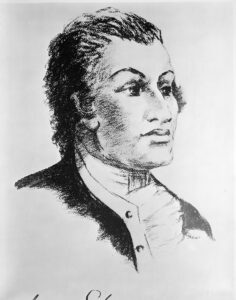
Haym Salomon
National Archives and Records Administration
From 1781 to 1784, Salomon helped secure and manage more than $600,000 for the revolutionary cause, the equivalent of $17 million as of this writing. While much of his work involved arranging and facilitating financial transactions, he also made personal loans to those most severely impacted by the war and to key figures such as James Madison and James Wilson.
Salomon’s dedication to liberty extended beyond military and political matters. As a committed member of Philadelphia’s Jewish community, he was also a vocal advocate for religious freedom. In 1783, he joined a campaign to remove the religious test oath for officeholders from Pennsylvania’s state constitution. Originally designed to weaken the political influence of Quakers, who opposed taking oaths, the test oath also affected Jews and other non-Christians because of the requirement of affirming belief in the New Testament. Salomon’s associate Robert Morris introduced the legislation that eventually ended this discriminatory practice in the Pennsylvania Constitution of 1790.
Also, as an active member of Congregation Mikveh Israel, the city’s historic synagogue, Salomon made the largest individual donation toward the construction of its main building in 1782. He also served as the treasurer to the Society for the Relief of Destitute Strangers, the first Jewish charitable organization in Philadelphia.
Paradoxically, Salomon’s final years ended in financial hardship. The majority of his wartime lending to the government had not been repaid by his death in 1785 at 44 years old. He died penniless, leaving his family destitute and fighting for repayment for generations.
Despite this tragedy, Salomon’s contributions were critical to the success of the American Revolution. His financial skills, personal sacrifices, and commitment to both political liberty and religious freedom mark him as one of the Revolution’s unsung heroes. He is buried at the Mikveh Israel Cemetery in Philadelphia.
The Pennsylvania Historical Marker for Haym Salomon was installed at 45 North 5th Street in Philadelphia and dedicated on September 7, 1997.
Alli Davis is the coordinator of the Pennsylvania Historical Marker Program.