
Gasping for Air: The Donora Smog Disaster
Written by Peter Durantine in the Features category and the Fall 2023 issue Topics in this article: American Steel and Wire, Andrew W. Mellon, Brian Charlton, Donora, Donora Smog, Donora Smog Museum, Donora Zinc Works, industry, Lukasz Musial, Mark Pawelec, Monongahela River, pollution, public health, Stan Musial, United States Steel Corporation, Webster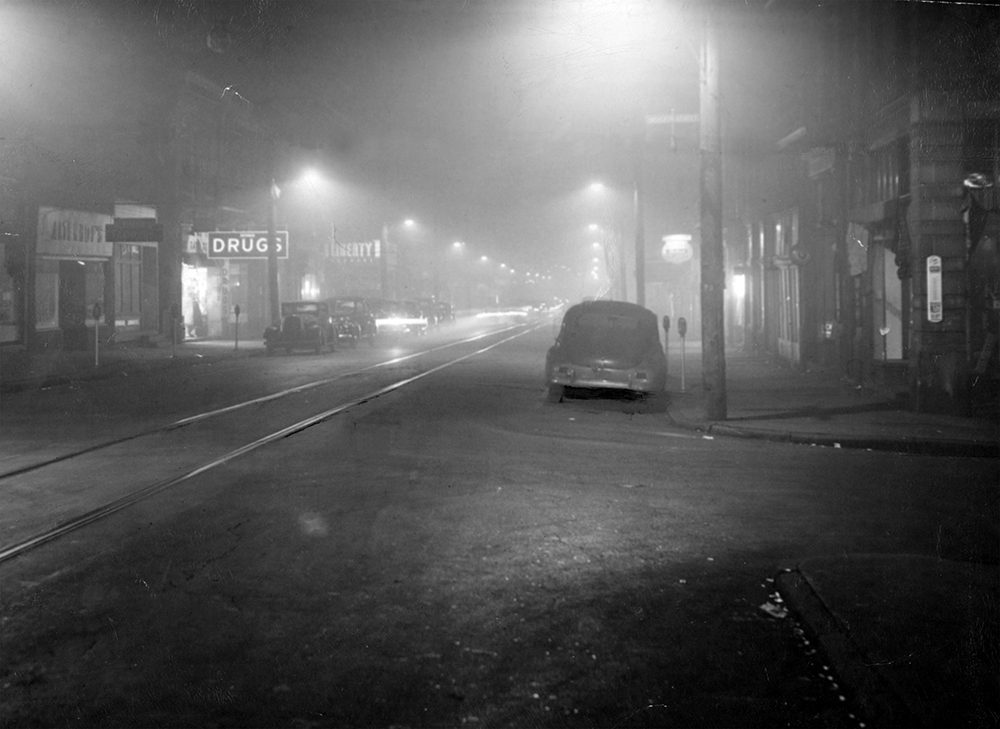
The smog, trapped by a temperature inversion, veils a street in downtown Donora.
Pittsburgh Post-Gazette
They couldn’t breathe.
During five days in autumn of 1948, the industrial town of Donora, Pennsylvania, became an environmental and public health nightmare when what the national media called a “killer smog” took the lives of nearly two dozen people who died struggling to breathe.
“We have had the worst fog in the last four days in [the] history of Donora. About 18 persons have died from as[th]ma from the fog and acid fumes from [the] Zinc Works,” resident and coal miner Walter Gilmore wrote in his diary on Saturday, October 30.
Gilmore’s two sentences offered a concise summation of a disaster that would forever change this Washington County town, bring world attention to industrial pollution and polluters, and eventually help in the creation of state and federal environmental protection laws such as the Clean Air Act of 1970.
“Air pollution hit the national headlines in the 1940s with the Donora, PA episode and Los Angeles smog,” wrote Arthur C. Stern in a 1982 article for Journal of the Air Pollution Control Association. “The former caused a ripple of concern but was soon forgotten, but the latter continued, grew in intensity, and precipitated the expenditure of millions of dollars for research as to its cause and cure — first by the City and County of Los Angeles, and by local industry, and later by the State of California.”
Donora, however, caused more than concern and was never forgotten. To this day, it is remembered by the town’s residents, the industry whose smokestacks spewed the skies overhead with toxins, public health officials, writers, and the physicians, environmentalists and scientists who continue to study the disaster. Even contemporary filmmakers such as the producers of the Netflix series The Crown included Donora in a 2016 episode to contrast London’s Great Smog event of 1952 that resulted in an estimated 4,000 deaths. Forty-seven years after Donora’s smog, in October 1995, the Pennsylvania Historical & Museum Commission erected a marker commemorating the disaster along Meldon Avenue (PA 837) near Fifth Street in Donora.
“The smog disaster, in turn, was one of the events that catalyzed the first steps taken nationally to reduce the effects of pollution,” according to Elizabeth T. Jacobs, Jefferey L. Burgess, and Mark B. Abbott in a 2018 article in American Journal of Public Health. “In the ever-increasingly industrial United States, efforts to curb pollution had been under way within cities, counties and states, finally culminating with the passage of the Clean Air Act.”
Little more than a year after the event, in December 1949, President Harry S. Truman, influenced by Donora, directed the secretary of the interior to organize the U.S. Technical Conference on Air Pollution, which opened in May 1950 in Washington, D.C. It was the first time the federal government acknowledged the health issues caused by air pollution. More than 750 experts participated. The city’s Evening Star reported the message Truman delivered at the conference: “There is an urgent need to bring to bear on the problem of air pollution all the scientific knowledge at the command of the industry, Government and scientific institutions.”
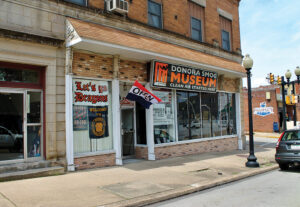
The Donora Smog Museum gets thousands of visitors each year, including researchers, writers and student groups.
Photo, Peter Durantine
Despite growing health and environmental concerns, however, it was not until five years later that Congress, after considerable debate, passed the Air Pollution Control Act of 1955, the first of many pieces of legislation that addressed man’s influence on the nation’s natural environment.
“Why do people still visit here?” Donora resident Mark Pawelec asks. “We do get different people that are interested in the environment, against pollution of any kind, and now we get the climate change folks because it’s all about emissions from the different plants causing it.”
Before the government started to respond to air pollution with legislation and regulation, Americans who lived and worked in industrial communities such as Donora, which is located along the winding Monongahela River about 27 miles south of Pittsburgh, could see what pollution did to the landscapes of their communities.
From the moment that the furnaces of U.S. Steel’s Donora Zinc Works and its American Steel & Wire plant fired up in the borough, spewing toxins from lines of tall smokestacks, most vegetation in town — and in the village of Webster across the river and downwind from the works — ceased and did not return until the mills closed decades later.
“I grew up on the south end of town, higher up on a hill, so from the Zinc Works, as the crow flies, it’s a good 2 miles away,” Pawelec tells me. “I grew up there in the ’60s and there was no vegetation there to speak of. There were weeds, but there were no trees. It was kind of moonscape up there.”
Pawelec, who still lives in Donora, and Brian Charlton, a retired history teacher who originally came from a Mon Valley community nearby, have embraced their mission to promote local economic development and ensure that the memory of the catastrophe is never forgotten. They run the Donora Smog Museum, located inside an old storefront on McKean Avenue, near 6th Street, which was the epicenter for emergency responders on those fateful October days in 1948. Since the museum’s opening in 2008 to commemorate the 60th anniversary of the event, Pawelec and Charlton have welcomed thousands of visitors and collected and archived a vast trove of documents, photographs and “Donora artifacts.”
“People are interested, especially about the smog disaster and Stan Musial,” Charlton says, explaining the museum’s purpose and popularity. “Those are the two big things that people come for, and the two walking tours we do of Eldora Park [formerly a trolley park 100 years ago but now an abandoned overgrown wooded area] and Cement City [a historic district of poured-in-place concrete houses built in 1916–17 to house workers]. They come from all over.”
Ironically, Baseball Hall of Famer and St. Louis Cardinals outfielder Stan Musial, born and raised in Donora, had been named MVP in 1948, just weeks before his father, Lukasz Musial, died from smog-induced respiratory failure. “You’re going to have deaths following the smog disaster over the course of time,” Charlton says.
When I met with Pawelec and Charlton in late April 2022, they just finished conducting several weekends of tours. We sat in part of the old store, where they laid out a makeshift auditorium for presenting the story about the catastrophe in a slideshow. They also invite science experts to lecture about their research on the disaster or the environment.
A few days earlier, a local TV news station was in filming about the 1948 smog incident as part of a series on weather-related disasters in western Pennsylvania such as tornadoes. In July, they welcomed an environmental science professor from the University of Maryland. And then there’s the steady flow of visitors curious about what happened those five fateful days.
“People like yourself are not coming to spend two minutes in the museum, buy a T-shirt and go,” Charlton says. “Writers, researchers—they keep coming back to us for information.”
The museum relies on local historians to help with the archives and serve as speakers. “We just buried one yesterday, 90-year-old Dr. Charles Stacey who was a longtime Donora resident and historian,” Charlton says. Stacey served on the museum committee. “We’re down to two now, actual professional historians.”
Pawelec and Chartlon are careful in responding to inquiries about interviews, largely to guard the privacy of the last of the residents who lived through the catastrophe. “Please keep in mind that a 90-year-old person 74 years ago was just 16 at the time,” Pawelec tells me. “Anyone that was an adult in 1948 that we’ve interviewed in the past is more than likely deceased.”
Birth of a Steel Mill Town
The story of the Donora smog disaster begins decades before the actual event, before the town existed, when the steep hills and floodplain along the Monongahela were farmland with a family farm and a mill — an idyllic setting until 1900 when all that would rapidly change. “If you came here one year, you would see fields of rye or corn; the next year you came, you would see a wire works,” Charlton says. “It would be like, ‘Whoa! What happened?’ And this would be all along the river.”
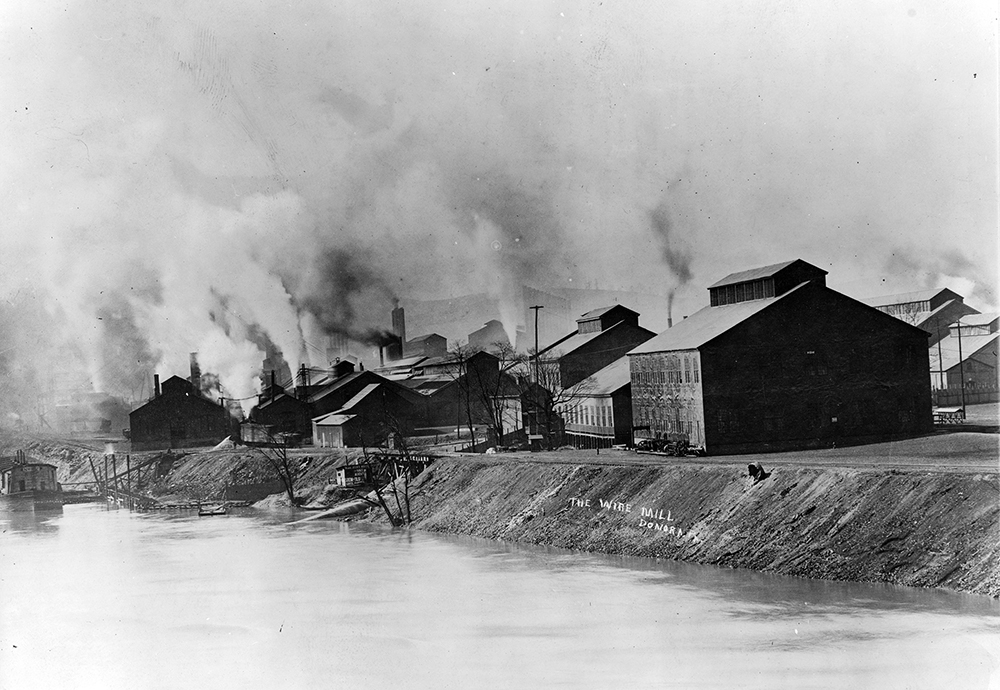
Smoke and exhaust surge from the American Steel & Wire plant on the banks of the Monongahela in Donora in this 1910 photograph.
Library of Congress Prints and Photographs Division
As the calendar page flipped to a new century, a businessman from Indiana, William Donner (1864–1953), eyed the farmland. He helped establish the town of Monessen, across the river and a mile south, and now he wanted to build a specialty steel mill and a company town. The mill would manufacture materials for the construction of homes, commercial buildings and infrastructure for the Midwest and Northeast. “Nails, wires, rods — those building products needed at the turn of the 20th century for not only expansion out west, but urban expansion,” Charlton says. “There’s a tremendous demand for that and he wants to tap into that market.”
As Charlton narrates, Donner becomes friends with Andrew Mellon (1855–1937), the banker and later U.S. secretary of the treasury from 1921 to 1932. The Mellon family of Pittsburgh began amassing a fortune in banking and manufacturing starting around 1870. Donner needed the backing of such a powerful financier for the scale he imagined for his steel works. “At the time, 1900, Andrew Mellon is getting married to Nora McMullen of England. She’s 20 years old, he’s 44,” Charlton says.
Nora had no desire to marry the Mellon family scion, but her father, Alexander McMullen, a wealthy merchant, arranged the union. “This is a marriage of two economic forces coming together.”
Following the nuptials, Mellon and Donner focused on building a company town that would house the workers of the steel mill. “Mr. Donner wants to name the town ‘Mellon Town’ or ‘Mellonville,’ and Mr. Mellon doesn’t want his name to be part of the town, so he suggests, ‘Mr. Donner, you put your name and also my new bride, Nora’s name, together,’” Charlton explains. “That’s where we get the name Donora, and we are the only Donora that we know of in the world.”
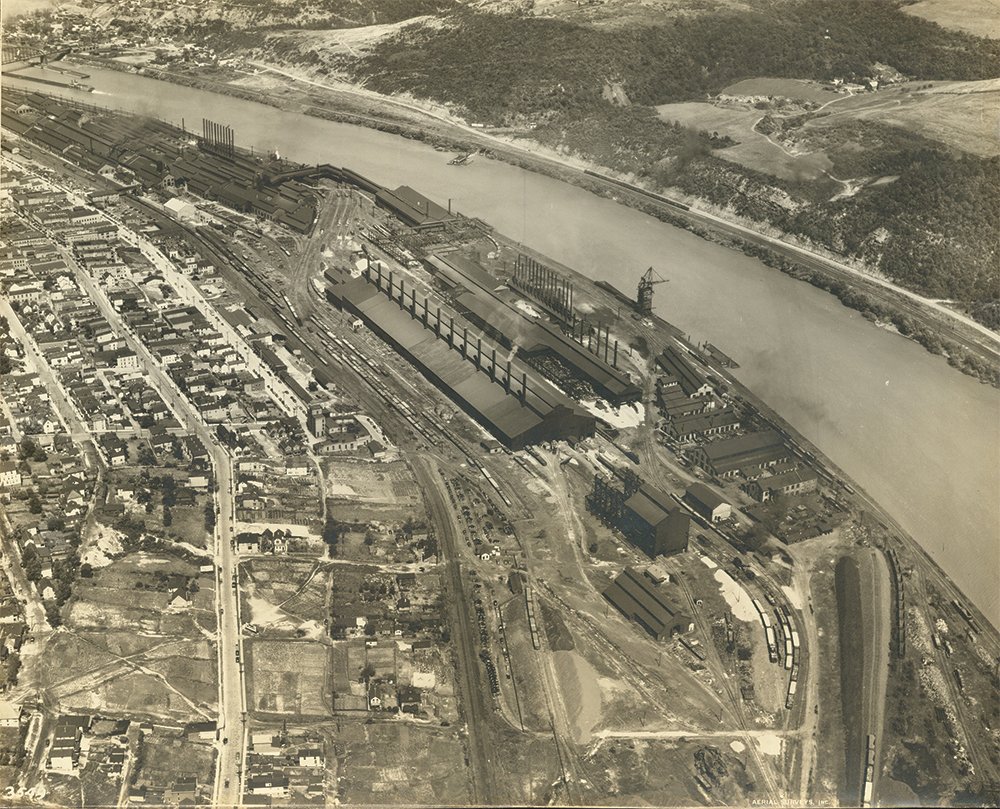
A mid-20th century aerial view of Donora and the industrial complex along the river.
Donora Historical Society
Running nearly 3 miles along the river’s horseshoe-shaped west bank was the industrial complex of blast furnaces, open-hearth furnaces, a wire works, a rod mill, a nail mill, a blooming mill, a zinc works and an acid plant. The Pennsylvania Railroad and Monongahela River barges, which brought coal to feed the furnaces, served the vast complex. “This is [Andrew] Carnegie’s vertical integration in action. Everything you need for production is there. You have shipping routes with the railroad, and you have the river as well to ship on. They don’t start shipping by truck until really after World War II,” Charlton says.
Within two years of the mill’s opening, photographs that Charlton flashes on the screen show thick smoke pouring from the stacks, clouding the skies. “You can see the industrial complex and the zinc works and the effect that it is having on the environment,” he says.
A photograph of a beautiful new large house just across the street from the zinc works appears on screen. Charlton narrates: “This is opening day and the superintendent’s house, 1904. It looks like a nice sunny summer day. We have leaves on trees, we have grass, and of course, then, a few years later, this is what the backend of that same house looked like because basically this [smoke from the stacks] kills all the vegetation. Oxygen is being taken out of the air by the zinc smelting process. The fluoride/fluorine and chlorine gases are extracting all the oxygen and so the plants don’t have any opportunities to survive. I’m sure the superintendent’s wife said, ‘This is no place to live, we’ve got to get out of here,’ and that’s what they do. They leave and they give this [house] actually to the Spanish community and this becomes the Spanish Club. In fact, the Spanish are going to put a swimming pool here in the 1950s, and it’s a place a lot of Donorans grew up with.”
Photos taken just before the zinc works went up show a pastoral scene of baseball games, mules grazing, and across the river the village of Webster, where there are apple orchards, sheep farming, a flour mill and coal mining.
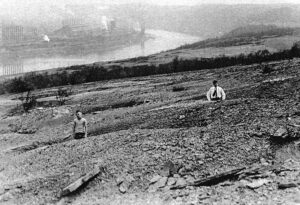
An early 20th-century view of smog-scarred land in Webster, across the Monongahela River from Donora.
Donora Historical Society
The Donora Smog Museum curators are thankful to Bruce Dreisbach, a quality control engineer hired at American Steel & Wire in 1905. His immense collection of glass-plate negatives, taken in the early decades, chronicled the town and industrial operations. They are now owned by the museum. “The mill would have him take pictures of cross sections of rods and things like that for quality control, but then they gave him the assignment of photographing Donora and he took it to heart,” Charlton says. “We have in our collection well over 2,000, maybe 3,000, different glass-plate negatives of his that were found in his apartment after his wife died. He died in 1959, but his wife [Lulu] lives on until 1986; she was 104 years old when she died.”
The zinc works’ billowing stacks, which emitted toxins that devastated vegetation along both sides of the river, contributing to smog deaths years later, appear in Dreisbach’s photos. “I’ve interviewed a lot of zinc workers over the years, and they used to talk about walking to work to get to the gate and they would walk through, they would say, ‘6 inches of dust or 6 inches of mud,’” Charlton recalls. “There was no in-between. It was either really dusty or really muddy. It’s a very bleak and barren kind of existence for them. Zinc workers would say, ‘If a bird flew into one of the smelter houses and didn’t turn around immediately, it wasn’t making it out the other end.’ A lot of dead birds [were] down there; they said they found them all the time.”
The Smog Disaster
In the early morning hours of Tuesday, October 26, 1948, the sky was clear, the winds light and almost calm — pleasant weather conditions that Donora’s residents enjoyed the evening before, just as the sun started setting behind the Mon Valley’s western mountains. But this was the start of a temperature inversion, a meteorological event that occurs when air near the ground cools more quickly than the air aloft. And because warm air rises, the cool air under the inversion cannot escape. Like putting a lid on a jar, the inversion traps smoke and pollution in the cool air, according to the U.S. National Oceanic and Atmospheric Administration.
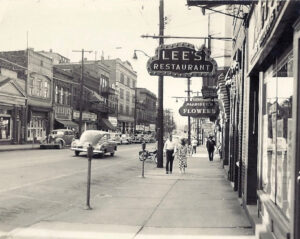
A clear day in Donora in the 1940s, before the smog disaster.
Donora Historical Society
As the steel mill belched red, black, white and yellow smoke, the temperature inversion settled over the town that morning. Fluorine gasses and sulfur trioxides flowed from the stacks at the zinc works, where 10 furnaces burned around the clock, filling the stagnant air. The toxic fog, unable to dissipate into the atmosphere, would thicken and soon engulf the town.
Meanwhile, Donora’s 14,000 residents looked forward to the Halloween Parade on Thursday night, the high school football game against rival Monongahela on Saturday afternoon, and Trick or Treat that evening. By Wednesday, the thickening fog limited visibility more than anyone could remember, according to a 2018 account by the Donora Historical Society and Donora Smog Museum. As smoke poured from the stacks, streetlamps burned all day and drivers were forced to use their headlights.
On Friday morning, resident Mary Holowach made her way through the fog to her job as a “weigher of steel” at the mill. At the 6th Street gate, she heard her coworker’s clicking heels approach and she called out, “I know that’s you Margaret, but I can’t see you. Isn’t this terrible?”
Saturday morning around 7 a.m., the quiet streets belied the panic at the Bell Telephone switchboard office at McKean and 6th. Twenty-one-year-old telephone operator Miriam “Alice” Uhriniak, after a slower-than-usual walk through pea-soup conditions, entered the building (at the time, she was unaware that she was newly pregnant with her first child). She was greeted by a switchboard lit up and a frantic supervisor shouting, “Hurry up, hurry up! Get your set on! Everyone in town is dying!”
Since around 1:30 a.m., the first victims, seven of them, had been dying. The last shortly before Uhriniak arrived at work. While she was busy connecting families of the ill and dying with doctors, pharmacists and emergency responders, five more victims died before noon. Two more deaths followed about an hour later. Five more perished throughout the afternoon. “It was totally chaotic,” says Brian Charlton, who many years later became Uhriniak’s son-in-law. “This community is totally unprepared for a disaster of these proportions.”
Across town, pharmacist Rose Marie Iiams, who had just earned her pharmacology degree from Duquesne University, was “getting requests for all sorts of problems people are having breathing,” Charlton says. “They were inundated with calls.”
Meanwhile, many residents went about their Saturday as they normally did, unaware that some of their neighbors were struggling to breathe and survive inside their homes. Many people attended and cheered the high school football game atop a hill. Whether the air was foggy or clear for the game that afternoon is somewhat disputed among witnesses that Charlton and Pawelec interviewed over the years. “Some people will swear that they could not see the game, and some will swear that you could see the game very clearly,” Charlton says.
Most residents did not react with alarm because, for them, the fog was part of their everyday life. “Most of the people lived in Donora all their lives, and it was smoggy a lot of the time anyway, and that maybe it was just a normal thing,” Pawelec explains.
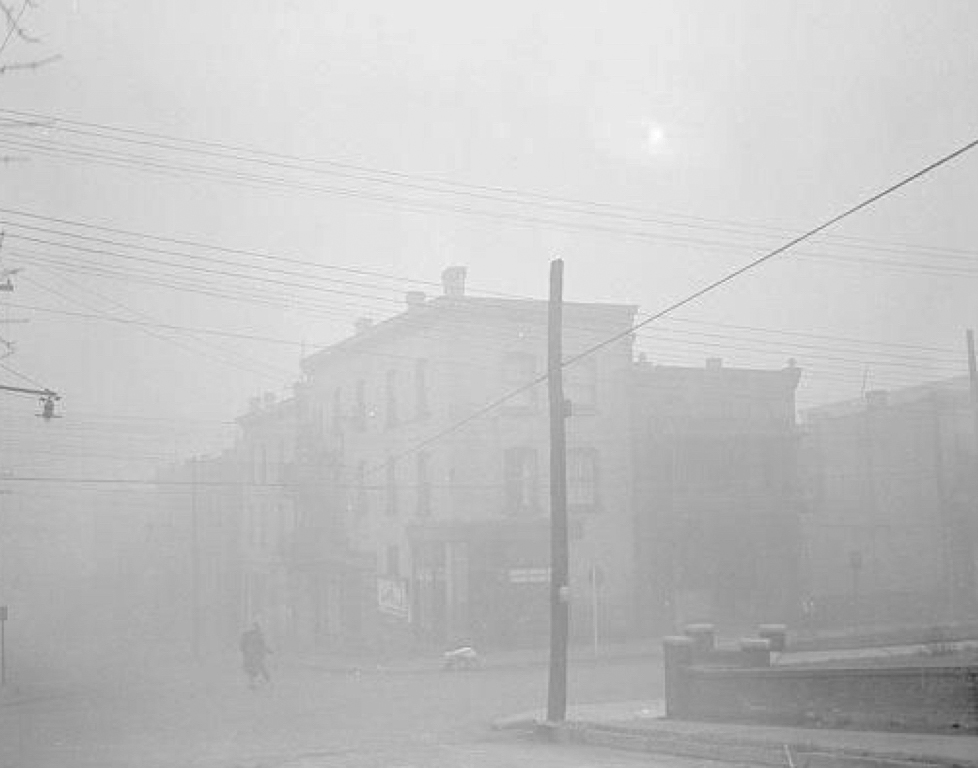
The thick smog envelops a street corner in Donora.
Donora Historical Society
That evening, as Trick or Treaters made their way door to door in their neighborhoods, white-sheet costumes turned yellow from the excessive sulfur in the air, according to the museum’s 2018 account. According to National Geographic, Anthony Massafra, a former mayor who died in 2016 and was a teenager at the time, recalled that people “began to realize something was wrong” during the Halloween parade. “They could hardly see the costumed marchers.”
Throughout the day Saturday and into Sunday, first responders struggled to adequately and effectively respond to a developing human disaster for which they had never trained. They were now learning how to adapt and respond. Two more residents died Sunday. “Everybody was just trying to figure out what their role was in this disaster because there were no really defined roles,” Charlton says.
The Zinc Shakes
Back then, Donora had 11 physicians, all of whom made house calls, then the standard healthcare practice. That Saturday, they started receiving calls from residents who complained of uncontrollable shaking as well as fever, chills, nausea, headache, fatigue — flu-like symptoms. “Everyone who is sick is trying to call a doctor, half of the town is sick, half of the town has the zinc shakes and they don’t know what to do for it,” Charlton says. “People were getting the zinc shakes just from the smog. That was the toxin that was in the air.”
The “zinc shakes,” or metal fume fever, are caused when someone exposed to chemicals such as zinc, aluminum or magnesium oxide inhales the byproduct in fumes emitted through heating certain metals in the manufacturing process. The men in the Donora Zinc Works often experienced these symptoms.
For residents, doctors advised consuming water, ice, milk, oatmeal and a shot of whiskey. Water and ice hydrates the body, and milk and oatmeal absorb some of the toxins, but this remedy was not helpful to zinc workers, says Charlton, “not at the levels these guys are ingesting them.”
Zinc workers were advised to get outside and get fresh air, but the air was laden with heavy smoke from the zinc works. Ironically, during the disaster, the mill was not producing zinc, but the furnaces were still burning, and smoke poured from stacks. “The zinc works changed the whole complexion of the environment here, and so people understood that, and the only way they understood that was because, you know, ‘Geeze, I had a garden last year, now nothing is growing,’” Pawelec explains. “And then the farmers started complaining across the river that their vegetation wasn’t growing. In 1930 the zinc works in Meuse, Belgium, created a disaster, too.”
From December 1 to 5 that year, the same weather event as in Donora, a temperature inversion, coupled with Meuse’s smog-producing zinc works, killed 63 people. Doctors attributed dyspnea, or shortness of breath, as the primary cause of death.
It is unlikely Donora’s residents were aware of what occurred in Belgium 18 years earlier, and despite smoggy skies and denuded land, people were proud to be from Donora. “They were not ashamed of the zinc works at all or the conditions they were living in,” Charlton says. “The people of Donora lived with this in the shadows of all their activities. Everything that they did was in the shadow of the mill.”
The Oxygen Tanks
On Saturday, October 30, the shadow that darkened Donora wasn’t the mill but death from suffocation. Two volunteer firemen, Bill Schempp and Jim Glaros, were hurrying around town on foot, carrying with them a pair of oxygen tanks to help victims as best they could. “The fire company had just introduced the idea of giving its firemen oxygen whenever they had some type of smoke inhalation, so they were experimenting with oxygen,” Charlton says, and points across the main room in the museum. “Jim Glaros’ tank is actually over there. Jim has long since passed away.”
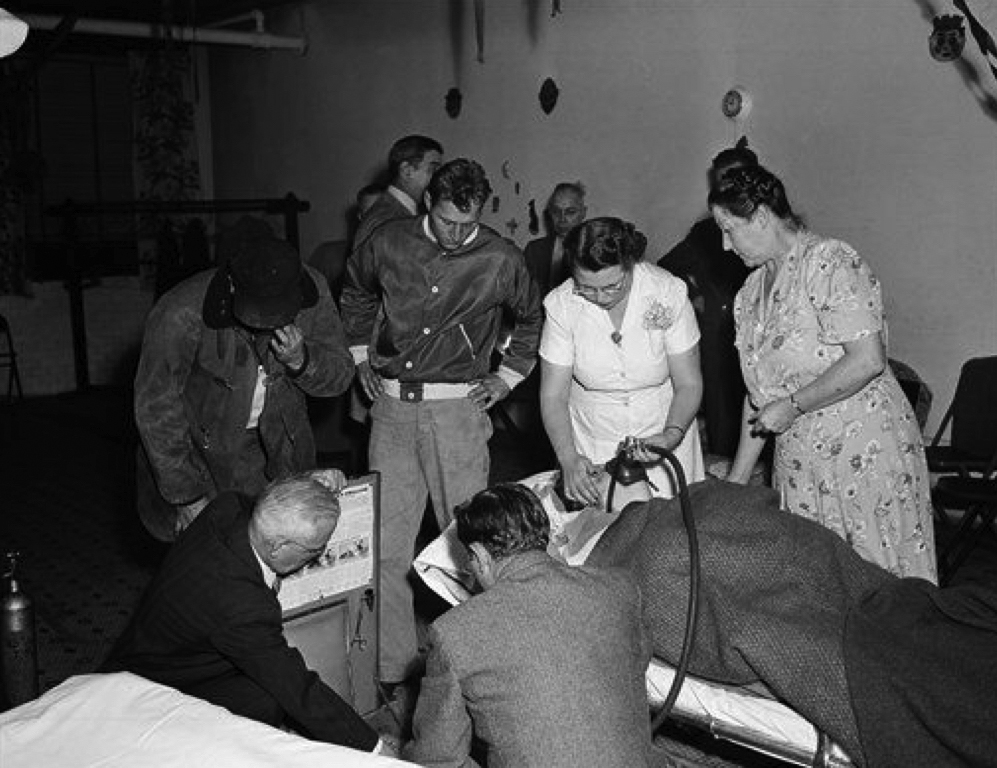
A woman receives oxygen at a makeshift triage center during the smog disaster, October 30, 1948.
Donora Historical Society
Fireman Bill Schempp was a mailman who knew Donora’s streets, which he and Glaros, a contract painter, found difficult to navigate as they answered pleas for oxygen. Charlton recalls his conversations with the two men about their response that day. “The thing that Jim and Bill talked about was the chaos, the panic of the family when they would come into the home, and then the panic and desperation of the family after they would bring their loved one back to consciousness and that person is able to breathe. ‘Ok. We’ve got to move on.’ ‘No! Don’t leave! If you leave the same thing is going to happen.’ And so, they had to tear themselves away. They said that was one of the hardest things that they did over the course of those several days as they would go from house to house on foot because the smog was so thick at that time that they couldn’t take the firetruck out and go from location to location.”
Smog victims were brought to the community center at McKean Avenue and 7th Street because Donora had no hospital, and the infirmary at the mill did not have the capacity for the dozens of people in need of medical attention. “At the community center, which was the old Donora Hotel, they had a large basement, where they created a triage center from where they could maybe get them out of town to one of the hospitals,” Charlton says.
When rains swept away the fog on Monday, about half the town had become ill. Among the dead, 16 lived in Donora, three in Webster, and two in nearby communities. Funeral homes in town ran out of caskets. The dead were buried on a hillside cemetery overlooking the mills, where smoke was pouring from its stacks. “Most of the death certificates of the victims will show asthmatic bronchitis, that’s a very common one,” Charlton says. “And then there’s another one here, vascular disease, having something to do with respiratory or heart related, with all of the death certificates.”
William Rongaus, a Donora physician, called the disaster “murder” in an interview with Life magazine in November 1948. He speculated then that if a rainstorm had not swept through the valley that Monday, the death toll could have reached more than 1,000. “People were dying while I was treating them,” he said in a 1995 interview. “I called it ‘murder from the mill.’ I was mad, but where was I going to go for help?” Fifty more deaths would follow over the ensuing weeks, including Lukasz Musial’s.
Aftermath
Following the disaster, lawsuits were filed against United States Steel, but the company never accepted responsibility. In a statement, the superintendent of the zinc works, Mercer Neal, said, “We do not believe our smoke and fumes are harmful.”
Many in the community were not satisfied with the company’s response. “All the lawsuits were settled out of court, so there was never a point where an executive from United States Steel had to take the stand and be questioned,” Charlton says.
Pawelec says two other zinc works operated in the U.S. at the time — Cherryvale, Kansas, and Spelter, West Virginia; one was on flat land, the other atop a hill. “You never heard about disasters there,” he says.
Like once smog-plagued Los Angeles, Donora sits in a bowl, surrounded by mountains that Pawelec says was part of the reason for the disaster: “The smokestacks of the zinc works were 120 feet high, but our hills around the valley are 400 feet high, and so there is no way the zinc works could ever dissipate those toxic gases unless their smokestacks were 410 feet high.”
In 1957 the zinc works, which employed 8,000 at its peak, closed. The National Smelting Co. of Avonmouth Docks, England, developed an advanced process for zinc that made Donora’s metal extraction procedure obsolete. Sales plummeted. Charlton says the mill was decimated, but the company chose not to reinvest in the new technology. “They said they would cut their losses and move to places like Fairless Hill in Cleveland for the making of nails and rods,” he says. “By 1966, everything is gone.”
In 2008, among the guest speakers at opening ceremonies for the Donora Smog Museum, was Dr. Devra Davis, a former resident whose 2002 book, When Smoke Ran Like Water: Tales of Environmental Deception and the Battle Against Pollution, featured Donora and the 1952 smog in London. She confirmed evidence that fluorine gas produced by the zinc works’ smelting process and trapped by the weather inversion was responsible for the 1948 deaths.
Davis, former epidemiology professor at the University of Pittsburgh Graduate School of Public Health, was 2 years old at the time of the disaster. She said an autopsy on one of the victims found lethal levels of fluorine in the body. “Donora was tragic, but it allowed us to understand how to avoid such tragedies in the future. That’s the rationale behind public health research.”
Davis said at the museum’s opening, “There are Donoras happening today in areas of India and China. . . . We can’t go back, but we can and must warn those living under similar conditions today.”
Further Reading
Davis, Devra. When Smoke Ran Like Water: Tales of Environmental Deception and the Battle Against Pollution. New York: Basic Books, 2002. / Jacobs, Elizabeth T., Jeffrey L. Burgess and Mark B. Abbott. “The Donora Smog Revisited: 70 Years After the Event That Inspired the Clean Air Act.” American Journal of Public Health 108, S2 (April 2018): S85–S88. / Mishkin, Sidney. Memories of Donora: Growing Up Jewish in a Western Pennsylvania Steel Town. Self-published, 2018. / Ross, Benjamin, and Steven Amter. The Polluters: The Making of Our Chemically Altered Environment. New York: Oxford University Press, 2010. / Stacey, Charles F., Brian Charlton and David Lonich. Donora. Charleston, SC: Arcadia, 2010. / Stern, Arthur C., and Emeritus Professor. “History of Air Pollution Legislation in the United States.” Journal of the Air Pollution Control Association 32, no. 1 (1982): 44-61. / Stewart, Wayne. Stan the Man: The Life and Times of Stan Musial. Chicago: Triumph Books, 2010.
Peter Durantine, a writer and journalist for more than 30 years, lives in Hummelstown, Dauphin County. His previous features for Pennsylvania Heritage are “Quecreek: Remembering the Remarkable Mining Rescue 20 Years Later” (Summer 2022) and “The Man for the Moment: Tom Ridge and the 9/11 Inflection Point” (Summer 2021).