
From the Executive Director
Written by Andrea Lowery in the From the Executive Director category and the Fall 2023 issue Topics in this article: geography, Keystone Historic Preservation Grant, Pennsylvania Historical and Museum Commission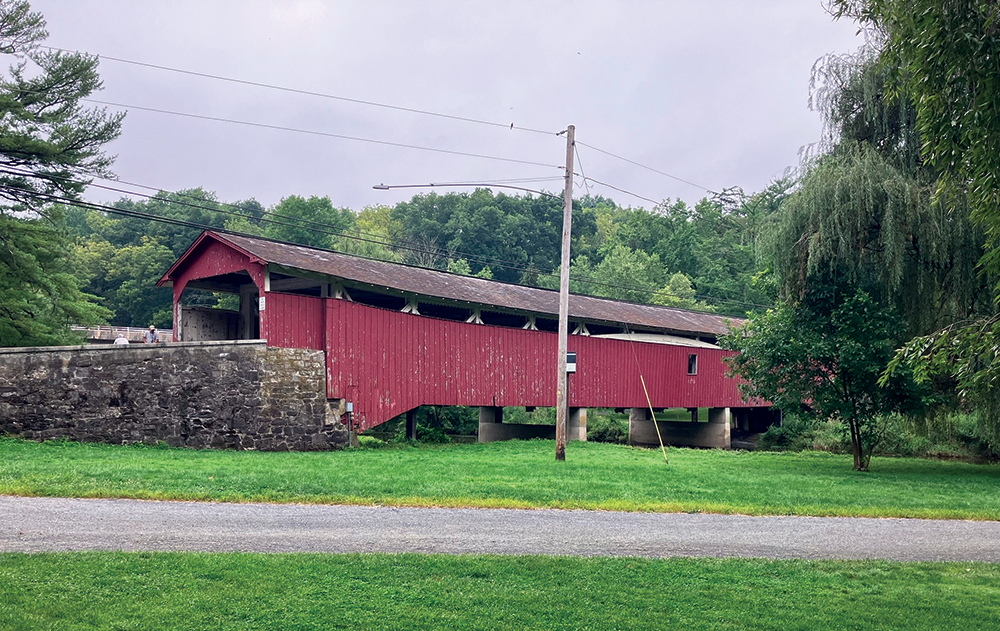
Bogert Covered Bridge in Allentown is one of the more than 200 covered bridges in Pennsylvania.
City of Allentown / Photo by Bryne Heffner-Bair
The American philosopher Edward S. Casey examines the ideas of place in Western thought. Although much of his work is a challenging read, he wrote the following in very plain language: “Whatever is true for space and time, this much is true for place: we are immersed in it and could not do without it. . . . We are surrounded by places. We walk over them and through them. We live in places, relate to others in them, die in them. Nothing we do is unplaced.”
I was recently asked to describe Pennsylvania and its sense of place. Of course, there is no one Pennsylvania, and that is part of what gives it complexity and beauty. In my travels across the commonwealth, I am constantly amazed by its variety: the shady forests of the Northern Tier, the rolling hills of the Piedmont, the mountains of the Laurel Highlands, and the sandy shores of Lake Erie; the urban centers of Philadelphia and Pittsburgh; the charming gas-lit main street of Wellsboro, the scenic downtown of Jim Thorpe, and the river town of New Hope; the iconic Fallingwater and Millionaires’ Row in Williamsport; Eckley Miners’ Village and Pittsburgh’s Carrie Furnace.
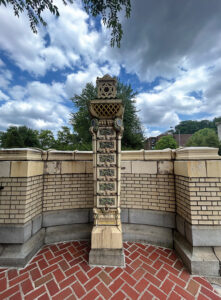
This is one of the two torchieres that stand at the entrance of Rodef Shalom Congregation in Pittsburgh.
Rodef Shalom Congregation, Pittsburgh / Photo by Kate Kim
Each area has its own distinct identity. Its geography, built environment, and natural environment, enhanced by the local culture, come together to create a unique memorable place. Of course, given all those variables, no single entity or state agency is charged with preserving this sense of place. But PHMC has the privilege of helping preserve landscapes, objects and buildings — from the elaborate to the utilitarian, the high style to the vernacular — that contribute to the unique character of Pennsylvania places. Some of the projects the agency has helped fund this year through its Keystone Historic Preservation Grants include the restoration of Bogert Covered Bridge in Allentown and two torchieres at the entrance of Rodef Shalom Congregation in Pittsburgh and the preservation of the Land Lighthouse in Erie, the Christ Church Burial Ground in Philadelphia, and the Revere Bell Tower in Meadville’s First Baptist Church.
We hope we can help the communities you love maintain their historic places. You can find out more about our Keystone grants at phmc.pa.gov/Preservation/Grants-Funding/Pages/Construction-Projects.aspx.
Andrea Lowery
Executive Director, PHMC