
From Fort Sumter to Appomattox and Back: The Civil War Career of Samuel W. Crawford
Written by Robert Hill in the Features category and the Spring 2025 issue Topics in this article: 3rd Division of the V Army Corps (Army of the Potomac), Abraham Lincoln, American Civil War, Appomattox, Army of the Potomac, Battle of Antietam, Battle of Gettysburg, Fort Sumter, Franklin County, Gettysburg National Military Park, James Buchanan, medicine, Pennsylvania Reserves, Robert Anderson, Samuel W. Crawford, State Museum of Pennsylvania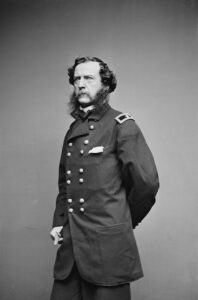
Samuel W. Crawford in a studio portrait taken during the Civil War.
Library of Congress Prints and Photographs Division
It started with a boom at 4:30 a.m. on April 12, 1861, as a single mortar shell arched appropriately from south to north high over the harbor at Charleston, South Carolina. The shell burst above Fort Sumter and was a signal to the artillery batteries positioned around the harbor to open fire. The next shot, fired from a battery farther east, was meant to be the ceremonial beginning of a second war for independence for the state of South Carolina and the six other states of the lower South that had joined together as the Confederate States of America. The honor of igniting both the cannon and the resulting national conflict was bestowed upon Edmund Ruffin, a native Virginian and long-time advocate of Southern secession. The cannon embedded an iron ball into a brick wall of the fort. The pressure that had been building for decades, slowly stretching and tearing the national fabric, had finally ripped the last threads.
Inside the fort, nine officers, 71 enlisted soldiers, and 40 construction workers hunkered down behind the fort’s masonry walls awaiting daylight. There was no point to returning fire and wasting their limited gunpowder and shells shooting into the darkness, unable to see their accuracy or make corrections. Among the officers was the garrison’s assistant surgeon, Capt. Samuel Crawford.
Born in Pennsylvania’s Franklin County on November 8, 1827, Samuel Wylie Crawford Jr. graduated from the University of Pennsylvania in 1846 and Penn’s School of Medicine in 1850. He joined the United States Army the following year as an assistant surgeon.
After service in the western territories over the next nine years, Crawford was on leave in Newport, Rhode Island, when he received a telegram on September 7, 1860, ordering him to proceed to Fort Moultrie near Charleston, South Carolina. As Crawford traveled south, he heard that his predecessor had died of a disease, thought to be yellow fever; however, Crawford’s diagnosis, after examining his first patient, was dengue, a less serious mosquito-borne virus.
The new assignment put Crawford in a political hotspot as well as a subtropical climate. The political pressure based on sectional economic arguments, particularly over slavery, which had been dividing the country, was about to be vented in the emotional presidential election of 1860. The incumbent president, Pennsylvania native James Buchanan, chose not to seek reelection, and in trying to select a nominee, the Democrats split their party along sectional lines, with two separate candidates for North and South. Another party, the Constitutional Union, composed of mostly Southern Unionists, also ran a candidate. The recently formed Republican party chose Abraham Lincoln of Illinois to represent their free soil or abolitionist views and high tariff, proindustry preferences. In the subsequent election, Lincoln won by carrying all the Northern states.
The election results clearly illustrated the divided nature of the country and represented a shift in the dynamics of national politics. Lincoln would be the first president from the North in roughly 30 years who was unsympathetic toward the South. Despite his repeated statements that he would only limit the growth of slavery and not interfere with the practice where it already existed, Southerners believed that the election of an antislavery Republican was the beginning of national government dominance by the North that would inevitably lead to additional assaults on their culture and agricultural economy.
The South Carolina legislature met in the state capital of Columbia for the electoral voting process and remained in session afterward. When the national vote certified Lincoln’s election, the legislature instituted a convention to decide the question of secession and draft the appropriate document. Due to outbreak of disease in Columbia, the convention was moved to Charleston, affording Crawford the opportunity to watch the national events as they developed locally.
South Carolina was the first state to secede from the Union on December 20, 1860. Six additional states of the deep South — Mississippi, Florida, Alabama, Georgia, Louisiana and Texas — followed during January and February of 1861. Representatives of these states met in Montgomery, Alabama, during the month of February and formed a government for a new country, the Confederate States of America.
President Buchanan did not believe that secession was constitutional, but he was hesitant to do much about it. He attempted to walk a fine line by denying the authority of the states or Confederate government to seize or negotiate the purchase of Federal property such as military installations in their territory, but he also wanted to avoid the armed conflict that would result from their forceful defense or recapture. Charleston became the primary friction point between the two sides.
The Federal forts in Charleston harbor consisted of three installations that could control the passage of ships to and from the city. To the north on Sullivan’s Island was Fort Moultrie, to the south on James Island was Fort Johnson, and in between was Fort Sumter, under construction on a man-made island. Castle Pinkney, a fourth and older fortification closer to the city, was nearly unmanned.
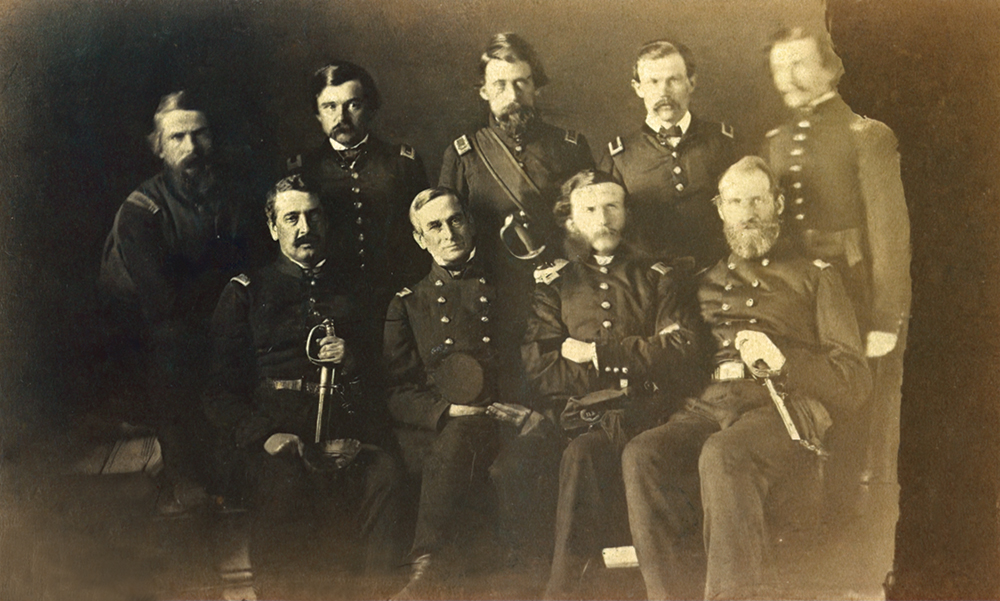
The Union officers at Fort Sumter were photographed together in this 1861 group portrait. They are, from left in the front row, Capt. Abner Doubleday, Maj. Robert Anderson, Capt. Samual W. Crawford and Capt. John G. Foster, and in the back row, Capt. Truman Seymour, Lt. George W. Snyder, Lt. Jefferson C. Davis, Lt. Richard Kidder Meade Jr. and Capt. Theodore Talbot.
Library of Congress Prints and Photographs Division
Maj. Robert Anderson of Kentucky was in command of the installations, headquartered at Fort Moultrie. Although he was personally sympathetic toward the South, Anderson was an officer of great integrity and firm loyalty to the Army and Federal government. Keenly aware of his delicate position and sharing with Buchanan a deep personal desire to avoid triggering a conflict, he also had the responsibility to defend the forts, if necessary. Faced with a daunting task and insufficient resources, Anderson abandoned the outlying fortifications and concentrated his forces in the more defensible Fort Sumter on December 26, 1860.
The move was within Anderson’s authority, but it surprised the Buchanan administration. The Confederates’ reaction was to first demand its reversal, which Anderson refused. Next, they set about converting the abandoned forts and installing additional batteries for use against Sumter. Anderson and his troops likewise strengthened their defenses as much as possible. This course of action continued in the harbor while unofficial negotiations took place over the next three months.
March 4, 1861, brought the constitutionally required change of presidential administration from Buchanan to Lincoln. In his 1887 book, The Genesis of the Civil War, Crawford evaluated the performance of his fellow Pennsylvanian: “[Buchanan] remained the politician and had rarely risen to the level of practical statesmanship . . . [he] had utterly misunderstood the real nature of the crisis and had compromised ‘a great position by feeble acts’; and when at last he did come to appreciate his position, his instinct was to save his administration and to protect himself. . . . [H]istory . . . will judge him not from what he did, but what, from his great opportunities and grave responsibilities, he utterly failed to do.”
The shift of administrations brought little immediate change, as Lincoln wanted to avoid aggressive moves that might prompt additional Southern states to join the Confederacy. Complicating matters over the coming weeks was the fort’s dwindling supplies. An attempt in January 1861 to deliver supplies and reinforcements to the fort had been thwarted when the Confederates fired on and drove off the commercial ship Star of the West. By early April, Crawford, having added the quartermaster function to his regular medical duties, reported to Anderson that the food supply was nearly gone. Anticipating the situation, Lincoln announced that the Navy would supply the fort with food but not arms or additional soldiers. Distrusting Lincoln and suspecting that the fort would be reinforced, the Confederates demanded that it be surrendered.
Anderson had his troops prepare powder charges for the conflict that seemed inevitable. Crawford noted, “The men worked cheerfully and in the greatest elation of spirits,” a feeling their commander didn’t share. Crawford saw “Major Anderson alone, walking slowly backward and forward among his guns. He was greatly depressed; he seemed to realize that upon himself rested mainly the great responsibility. He had endeavored to avert the crisis upon him by every means in his power; he had failed, and the struggle was unavoidable and imminent. His sense of duty now overcame every other consideration, and he prepared to meet the worst.” He refused to surrender Fort Sumter, so the Confederates opened fire.
Anderson’s defensive plan was to conserve his ammunition and limit his return fire to the lower tier of guns that were the best protected. With the gun crews in the safest positions, Assistant Surgeon Crawford volunteered for another duty — battery commander. Taking command of three “32-pounders,” Crawford had the gunners aim for a floating ironclad battery. Noting that most of their shots deflected off the iron covering, Crawford moved his gun crews to another area and began returning fire on Fort Moultrie, their former home, for four hours.
The battle continued through the day until, with night approaching, the Federals ceased fire, and the Confederates reduced their rate to a few shots per hour, just to disturb the sleep of those in the fort. About midnight, Crawford and another officer inspected the damage on the exterior walls of Sumter. While dimpled and gouged, the walls remained intact, and the lower tier of cannons were still operational.
Each side resumed firing the next morning and the Confederates added heated “hot shot” rounds that started the wooden barracks and officer’s quarters burning. As the fires moved toward the powder magazine, its contents were relocated and some of it dumped into the surrounding waters to prevent a disastrous explosion. One incoming round hit the magazine door, mangling the lock and sealing it shut. With the fort burning, the flagstaff temporarily shot away, and the Federal fire ending as the powder ran out, two delegations of Confederate officers arrived under separate flags of truce and, after some miscommunication, secured Anderson’s agreement to evacuate.
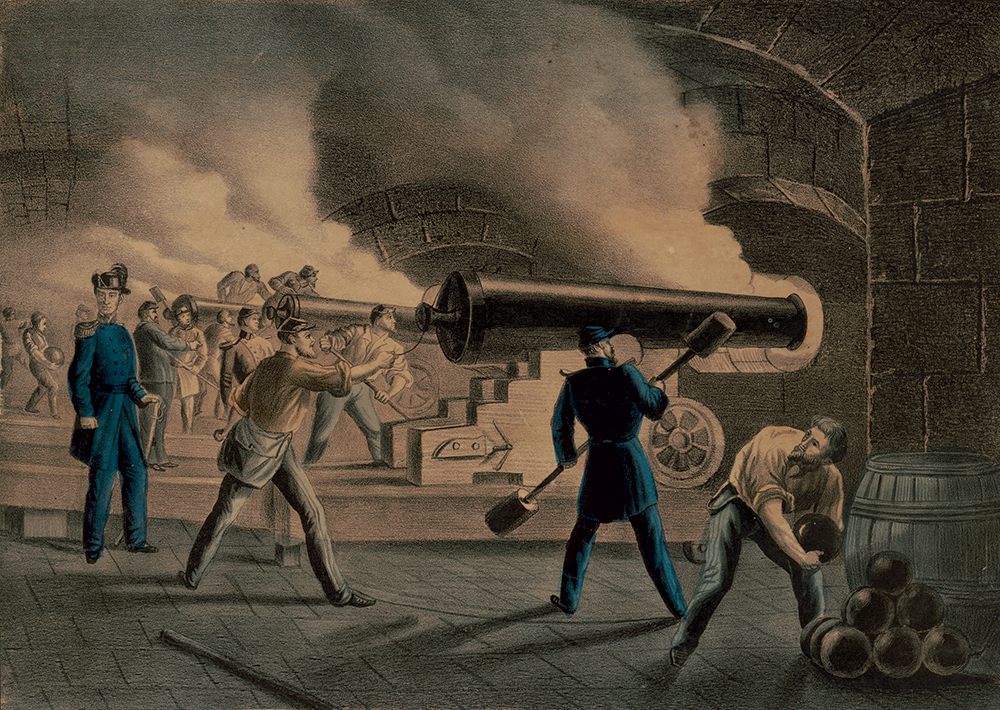
The bombardment of Fort Sumter in the Charleston Harbor marked the beginning of the American Civil War. This Currier & Ives lithograph depicts Union soldiers firing back at the Confederates from inside the fort.
Library of Congress Prints and Photographs Division
Crawford observed that the Federal resupply flotilla had arrived but remained off the harbor entrance and did not engage in the fighting. As to his medical duties, Crawford reported only four men having been wounded by flying masonry debris. The casualty report had to be revised upward the following day when a saluting cannon misfired, causing a secondary explosion that killed one soldier, mortally wounded another, and seriously injured a third who later recovered. Due to the accident, the garrison’s departure was delayed until the following day, April 15, when they transferred to the steamship Baltic and sailed for New York.
As Crawford described it decades later, the veterans of Fort Sumter received a welcome in New York of “enthusiasm and demonstration seldom exceeded and wholly exceptional.” One officer resigned and joined the Confederate army after Virginia seceded, but the others remained in Federal service. As fellow Sumter veteran Capt. Abner Doubleday noted of Crawford, “His ambition to win a name as a soldier soon induced him to quit the ranks of the medical profession.”
Initially commissioned as a major in the 13th U.S. Infantry regiment, Crawford was appointed inspector general of the Department of Ohio under Gen. William Rosecrans. On Rosecrans’ recommendation, Crawford received a three-grade promotion to brigadier general and assignment to the Army of the Shenandoah. After the Battle of Cedar Mountain, Crawford’s brigade was transferred to the XII Army Corps in the Army of the Potomac.
At the battle of Antietam on September 17, 1862, Crawford commanded the 1st Brigade of the 1st Division of the XII Army Corps, which deployed to support the attack of the I Corps on the northern end of the battlefield. Amid the heavy fighting, XII Corps commander Brig. Gen. Joseph Mansfield was mortally wounded. Corps command devolved to 1st Division commander Brig. Gen. Alpheus Williams, and in turn, Crawford took command of the division.
Crawford suffered a severe wound in the right thigh but remained on the field as long as possible, finally relinquishing command to seek medical treatment to get the bleeding stopped. The wound took Crawford out of action while his leg healed. Nine months later he returned to the Army of the Potomac to assume command of a unique division.
The Reserve Volunteer Corps of the Commonwealth, more commonly known as the Pennsylvania Reserves, had been formed during the initial phase of the war after the bombardment of Fort Sumter. President Lincoln issued a proclamation calling upon the loyal states of the Union to provide 75,000 militia troops to the Federal government for three months service. Four states of the upper south — Virginia, North Carolina, Tennessee and Arkansas — responded by seceding and joining the Confederacy.
Pennsylvania sent its quota of 11,700 soldiers in 15 regiments to the Federal government. With the loyalty of neighboring Maryland being doubtful, and as Pennsylvania shared a border with Confederate Virginia in the southwest, the governor and legislature of the Keystone State recruited another 13 regiments of infantry plus one regiment each of field artillery and cavalry that would remain under state control.
After the Union Army’s loss at the Battle of Bull Run and the expiration of the militia’s term in July 1861, Pennsylvania sent the Reserves into Federal service. The infantry regiments were organized into three brigades that served together as one division. A division with all its regiments from the same state was unusual in the Federal army.
The division’s operations and corps assignments varied during 1862 as they fought in the Peninsular Campaign, Second Bull Run, Antietam and Fredericksburg. In February 1863, they were assigned to the defenses of Washington, D.C. The end of the division’s rotation for rest coincided with Crawford’s recovery from his leg wound. He was awarded the command of the Reserves’ 1st and 3rd Brigades with the designation of the 3rd Division of the V Army Corps in the Army of the Potomac. To Crawford’s annoyance, the 2nd Brigade was to remain in Washington. He protested, but with the Confederate Army of Northern Virginia moving north, the capital city’s defenses had to be maintained.
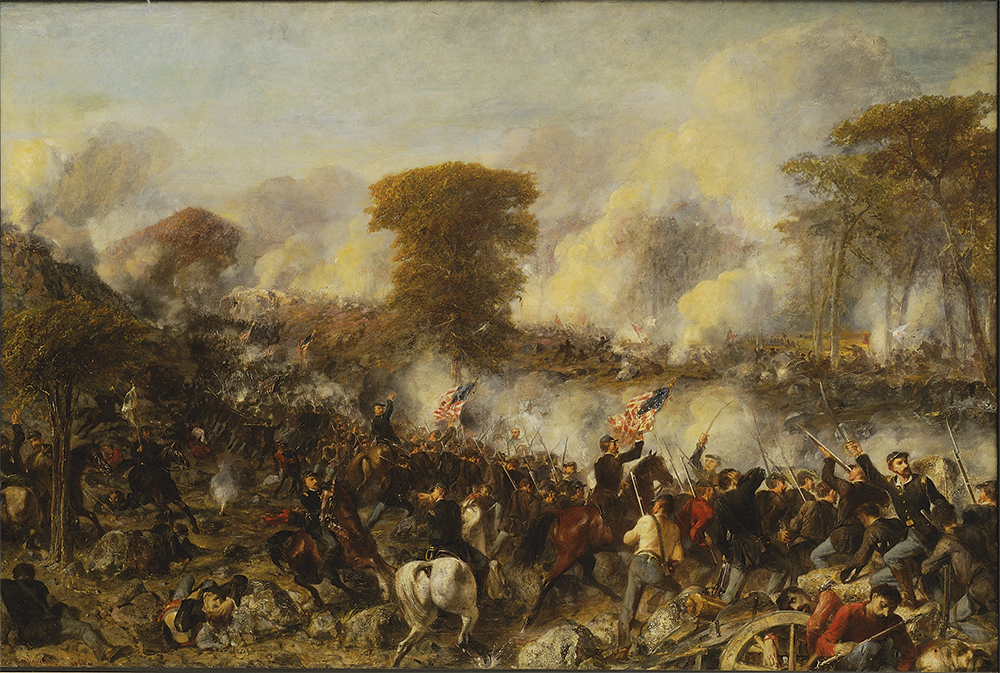
Crawford carries the colors of the First Pennsylvania Reserves as he leads a charge near Littlen Round Top on the second day of the Battle of Gettysburg. Peter Frederick Rothermel depicted the scene in Charge of the Pennsylvania Reserves at Plum Run, painted in 1881.
The State Museum of Pennsylvania, PHMC
The Reserves filed in with the V Corps as the units of the Army of the Potomac moved to intercept the Confederates. Advanced elements of both armies engaged each other northwest of Gettysburg, Pennsylvania, on July 1, 1863. The V Corps arrived the following day as the battle had shifted to an area between Seminary and Cemetery ridges, south of the town. The Confederates launched a rolling attack from Seminary Ridge in a southwest to northeast direction as the Federal line was forming. The V Corps was assigned to bolster the III Corps’ defense of the hills at the southern end of Cemetery Ridge. The deployment of the V Corps’ divisions mirrored the Confederate attack with the 1st Division along the crest of the deforested Little Round Top, while the 2nd Division advanced to the west across a small stream called Plum Run. The Third Division was ordered to support the other two.
Quickly realigning his force, Crawford sent most of his 3rd Brigade around the east side of Little Round Top. The Confederates had already been pushed back by the time the 3rd Brigade arrived, but with Crawford’s subsequent approval, they extended the Federal line to Round Top and fortified the area between the hills.
Having retained the 3rd Brigade’s 11th Reserve regiment, Crawford used it as the nucleus for an expanded 1st Brigade. As the Confederates pushed the 2nd Division back, Crawford ordered the 1st Brigade forward. As he recounted years later, “As soon as we started I found myself by the side of the color guard of the 1st Reg[iment, and] just beside the colors which were flapping in my face. . . . I stooped down and seized hold of the staff when the color bearer refused to let me have them. He said, ‘I can’t give you my colors.’ I said, ‘don’t you know me, I am your General. Give me your colors.’ He then let me have them but he clung to my pantaloons until we had nearly reached the wall and the enemy began to fall back when I handed them back to him.”
Other units also joined in the advance from the arriving VI Army Corps and the Confederates lost both their momentum and numerical advantage. Confederate Gen. James Longstreet called off the attack. As their opponents retreated, the Reserves’ 1st Brigade took position at a stone wall that afforded them some defensive cover. With the Confederate attacks thwarted, both brigades of the Reserves consolidated and held their positions. After the failure of Pickett’s Charge on July 3, the 1st Brigade launched another attack, pushing the Confederates back further and capturing nearly 200 prisoners and a stockpile of muskets they had gathered on the battlefield.
With the Confederates’ withdrawal from the battlefield, the Reserves had accomplished their objective and justified their creation two years before. For Crawford, it was a high point of his career that he would continue to recount for years to come; however, even though the second Confederate invasion of the North had failed, there would be many more battles before the war was over.
The Reserves remained the 3rd Division of the V Corps during the early battles of the Overland Campaign of 1864. By the end of May, at Bethesda Church, Virginia, the original Reserves reached the end of their enlistments. The original regiments were disbanded and the veterans who reenlisted, along with more recent recruits, were formed into two new regiments, the 190th and 191st Pennsylvania infantries. No longer of sufficient size to be a division unto themselves, they became the 3rd Brigade of Crawford’s 3rd Division.
The opposing armies spent the next nine months around Richmond and the Confederate base of supply to the south at Petersburg, Virginia. During this time the nature of the war changed from a conflict of open movement to siege warfare. The armies fought in parallel lines of entrenchments and field fortifications as the Confederates defended their national capital, while the Federals probed for weak spots and mounted raids attempting to sever their enemy’s supply lines. Moving westward, they stressed Confederate defenses, forcing them to stretch and cover greater distances.
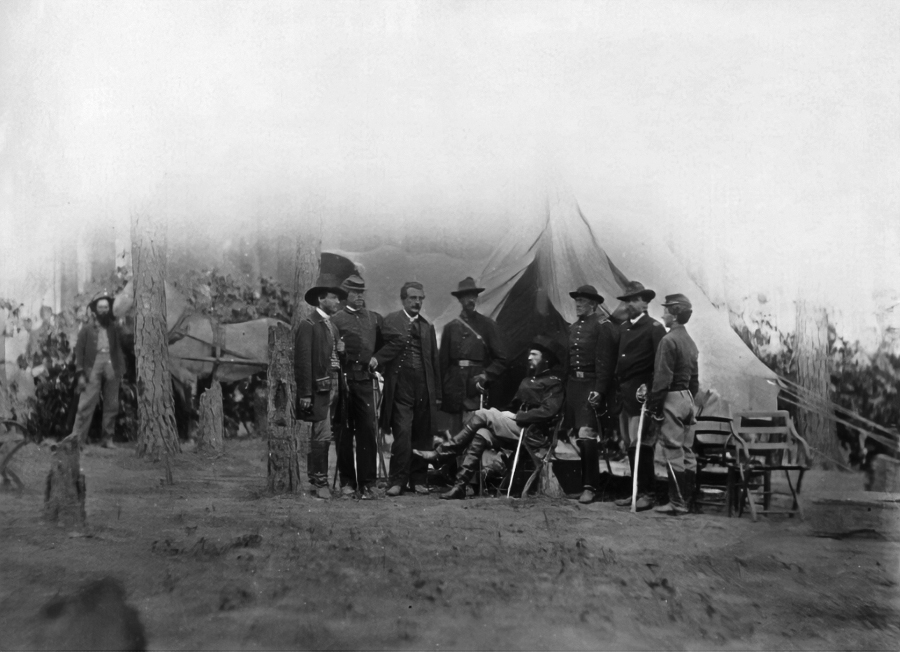
Crawford, seated, commanding the 3rd Division of the V Corps, meets with his staff in the field, circa 1864.
The Medford Historical Society & Museum
By the end of March 1865, the V Corps was part of an advance to capture the Southside Railroad at the road junction called Five Forks. Although Crawford initially missed his objective, his corrective course brought his division around behind the Confederates, forcing them to withdraw. With their critical supply line cut and the Federals enveloping their western flank, the Confederates had no choice but to evacuate Richmond and Petersburg. During the next week the Confederates moved west toward Lynchburg trying to evade the pursuing Federal armies, but they were trapped at Appomattox Court House.
Generals Samuel Crawford and Truman Seymour were the only officers from Fort Sumter present when Gen. Robert E. Lee surrendered his Confederate army on April 9, 1865. Five days later, Crawford returned to the remains of the fort with his fellow veterans for a ceremonial raising of the flag that had been taken down four years before.
Crawford remained in the Army during the postwar Reconstruction period, serving as colonel of the 2nd U.S. Infantry Regiment in Huntsville, Alabama. Due to increasing disability from his leg wound, he retired on February 19, 1873, with the rank of brigadier general.
The legacy of his war service and that of the Pennsylvania Reserves kept Crawford busy during his retirement. He often visited Gettysburg and participated in reunions. He purchased the land west of Little Round Top and hoped to build a museum and archive to honor and preserve the history of the Reserves but could not get approval for the project. He passed away peacefully on November 3, 1892, never regaining consciousness after suffering a stroke in his sleep.
Samuel Crawford was one of the few officers present at both the Civil War’s outbreak at Fort Sumter and the Confederate surrender at Appomattox Court House. In between, he led his troops through numerous battles including the significant engagements at Antietam and Gettysburg. Today, his legacy is preserved through a memorial, sculpted by artist Ron Tunison, at the Gettysburg National Military Park in the location where Crawford grasped the colors, and at The State Museum of Pennsylvania, where his division commander’s flag and two artistic portrayals of the charge of the Pennsylvania Reserves at Gettysburg by Peter Frederick Rothermel are included in the Civil War exhibit, Objects of Valor.
Sidebar: Preserving Crawford’s Legacy at The State Museum
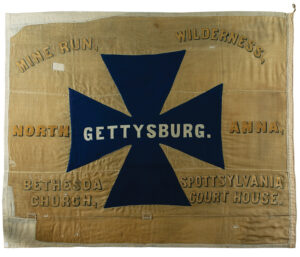
Crawford’s division headquarters flag during his command of the Pennsylvania Reserves.
The State Museum of Pennsylvania, PHMC
Samuel Crawford had no children, so his siblings took charge of his estate after his death. In the early 20th century, the family donated two of the general’s division flags and his dispatch case to the state adjutant general, who in turn donated them to The State Museum of Pennsylvania.
One of the flags is decorated with the names of battles fought during Crawford’s command of the Pennsylvania Reserves, from Gettysburg through Bethesda Church. Crawford mentioned it in his description of the Gettysburg charge to artist Peter Rothermel in 1871: “Having taken the colors I rode out a little way in front of the line two staff officers with me and two or three mounted orderlies, one carrying my Division flag, a white flag with a Maltese cross in blue.”
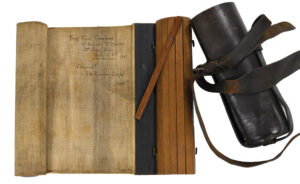
Crawfords portable writing case and its leather carrier.
The State Museum of Pennsylvania, PHMC
The second flag, with a dark blue field and central white circle with a blue Maltese cross, is likely from the final months of the war after the end of the Reserves’ enlistments.
The dispatch case, made to be rolled to fit into its leather carrier, has cross braces that provided a writing surface. A hand-printed inscription dates it to 1862, after Crawford’s promotion to brigadier general. Preprinted envelopes held the dispatches and served as passes for the messenger to deliver them to other commanders.
Further Reading
Crawford, Samuel Wylie. The Genesis of the Civil War: The Story of Sumter, 1860–1861. New York: Charles L. Webster & Co., 1887. / Doubleday, Abner. Reminiscences of Forts Sumter and Moultrie in 1860–’61. New York: Harper & Brothers, 1876. / Wagner, Richard. For Honor, Flag, and Family: Civil War Major General Samuel W. Crawford, 1827–1892. Shippensburg, PA: White Mane Books, 2005.
Robert D. Hill is senior curator of the Military, Political and Industrial History Collections at The State Museum of Pennsylvania. His several articles for Pennsylvania Heritage include “Outstanding Perseverance and Courage: Pennsylvania’s Thomas Mosley and the Montford Point Marines in World War II” (Summer 2024) and “From the Susquehanna to the Rhine: The Military Career of Daniel Strickler in Two World Wars”(Summer 2020).