
Elizabeth Graeme Fergusson: A Woman of the American Enlightenment
Written by Jennifer Barndt in the Features category and the Summer 2026 issue Topics in this article: American Revolution, Ann Diggs Graeme, Anna Young Smith, Annis Boudinot Stockton, Benjamin Rush, Elizabeth Graeme Fergusson, Francis Hopkinson, George Washington, Graeme Park, Hannah Griffitts, Henry Hugh Fergusson, Horsham, Jacob Duche, Joseph Reed, Old Swedes Church (Philadelphia), Philadelphia, poetry and poets, Richard Peters, salons, Thomas Graeme, William Franklin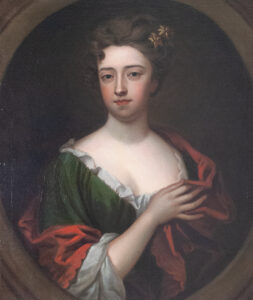
Well-known throughout Philadelphia for her literary gatherings and impressive intellect, Elizabeth Graeme lived a life fraught with difficulty. Swept up in treasonous plots through her marriage to Henry Hugh Fergusson, she struggled to regain her reputation and her property.
Graeme Park, GP86.1.1
By the late 1760s, Elizabeth Graeme Fergusson’s name was known throughout the city of Philadelphia for her evening literary gatherings attended by the city’s intellectual elite. Dubbed “the most learned woman in America” by Anne Hollingsworth Wharton, first historian of the National Society of the Colonial Dames in America, Fergusson’s poetry and journals captured the experience of a woman whose life was shaped, and perhaps shattered, by the turbulence of the Revolutionary War. Twice swept up in scandal by her marriage to a British sympathizer, she spent many years using her literary voice to regain her property and her reputation.
Born in 1737 to Ann Diggs (1700–65) and Dr. Thomas Graeme (1688–1772) of Philadelphia, Elizabeth Graeme enjoyed a privileged upbringing as a member of the city’s upper class. Thomas Graeme was an unofficial advisor to the Penn family and one of the few trained doctors in the colony. His amiable personality earned him numerous political jobs as well, including naval officer of Philadelphia and justice of the Supreme Court of Pennsylvania. Ann was the stepdaughter of Pennsylvania provincial governor Sir William Keith (1669–1749). She bore between nine and 12 children (no firm record exists) during her marriage but much to her distress, only three in addition to Elizabeth survived to adulthood: Thomas, who died at 26 in 1747, Ann (1726–66) and Jane (1727–59). Though Ann and Jane were significantly older than Elizabeth, the three sisters shared a close relationship throughout their lives.
By the time of Elizabeth’s birth, the Graeme family maintained two houses: a rented mansion in Philadelphia used during the winter months and an estate in Horsham called Graeme Park, which Graeme had purchased in 1739 from Keith, who had a falling out with the Penn family, forcing him to return to England. The 1,700-acre estate, originally established in 1722, consisted of a mansion house, servants’ quarters, a malthouse and several dependencies. Under Graeme’s supervision, the property flourished into a lush country estate and working farm with a deer park, livestock, ornamental and medicinal gardens, and marketable crops such as wheat, rye, barley, oats and hay. He also remodeled the house to reflect the style of the day, installing fine wood paneling and imported marble fireplaces. The Graeme family spent their summers at Graeme Park until 1772, when Elizabeth made it her permanent residence.
Though numerous educational institutions for girls existed in Philadelphia during Elizabeth’s childhood, her mother took it upon herself to provide her with an extensive education. Influenced by pamphlets circulating from Great Britain that encouraged elite women to pursue an education grounded in the Enlightenment ideals of reason and rationality rather than ornamental pursuits, Ann introduced her daughter to a broad variety of subjects, such as history, literature, the arts, moral philosophy and the sciences. She encouraged Elizabeth to think critically, read extensively, and voice her opinions. Careful to ensure her daughter was a well-rounded woman, Ann also instructed her in the feminine pursuits of needlework, spinning and weaving — activities Elizabeth pursued throughout her life.
Elizabeth and her elder sisters were often present at gatherings hosted by their mother where upper-class Philadelphians of both sexes engaged in discussions related to literature, history and philosophy. By the time Elizabeth reached adulthood, she was a prolific poet, well-versed in the Bible and popular literature of the day. She could read the classics in Latin and Greek, spoke fluent French, and studied Italian.
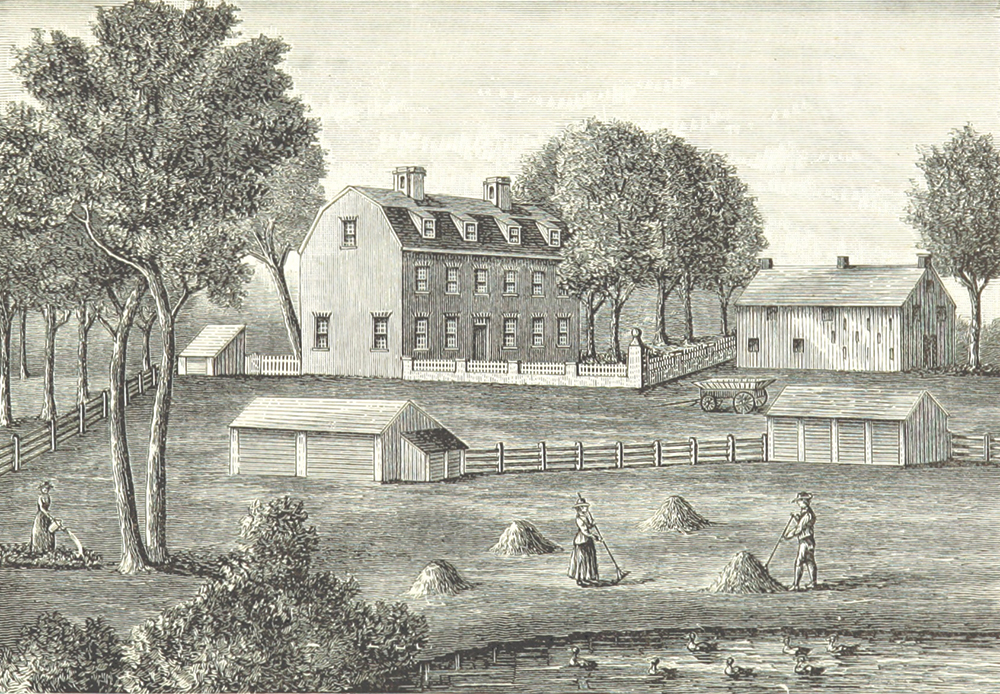
Dr. Thomas Graeme purchased this estate in 1739 as a summer home. The house was originally constructed in 1722 by provincial governor Sir William Keith and named Fountain Low. Graeme began extensive renovations in 1755, including the installation of Georgian-style paneling, a formal garden, and a 300-acre deer park.
Wikimedia Commons / Mechanical Curator Collection, British Library
Through her parents’ broad social connections, Elizabeth established a circle of friends that included many influential Philadelphians: Benjamin Rush (1746–1813), Francis Hopkinson (1737–91) and Rev. Jacob Duché (1737–98). Elizabeth and her friends socialized at dancing events, spinning bees and hunting parties. They also gathered to read aloud and discuss poetry that they had written, critiquing each other’s work, exchanging ideas, and offering suggestions for self-improvement.
Elizabeth’s affluent upbringing and extensive education should have enabled her to lead a comfortable life. Her family had prepared her well to become the wife of any number of eligible Philadelphia bachelors. Elizabeth’s fate, however, was much more complicated and fraught with difficulties. An early failed romance followed by the death of her mother and sister caused Elizabeth much grief, but later a disastrous marriage rife with betrayal, combined with the outbreak of the Revolutionary War and its ensuing consequences, irrevocably damaged Elizabeth’s reputation and finances. These events cost her the loss of many of her friends and ultimately her home, leaving her with little in her later years but her writing, for which she is still known today.
In 1752, when Elizabeth was 15, she began a relationship with 21-year-old William Franklin (1730–1813), son of Benjamin Franklin, who was studying law, serving as clerk to the Pennsylvania Assembly, and acting as aid to his father. Thomas Graeme, a political opponent of Benjamin Franklin, disapproved of Elizabeth’s budding relationship. William declared his love for Elizabeth in a letter dated February 26, 1757. He addressed Elizabeth by her pseudonym, “Laura,” and in verse: “Laura’s too powerful Charms have shown, My Heart is now no more my own.”
William urged Elizabeth to agree to marriage before he went to England to continue his legal studies. Elizabeth’s parents, hoping the relationship would dissolve during William’s absence, persuaded the couple to postpone a formal engagement or marriage until William returned from England. Elizabeth’s frustration with William’s poor communication while abroad, and his inability to reconcile their families’ political differences, caused the relationship to founder, and the pair ended their engagement in 1759.
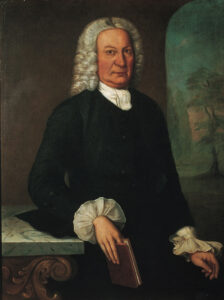
The son-in-law of Sir William Keith, Dr. Thomas Graeme was a respected physician who served as the port physician of Philadelphia. He was appointed to the Supreme Court of Pennsylvania in 1731 and frequently served as an unofficial advisor to the Penn family. Graeme died of a heart attack on the grounds at Graeme Park in 1772.
Graeme Park
Between 1759 and 1762 Elizabeth’s family suffered numerous hardships. Her elder sister Jane Graeme Young died in childbirth in January 1759. Jane’s husband, James, unable to raise their surviving children alone, left Anny, aged 3, and John, aged 2, with Elizabeth and her parents, who raised and educated them until 1772. Elizabeth’s mother suffered several bouts of illness, complicated by the grief of losing Jane, prompting Ann to prepare for her own death. Thomas Graeme developed a lingering cough that so debilitated him, he feared he would have to give up his medical practice. And Elizabeth herself, who had always been frail, was plagued by recurring headaches and fevers.
In 1763 an opportunity arose for Elizabeth to accompany family friend Richard Peters (1704–76) on an extended trip to England. Peters, the Anglican rector of Christ Church in Philadelphia, was traveling overseas to seek medical advice and formalize his appointment as rector. Highly educated, literate and well connected, Peters promised to introduce Elizabeth to his English acquaintances and guide her through the country. The pair arrived in England in July 1764, and during the trip, Elizabeth kept a travel journal that she sent home to Philadelphia in three parts, where it was passed among family and friends who read her observations with great pleasure.
Though Elizabeth’s original journals no longer exist, friends copied portions of them into their own journals, some of which survive. Her observations reflect the pleasure she took in making new friends and absorbing the arts, culture and natural beauty of England; however, tragedy struck on July 15, 1765, when Elizabeth received a packet of letters from Pennsylvania, including a letter from home informing her that her mother had died on May 29. Ann Graeme fell ill not long after Elizabeth left Philadelphia but had placed her family under strict orders not to inform Elizabeth of the severity of her illness. Elizabeth and Richard Peters sailed for Pennsylvania in October, arriving in Philadelphia the day after Christmas. She joined her father and remaining sister, Ann, in an emotional reunion. Their reunion was short lived; Ann died suddenly in March 1766.
Unmarried, childless, and now solely responsible for caring for her aging father and her young niece and nephew, Elizabeth reflected sorrowfully on her situation: “an Exile left, forlorn, alone, / One antient Parent all I claim my own.”
Elizabeth turned to her writing to assuage her grief; she paraphrased the Psalms and other sections of the Bible, completed a verse translation of the French work Les Adventures de Télémaque, fils d’Ulysse, and published two articles in the Pennsylvania Chronicle. Elizabeth also exchanged works with other women who shared her passion for writing, including her niece Anna Young Smith (1756–80), whose literary ambitions she encouraged and helped shape; Annis Boudinot Stockton (1736–1801), one of the first female published poets in the colonies; and Hannah Griffitts (1727–1817), a Quaker poet best known for her satiric celebrations of American resistance to British policy in the years leading up to the Revolution.
Serving as her father’s hostess, Elizabeth began to keep regular calling hours through the winter months on Saturday evenings in 1767 at their rented home in Philadelphia. These gatherings to discuss literature, philosophy and politics, similar to salons that were popular in France during the Enlightenment, attracted the intellectual elite of the city. Attendees included Dr. Benjamin Rush, John Dickinson, Rev. and Mrs. Jacob Duché, Francis and Ann Hopkinson, and others. Rush, with whom Elizabeth enjoyed a lifelong friendship, recalled the gatherings with fondness in a biographical essay in Portfolio, published in 1809 a few years after her death: “The genius of Miss Graeme evolved the heat and light that animated them . . . she charmed by a profusion of original ideas, collected by her vivid and widely expanded imagination.” Elizabeth’s “attic evenings,” as Rush called them, became the talk of the city.
In December 1771, Rush attended an attic evening with a guest, Henry Hugh Fergusson (1748–1819), who had recently arrived from Scotland. Twelve years younger than Elizabeth, he was tall, handsome and charming, classically educated, fluent in French, proficient in Italian and Spanish, and had traveled extensively in Europe. Elizabeth was quickly smitten with him. Again, her father had reservations, fearing that Fergusson’s questionable origins and his youth made him a poor suitor. In a poem dated March 4, 1772, Elizabeth declared her love to Fergusson and agreed to marry him, though she was reluctant to set a date. Eager to solemnize their union, Fergusson urged Elizabeth to elope with him, arguing that her reluctance indicated a lack of commitment. They quietly wed on April 21, 1772, in Philadelphia at Swedes Church. Much to Fergusson’s dismay, their union remained a secret throughout the spring and summer as he prepared to return to Scotland on family business. By September of that year, Elizabeth resolved to tell her father, but the day she decided to do so, he died suddenly while walking in the gardens at Graeme Park.
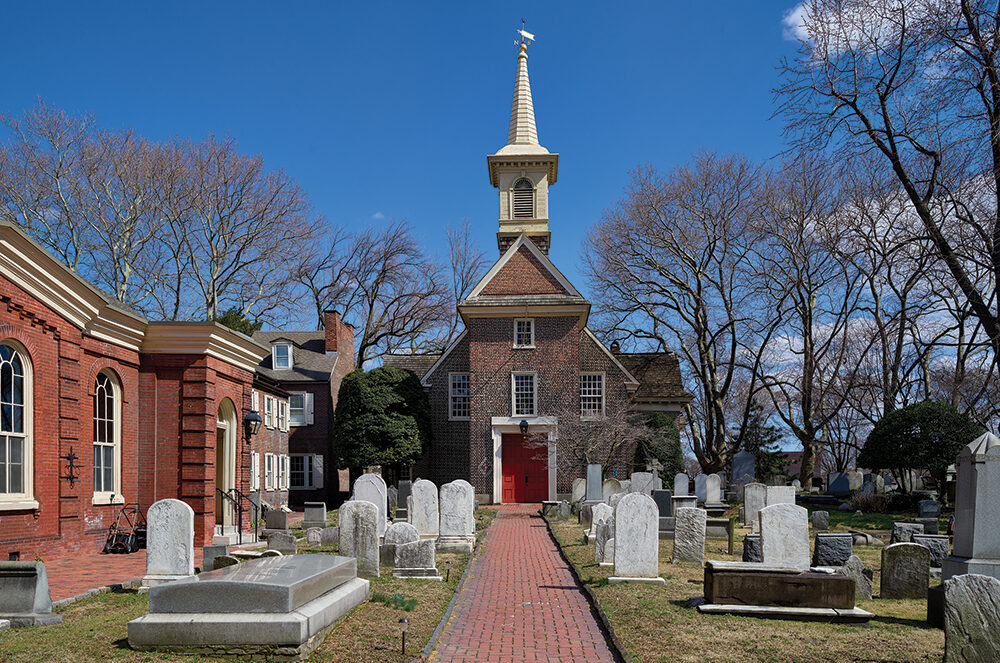
Built between 1698 and 1700, Gloria Dei in Philadelphia is the oldest church in Pennsylvania. Elizabeth Graeme secretly wed Henry Hugh Fergusson in the churchyard on April 21, 1772. After the ceremony, Elizabeth allegedly tripped on a grave—a poor omen for the future.
Carol M. Highsmith Archive, Library of Congress Prints and Photographs Division
Thomas Graeme’s death presented Elizabeth with a serious financial predicament. As a married woman, under colonial law, all her property became her husband’s for her lifetime, and she was now unable to dispose of her recent inheritance, including Graeme Park, without Fergusson’s approval. Though Elizabeth had spent many happy summers at the estate, she was ill-equipped to manage the sprawling property, nor did she wish to live so far removed from Philadelphia society. She hoped to sell most of the estate and live off the invested capital from the sale, but in her husband’s absence, Elizabeth struggled to be able to settle the debts accrued by the estate. Further, under the terms of her father’s will, Elizabeth inherited the property with the stipulation of a £1,000 legacy payment to her brother-in-law, James Young, and his children, payable at any time or immediately upon the sale of the property.
Fergusson returned to Pennsylvania around 1773 and by October had agreed to sell Graeme Park, though the sale was unsuccessful. Unable to afford a rented house in Philadelphia, the couple lived at Graeme Park year-round. Fergusson spent much of his time on the grounds of the estate, leaving Elizabeth, who had been accustomed to the lively social scene of Philadelphia, isolated and bored.
In November, Fergusson disappeared into the city for a week. Frustrated by his absence, Elizabeth wrote a poem entitled “An Advertisement,” imploring the reader to help her locate her husband who was “Lost, Strayd or Stollen” from her. The emotional toll of her situation likely weighed heavily on her and stifled her intellectual energy. During the period from 1773 to 1777, the once-prolific writer composed only two poems and ceased correspondence with many of her friends, though she did remain in sporadic contact with her niece and nephew. With Anny, Elizabeth discussed poetry, and with John, she discussed the growing conflict between America and Great Britain.
Torn between supporting the increasingly violent colonial opposition to British policy and allegiance to the mother country and not wishing to be swept up in violence, many of Elizabeth’s friends fled Philadelphia. Fergusson himself spoke freely of his disaffection with colonial resistance and his desire to see the colonies reconcile with Britain. In correspondence with Benjamin Rush in June 1775, Fergusson questioned whether war with Britain was worth the sacrifices it required: “Are then our resentments so high, is revenge so sweet a thing, that to distress Britain a few particulars, we will expose ourselves to every horror the imagination can paint? – Our cities destroyed, our fields uncultivated, our plains strew’d with death and ruin and to what end all this?”
Fergusson’s outspoken disaffection upset Elizabeth, who feared that he would be labeled a traitor and punished or imprisoned by colonial authorities. In September 1775, Fergusson departed for Great Britain, allegedly to conduct family business with his brother in Scotland. Whether his decision to leave Pennsylvania was influenced by his feelings about the growing war in the colonies is unclear, but Elizabeth implored him to remain abroad until the conflict was over. His absence, however, quickly became problematic for Elizabeth. She struggled to make the farm at Graeme Park profitable, and she still owed several debts, including the legacy payment to John Young and his children. She petitioned Fergusson for power of attorney to again attempt to sell Graeme Park. Receiving such power in the summer of 1776, Elizabeth sold a portion of the land to satisfy the legacy payment and outstanding debts.
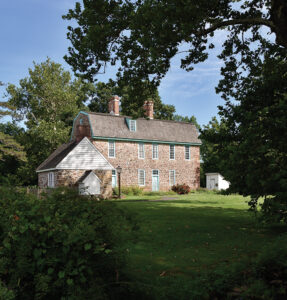
Graeme Park is the only surviving residence of a colonial-era governor and remains largely unchanged, save for the renovations undertaken by Thomas Graeme in the 1750s. The property was donated to the Pennsylvania Historical & Museum Commission in 1958.
Photo, Pennsylvania Historical & Museum Commission
Fergusson remained abroad until 1777, arriving unbeknownst to Elizabeth in New York the night before the British fleet sailed for Philadelphia. Attempting to return to Graeme Park, Fergusson accompanied the fleet and marched inland with the British army as far as Brandywine Creek. There, he was prevented from completing his journey by colonial forces because of his association with the British, and so he rejoined the army. Word of his return reached Elizabeth on September 25, the day before the British army entered Philadelphia. Unable to return to Graeme Park, Fergusson remained with the British army during their occupation of the city, serving as commissary of prisoners and lodging with loyalist friends Charles and Ann Stedman.
In October 1777 Fergusson persuaded Elizabeth to carry a letter from Rev. Jacob Duché, a longtime friend of Elizabeth’s, to Gen. George Washington. Duché, once a committed patriot and chaplain to the Continental Congress, had become disaffected with the violence of the colonial rebellion and penned a letter to Washington urging him to sue for peace with the British. Whether Elizabeth knew the contents of Duché’s letter is unclear. Nevertheless, she agreed to deliver it and did so on October 15.
Washington read the letter in Elizabeth’s presence, and horrified by its contents, informed her that if the letter was discovered, he would be labeled a traitor. He allowed Elizabeth to leave but told her that he will immediately deliver the letter to the Continental Congress. Washington’s response accompanying the Duché letter called Elizabeth’s participation in its transmittal “ridiculous – and illiberal,” thus rendering her guilty of participating in potentially treasonous activity.
Word of the Duché scandal and Elizabeth’s role in it quickly spread throughout the colonies. At the same time, the Pennsylvania Assembly enacted legislation to seize the property of people who did or had the potential to defect to the British. When news of the act reached Elizabeth, she feared that authorities would seize Graeme Park because of Henry Fergusson’s — and now her own — actions.
Facing the possibility of ruin, Elizabeth wrote to her friends in great distress. Her plight so moved Benjamin Rush that he offered to speak on her behalf to the Executive Council responsible for executing confiscations. Throughout 1777, despite the possibility of losing her home because of Fergusson’s obvious ties to the British, Elizabeth obtained a pass to visit him in Philadelphia as much as she could, obeying the strict orders outlined in her pass.
On May 18, 1778, the Supreme Executive Council of Pennsylvania published Fergusson’s name on a list of men suspected of having joined the British and demanded they appear for a treason trial before June 25 or have their property confiscated by the state. Desperate to retain Graeme Park, her sole source of income, Elizabeth begged Fergusson to report for trial, which he adamantly refused. Believing that she ought to be allowed to retain her property because it had been willed to her by her father and that Fergusson was incapable of committing treason because he was Scottish and not an American citizen, Elizabeth prepared to argue her case to the Supreme Executive Council in Lancaster.
At the same time, a delegation of British peace commissioners including George Johnstone (1730–87) arrived in Pennsylvania, hoping to convince colonial officials to negotiate with Great Britain. Johnstone also lodged with Fergusson at the Stedman home, and hearing of Elizabeth’s planned trip, asked her to convey a letter to Joseph Reed (1741–85), then a member of the Continental Congress, on her way to Lancaster. Elizabeth met with Reed on June 18, hoping he would intercede on her behalf with the Supreme Executive Council. During that meeting, she also conveyed Johnstone’s message, which promised Reed a substantial reward if he would negotiate peace with Great Britain. Reed refused to assist Elizabeth in her attempt to retain her property and rebuffed Johnstone’s offer, stating he “was not worth purchasing, but such as [he] was, the king of England was not rich enough to do it.”
Elizabeth hastened on to Lancaster, where she was unsuccessful at making her case to retain Graeme Park. Compounding her distress, Johnstone’s letter to Joseph Reed and Reed’s account of his meeting with her were published in The Pennsylvania Evening Post on July 26, 1778. Though Reed did not identify Elizabeth, the details of his account made her readily known. Horrified that Reed had implicated her in the transmittal of a bribe attempt, Elizabeth composed a long letter to Reed attempting to exonerate herself, asserting that Reed had already been aware of Johnstone’s mission and wondering, “How far, at this critical juncture of time, this affair may injure my property is uncertain.”
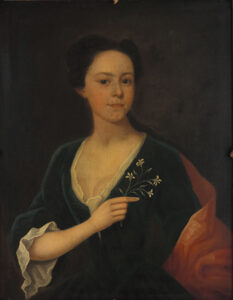
One of the first women to be published in the American colonies, Annis Boudinot Stockton was a member of Elizabeth Graeme’s literary circle. In 1787 Elizabeth compiled a commonplace book for Stockton that contained transcriptions of letters, commentary, and poems by Elizabeth, Henry Hugh Fergusson, her niece Anna Young Smith, and Francis Hopkinson.
Princeton University Art Museum (Gift of Mr. and Mrs. Landon K. Thorne, for the Boudinot Collection)
Having now been implicated in two treasonous scandals at the encouragement of her husband, who was working for the British army, Elizabeth’s ability to retain Graeme Park was in serious jeopardy. She again petitioned colonial authorities, arguing that it had been willed to her by her father in fee simple, meaning that while the property could be sold in her lifetime, upon her death it still passed to her heirs. As such, the colonial government would be unable to make a profitable sale of the property.
Elizabeth was unsuccessful. Pennsylvania’s Agents for Confiscated Estates sold the contents of Graeme Park at auction on October 15, 1778. Though she retained the estate itself and was able to live there so long as she paid rent and taxes, the property remained under threat of sale by the colonial government. Elizabeth made several more petitions to the Assembly, again asserting that Graeme Park was her property and Fergusson was a foreigner. Aided in her plea by several friends including Elias Boudinot, Thomas Franklin and Francis Hopkinson, Elizabeth successfully regained control of Graeme Park in 1781.
Aggravating Elizabeth’s strife, Henry Fergusson went to New York when the British evacuated Philadelphia in June 1778 under suspicion of having fathered a child with the Stedman family’s servant, Jenny. Though Fergusson adamantly denied the allegations and urged Elizabeth to join him in New York where they could depart for a new life in England, Elizabeth demanded proof of his innocence. Throughout the fall, she interrogated Jenny and investigated every possible lead to disprove the child’s paternity without success, all the while pleading with Fergusson to return to Philadelphia to answer the charges of treason and paternity against him. The couple had one final meeting in New Jersey in January 1779 before he departed for England.
Though Elizabeth refused to leave her home, she could not accept her husband’s betrayal and for the next several years hounded him and her friends for evidence to prove or disprove his infidelity. She wrote to Fergusson, begging him to swear an oath of his innocence, which he claimed he did but that it was lost in transit to America. He refused to swear another oath and eventually refused to communicate with Elizabeth about the matter at all. He wrote her in July 1783, issuing an ultimatum to join him in England or he would consider her refusal a “renunciation” of their marriage.
Similarly, many of Elizabeth’s friends tired of hearing her marital woes and eventually stopped communicating with her as well. Elizabeth channeled her woes into a long poem entitled “The Deserted Wife.” Written between 1780 and 1782, the four-part work chronicled how Elizabeth moved from “Hope” to “Doubt” through “Solitude” and “Adversity,” as she struggled to accept her husband’s betrayal.
Following the end of the Revolutionary War, Fergusson filed a claim in England for reimbursement of his losses during the war, including Graeme Park and its contents, claiming that Elizabeth had turned the estate over to him in fee simple before he left Pennsylvania and that he could not return to claim the estate because he was estranged from Elizabeth. English authorities required proof of the value of the estate and Fergusson’s loyalty to Great Britain. Elizabeth provided documentation establishing the value of the estate, but not of Fergusson’s ownership, and he attested to his involvement aiding the British during the war. In 1785 he received compensation totaling £2,304 and had no further contact with his wife. Of the 28 years he and Elizabeth were married, they spent only two and a half of them together. Sources suggest that Henry Fergusson joined the British army in 1793 and was receiving a small allowance from the British government until 1801, after which he disappears from the historical record.
Elizabeth remained at Graeme Park until 1791 when overwhelming debt forced her to sell the estate, which was purchased by William Smith, the widower of her niece Anny, who died in childbirth in 1780. Though Smith offered to allow her to remain at Graeme Park indefinitely, Elizabeth chose to move in 1793, living the remainder of her life in rented rooms. She lived a life of semi-seclusion, largely refusing invitations to visit her remaining friends in Philadelphia, as she feared her husband’s infidelity still made her the subject of vicious gossip.
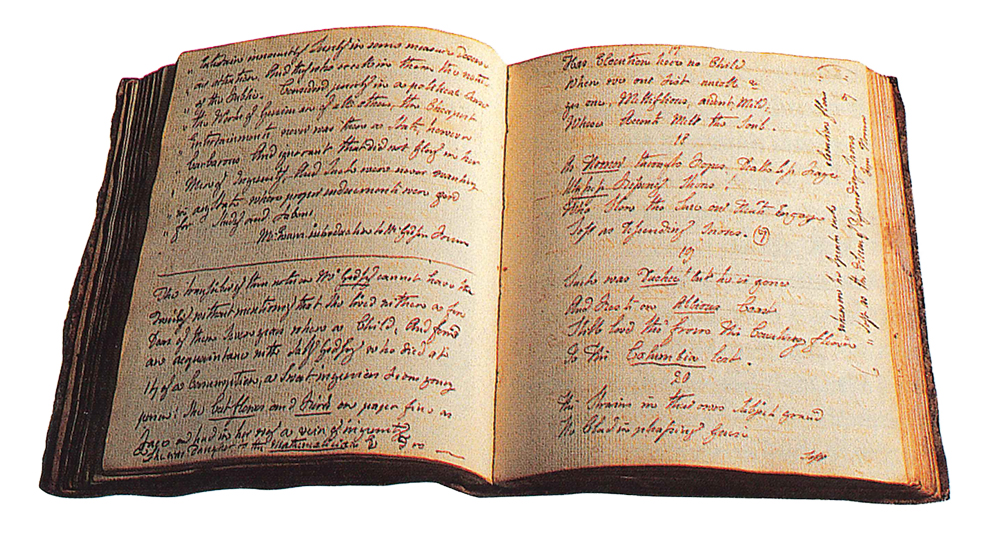
Throughout her life, Elizabeth compiled several commonplace books, personal notebooks containing poetry, quotes, letters, observations, recipes and references. These works were shared among writers or compiled specifically for a recipient. Elizabeth compiled this book between 1787 and 1788 for the five sisters of the Willing family. It is now in the collection of Graeme Park.
Photo, Pennsylvania Historical & Museum Commission
Having lost Graeme Park and with her finances in shambles, Elizabeth sought to rehabilitate her reputation, which had been tarnished by her marriage to Henry Hugh Fergusson and the treasonous actions with which he was associated, by engaging in the intellectual pursuits that earned her so much esteem in her youth. She revised and annotated her earlier writings, wrote endlessly, and submitted her works for publication as new periodicals sprang up in Philadelphia. Though she succeeded in publishing numerous pieces, Elizabeth’s financial situation remained precarious as her health declined. Elizabeth took to her bed and died on February 23, 1801.
Though Elizabeth Graeme Fergusson’s life was marked by heartbreak and loss, her contributions to early American literature remain invaluable today. Her poetry and commonplace books capture the heart-rending experiences of a woman whose life was upended by a disastrous marriage and the chaos of revolution. Further, her attic evenings and correspondence with other female writers in Philadelphia fostered an environment in which women honed their literary voice and shared their experiences, producing a body of work that chronicles the importance of women’s contributions to the Revolution and how that event shaped and reshaped their lives.
Further Reading
Fatherly, Sarah E. “‘The Sweet Recourse of Reason’: Elite Women’s Education in Colonial Philadelphia.” Pennsylvania Magazine of History and Biography 128, no. 3 (July 2004): 229–56. / Gratz, Simon. “Some Material for a Biography of Mrs. Elizabeth Fergusson, née Graeme.” Pennsylvania Magazine of History and Biography 39, no. 4 (1915): 385–409. / Mader, Rodney. “Elizabeth Graeme Fergusson’s ‘The Deserted Wife.’” Pennsylvania Magazine of History and Biography 135, no. 2 (April 2011): 151–90. / Nath, Kimberly. “Left Behind: Loyalist Women in Philadelphia During the American Revolution.” In: Oberg, Barbara B., ed. Women in the American Revolution: Gender, Politics, and the Domestic World. Charlottesville: University of Virginia Press, 2019: 211–28. / Ousterhout, Anne M. The Most Learned Woman in America: A Life of Elizabeth Graeme Fergusson. University Park: Pennsylvania State University Press, 2004. / Reed, Joseph. Remarks on Governor Johnstone’s Speech in Parliament. Philadelphia: Francis Bailey, 1779. / Slotten, Martha C. “Elizabeth Graeme Ferguson: A Poet in ‘The Athens of North America.’” Pennsylvania Magazine of History and Biography 108, no. 3 (July 1984): 259–88. / Tillman, Kacy Dowd. Stripped and Script: Loyalist Women Writers of the American Revolution. Amherst: University of Massachusetts Press, 2019. / Treese, Lorett. Graeme Park: Pennsylvania Trail of History Guide. Mechanicsburg, PA: Stackpole Books; Harrisburg: Pennsylvania Historical & Museum Commission, 2003.
Jennifer Eaton Barndt is the curator at the Pennsylvania Military Museum in Boalsburg. Her other articles for Pennsylvania Heritage on women and the American Revolution include “Hastening the Deliverance of Her Country: Esther DeBerdt Reed and the Ladies Association of Philadelphia” (Spring 2024), “Elizabeth Drinker and the Quaker Exile” (Spring 2023), and “Two Faces of Molly Pitcher” (Spring 2022).