
Douglas L. Allison, Civil War Veteran and Professional Baseball’s First Modern Catcher
Written by Richard Saylor in the Our Documentary Heritage category and the Summer 2025 issue Topics in this article: American Civil War, Army of the Potomac, baseball, Camp Cadwalader, Cincinnati Red Stockings, Douglas L. Allison, muster rolls, Philadelphia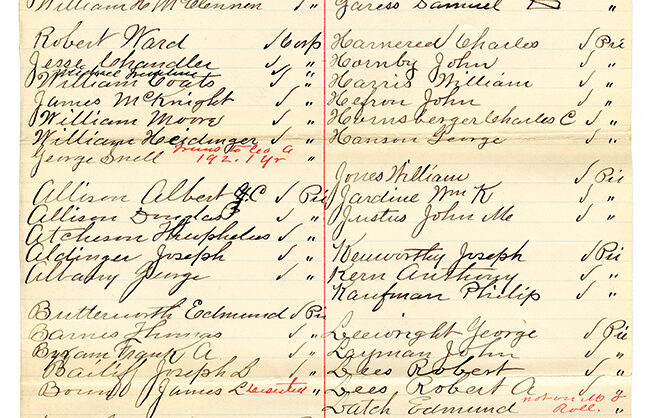
Page from the muster roll roster for Company L, Pennsylvania Volunteer Infantry Regiment.
Pennsylvania State Archives, RG-19.11, Carton 125
The Pennsylvania State Archives holds the American Civil War muster rolls for Pennsylvania-raised troops in its collection. Entries in these rolls include essential information about the soldiers who served in the conflict, and they are used by historians, genealogists, students and other patrons to trace the lives of individuals who fought in the war and went on to other pursuits.
One of the soldiers listed in the muster rolls is Douglas L. Allison (1846–1916). On July 11, 1864, at the age of 18, he enlisted as a private in Company L, 192nd Pennsylvania Volunteer Infantry Regiment, in his hometown of Philadelphia. His term of enlistment was for a period of 100 days.
Hundred-day regiments, like the 192nd, were raised in 1864 when Confederate Gen. Jubal A. Early launched attacks down the Shenandoah Valley that threatened the nation’s capital, Maryland, and the southern border of Pennsylvania. The Army of the Potomac had suffered a tremendous number of casualties in Gen. Ulysses S. Grant’s Overland Campaign in May and June of that year. Therefore, calls for 100-day volunteers went out across the North on July 6. Pennsylvania regiments numbered 192 through 197 were some of those who answered the government’s plea.
The 192nd trained at Camp Cadwalader in Philadelphia. The regiment left the city on July 23 and proceeded to Baltimore, where it camped until the beginning of August. It was then dispatched to Fort McHenry. While there, the 192nd underwent intensive training with heavy artillery. It is believed that this is where Allison suffered the hearing loss that would plague him for the rest of his life.
The regiment next traveled to Johnson’s Island at Lake Erie where large numbers of Confederate prisoners of war were held. After a few days there they were posted at Gallipolis, Ohio, where a large Union supply depot existed. They guarded the depot and helped ship supplies until September 30 when Company L and five other units of the 192nd were sent to Weston, West Virginia, where they remained until their terms of service expired. Allison mustered out of service with his regiment on November 11, 1864.
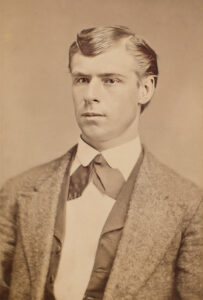
Doug Allison, circa 1870.
New York Public Library
By the end of the 1860s, the game of baseball had spread across most of the country. The sport was a popular form of recreation in the Union Army during the Civil War, providing soldiers with some relief from the boredom of camp life. After the war, many soldiers took the game back with them to their hometowns, spreading the sport into new regions. It is not surprising, therefore, that a number of former soldiers would gain success as the first professional players in baseball history.
After the war, Allison worked for a time in a brickyard in Philadelphia. He also became an accomplished baseball player who was recruited from the Geary Baseball Club of Philadelphia to be a member of the Cincinnati Red Stockings for the 1868, 1869 and 1870 seasons. At 5 feet, 10 inches and weighing 160 pounds, Allison was Cincinnati’s primary catcher, while occasionally playing in the outfield. The 1869 Cincinnati team was in the National Association of Base Ball Players and is considered to be the first openly professional baseball squad in the history of the sport. The team posted a perfect 65–0 record in 1869, while playing teams from across the country.
On June 27, 1870, Allison made history when he wore a pair of buckskin gloves while catching. This is the first known instance of anyone in professional baseball wearing any form of glove for catching. Allison is also credited with being the first catcher to stand directly behind the batter in 1866. The norm at the time had been for catchers to stand 20 to 25 feet behind the plate and catch the ball on one bounce.
The Cincinnati team broke up after the 1870 season, and its players dispersed to other teams around the country. Allison later played for the Washington Olympics, Troy Haymakers, Brooklyn Eckfords, Elizabeth Resolutes, New York Mutuals, Hartford Dark Blues, and Providence Grays. His Major League career lasted through 1883, when he played for the Baltimore Orioles. He was a right-handed thrower and hitter, compiling a .271 career batting average.
Allison was not alone as a Civil War veteran who went on to play Major League Baseball. The Society for American Baseball Research estimates that there were 30 Major League players or managers who had been Civil War veterans. Several other veterans of the war from Pennsylvania, whose names and details of service can be found in the muster rolls, were part of this group.
Richard C. Saylor is an archivist for the Pennsylvania State Archives and author of the award-winning book Soldiers to Governors and numerous articles on military, political and sports history.