
Digging in the City of Brotherly Love by Rebecca Yamin
Written by Janet Johnson in the Book Review category and the Spring 2024 issue Topics in this article: archaeology, Philadelphia, Rebecca Yamin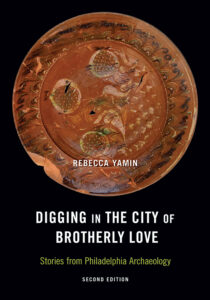 Digging in the City of Brotherly Love
Stories from Philadelphia Archaeology
Second Edition
by Rebecca Yamin
Temple University Press, 320 pp., paperback $35
Digging in the City of Brotherly Love is a captivating exploration of Philadelphia’s rich historic past through the eyes of an exceptional historical archaeologist. The race against development and the destruction of hidden stories are focal points in this update of Yamin’s original 2008 publication. Three additional chapters of recent discoveries further disclose the depth of a complex and diverse city and the pressures to save the past.
Remarkably, the material culture of the people who contributed to the complexity of this city was discovered in buried surfaces, undisturbed by the ever-sprawling urbanization. Construction on the expanded I-95 corridor has uncovered countless archaeological sites. The Gunners Run South site, located in the Kensington-Fishtown neighborhood, northeast of Center City, offered evidence of human activity over thousands of years. Stone tools, clay pottery and cooking hearths have been dated to roughly 4,500 years ago. Shipwrights and fishermen later occupied the site, but it wasn’t until the mid-1800s that glassworks, taverns and shoe stores arrived. Archaeologists exposed privies and house foundations flush with the artifacts of 19th-century working class families. Untold stories discovered through the excavations allow descendants to connect to their cultural heritage.
Philadelphia is not unique in the discovery of unmarked graves; it is an unpleasant reality of urbanization. Yamin addresses this issue at a development project on the site of the First Baptist Church. Documentation indicates the burial grounds were moved in 1860 to Mt. Moriah Cemetery; however, construction revealed a much different story. The developer exposed human remains but continued to operate heavy equipment at the site, dislodging and damaging burials before archaeologists could recover the remains. The Philadelphia Orphan’s Court facilitated a pause in construction enabling the removal of nearly 400 burials. Archaeologists and historians continue the painstaking process of examining physical traits, burial placement and accoutrements to identify the individuals. The human remains and the associated artifacts were reinterred in the Moriah Cemetery more than 150 years later than historic documents denoted. The author raises the issue of respectful treatment of cemeteries and the need to improve preservation laws prohibiting their destruction.
Yamin artfully merges the archaeological evidence and historic research into compelling stories of individuals and communities often omitted in textbooks and tourist attractions, reaching beyond the iconic symbolism to examine the city as she suggests, “from the inside out.”
Janet Johnson
The State Museum of Pennsylvania