
Defining Boundaries: Pennsylvania vs. Virginia
Written by Richard Saylor in the Our Documentary Heritage category and the Summer 2024 issue Topics in this article: American Revolution, Andrew Allen, James Tilghman, John Murray, John Penn (governor), Pennsylvania Constitution of 1776, Pittsburgh, state archives, Virginia–Pennsylvania boundary dispute, Westmoreland County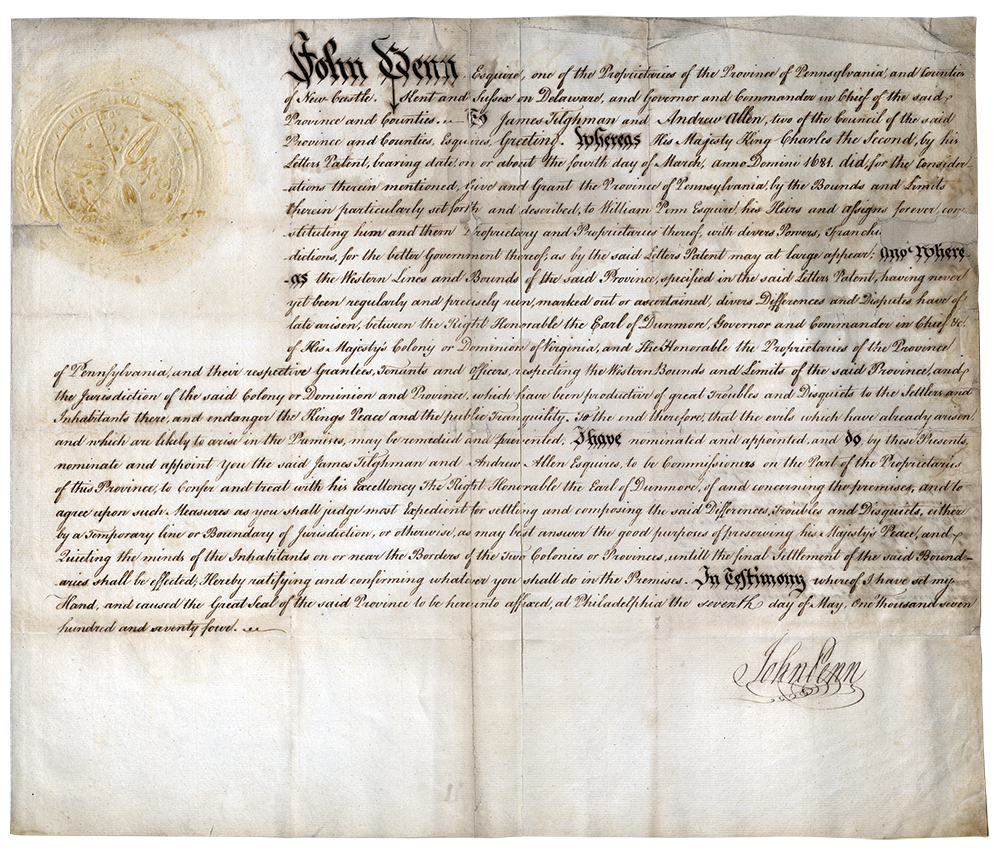
In 1774 most of Pennsylvania was focused inward, not outward, as the commonwealth disputed claims from Virginia for the southwest corner of the colony and from Connecticut for the Wyoming Valley and part of the northern tier. While Philadelphians were involved in resisting the British taxation laws, most other Pennsylvanians were preoccupied with troubles on the frontier.
Colonial competition over Pennsylvania’s borders is paramount to understanding its development in the 1700s. The Virginia–Pennsylvania boundary dispute began after the British army garrison was removed from Fort Pitt in 1772. With the establishment of Westmoreland County in February 1773, Pennsylvania claimed all the southwestern corner of the colony, including Pittsburgh. The vague Virginia Charter of 1609, however, led Virginians to believe that their westward expansion would include land as far northwest as the coveted forks of the Ohio River at Pittsburgh, clashing with the boundary set for Pennsylvania’s western expanse in William Penn’s 1681 Charter.
From 1773 until the start of the American Revolutionary War, Virginia’s governor, John Murray, 4th Earl of Dunmore, controlled southwestern Pennsylvania as a district of Virginia, and irregular warfare took place between settlers loyal to Virginia and those devoted to Pennsylvania.
Many western Pennsylvanians felt that those in the eastern part of the colony failed to understand their concerns and desires, and they believed that they were lacking adequate representation in the Assembly. At the same time, Virginia was trying to convince western Pennsylvania settlers that they would be better protected by the Virginia government in frontier disputes.
On May 7, 1774, Gov. John Penn signed a commission authorizing James Tilghman and Andrew Allen to “confer and treat” with the Earl of Dunmore on behalf of the proprietors of Pennsylvania. It states that Pennsylvania’s Charter of 1681 and Virginia’s Charter of 1609 have caused disputes in the western boundaries, particularly in the southwest corner of Pennsylvania, and to settlements and inhabitants there. It also states that the troubles were endangering the “King’s Peace and the public Tranquility.” The two commissioners were instructed to negotiate a “temporary line or boundary of jurisdiction, or otherwise as may best ensure the good purposes of His Majesty’s Peace, and quieting the minds of the Inhabitants on or near the Borders of the two Colonies or Provinces, until the final settlement of the said boundaries shall be effected.”
The commissioners were unsuccessful in their subsequent negotiations, as Lord Dunmore refused to relinquish Virginia’s claim on Pittsburgh, but other developments would ultimately settle the dispute. As part of the new United States, Pennsylvania adopted its own Constitution in 1776, which allayed some of the concerns of western Pennsylvanians, as it gave them a larger number of representatives and a greater role in the new state government. This boosted a sense of cohesion in the state and made western residents less likely to want to be governed by Virginia. Also, Pennsylvania militias would now be organized and funded by the state, providing additional security on the frontier.
During the Revolutionary War, Virginia changed its policy to focus on the conflict in the east and cut back on the number of troops allocated in western Pennsylvania. In August 1779 the two states agreed to push the Mason–Dixon Line west to a point 5 degrees longitude west of the Delaware River. The Continental Congress affirmed this by resolution in December 1779. In the conclusion of this border dispute, Pennsylvania accepted many Virginia land titles in Washington County in 1780.
John Penn’s commission to James Tilghman and Andrew Allen is preserved in the Pennsylvania State Archives in Record Group 21: Proprietary Government, Executive Correspondence.
Richard C. Saylor is an archivist for the Pennsylvania State Archives and author of the award-winning book Soldiers to Governors and numerous articles on military, political and sports history.