
Cradle of Conservation by Allen Dieterich-Ward
Written by Char Miller in the Book Review category and the Spring 2025 issue Topics in this article: Allen Dieterich-Ward, conservation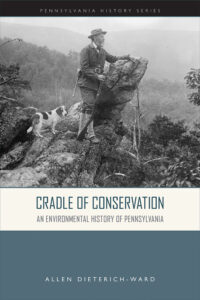 Cradle of Conservation
An Environmental History of Pennsylvania
by Allen Dieterich-Ward
Temple University Press, 144 pp., paperback $19.95
Cradle of Conservation is the first comprehensive analysis of the commonwealth’s environmental history and is a superb addition to the Pennsylvania History Series. Better still, this slim volume offers a compelling model for any state eager to better understand its environmental past.
In five tightly written chapters that flow chronologically, the book begins by exploring the world that the “First Pennsylvanians” created — Indigenous stewardship that postcontact, settler-colonial society overran in its pursuit of marketable commodities to sell within the transatlantic economy. Timber, foodstuffs and iron were among those capital-generating commodities that drew new migrants to Penn’s Woods.
By the mid-19th century, the state was divided into a series of “working landscapes” that provided raw materials to rapidly growing cities linked by an expansive network of roads, canals and rails. Industrial Pennsylvania generated new concentrations of wealth and myriad problems — splintered forests, depleted soils, polluted air and water, and exploited labor — that an emerging conservation movement tried to correct.
Progressive efforts to beautify cities, protect wildlife, and regenerate woodlands helped mitigate some of these earlier excesses, though new challenges arose with the post-World War II economic and demographic boom. Federal and state environmental regulations focused on endangered species, wilderness, flood control and other dilemmas, yet these interventions also sparked a conservative pushback that Dieterich-Ward argues limited top-down management in favor of a more voluntaristic, public-private approach.
Ironies awaited. This political strategy, for example, could not revive the catastrophic loss of the Three Mile Island nuclear power plant and could not because postindustrial Pennsylvania mined its vast natural gas deposits — combusting this fossil fuel further accelerated climate change’s disruptive energy.
Richly detailed and well argued, Cradle of Conservation balances fine-grained analyses with an inclusive sweep of people and place over time. It is a remarkable achievement.
Char Miller
Pomona College