
Carved in Stone, Revealed in New Light: Early Gravestone Carvers and Funerary Folk Culture of the Pennsylvania Dutch
Written by Patrick Donmoyer and Michael Emery in the Features category and the Summer 2024 issue Topics in this article: Baroque Carver (Lancaster), Berks County, blank gravestones, Bucks County, cemeteries, Dauphin County, gravestone carvers, Henry M. Muhlenberg, Jacob Motz (Northampton Carver), Jacob W. Gross, Johann Jacob Hirneisen, Joseph Clodfelter, Lancaster County, Lebanon County, Lehigh County, Moers Marble Works, Montgomery County, Northampton County, Pennsylvania Dutch (Pennsylvania German), Schuylkill County, Tulpehocken Carver, Tulpehocken Valley, wooden gravestones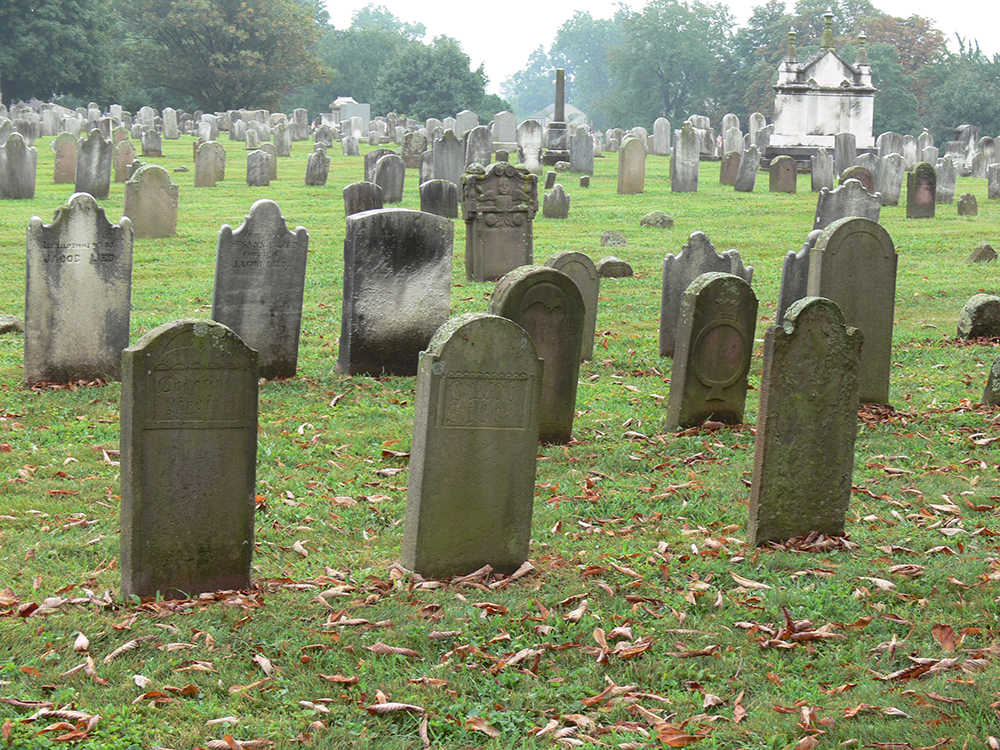
The gravestones at Muddy Creek Lutheran Church Cemetery in Denver, Lancaster County, are set in succession beginning with those from the 18th century in red sandstone and followed by those from the later 19th century in white marble.
Photo, Patrick J. Donmoyer
In the winter of 1747, tragedy struck in the Tulpehocken Valley. Leonard Rieth (1691–1747) — among the first German-speaking settlers to journey into the valley from Schoharie, New York, in 1723 — was crushed by two cogs in his gristmill along the Mill Creek. Rieth’s untimely death also coincided with a schism that divided the Lutheran congregation that bore his family name: Rieth’s (later Reed’s) Church. With the absence of Lutheran leadership in those early years, the church building, constructed in 1727, had come under Moravian control. When Johann Nicholas Kurtz (1720–94), the first Lutheran pastor to be ordained in North America, attempted to hold Rieth’s funeral without support from the Moravians, the whole funeral party was locked out of the church and forced to hold the service in the cemetery in the bitter cold on February 4, 1747. This event was the final straw in the confessional conflict dubbed “the Tulpehocken Confusion.”
A letter from Moravian minister Johann Brucker (d.1765) to Bishop Augustus Gottleib Spangenberg (1704–92) describes the whole affair and inadvertently provides the earliest documentation of funeral customs among the Pennsylvania Dutch. While the ministers engaged in a stand-off over which denomination would officiate, three men “were called to watch” and hold vigil over the body of Leonard Rieth — a customary time of community visitation and overnight observation, as much practical as it was religious, to confirm that the deceased was ready for the grave hastily dug for the occasion. The following morning, the funeral party processed along with the bearers of the casket into the cemetery while singing mourning hymns. Reverend Kurtz conducted a graveside service and burial, after which mourners confronted Brucker, who refused to allow them access to the church sanctuary, so Kurtz held the service outside in the churchyard, delivering a funeral sermon that purportedly lasted two hours in the cold of winter.
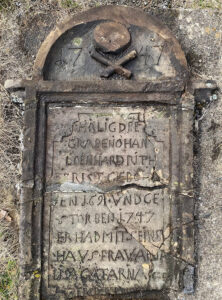
Leonard Rieth was among the first German-speaking immigrants to settle in the Tulpehocken Valley in 1723. The celebrated Tulpehocken Carver made this gravestone after Rieth died in a milling accident, sparking a denominational dispute between the Lutherans and Moravians called the “Tulpehocken Confusion.”
Photo, Patrick J. Donmoyer
This three-fold approach to memorializing the departed — the vigil in the home, the funeral in the church, and the graveside service in the cemetery — would remain the traditional form for centuries to follow among the Pennsylvania Dutch, culminating in the placement of a permanent stone memorial in the year to follow. Rieth’s elaborate sandstone memorial, bearing a skull and crossbones carved in deep relief beneath an arched pediment, bore this inscription in abbreviated High German:
HIR LIGD BEGRABEN
IOHAN LOENHARD RITH
ER IST GEBOHREN 1691 UND
GESTORBEN 1747. ER HAD MIT SEINER
HAUS FRAU ANA LISA CATARINA
GEZEIGT 8 KINDER 65 OENKELEIN.
Here lies buried
Johann Leonard Rieth.
He was born 1691 and
died 1747. He had with his
Wife Annalisa Catharina
8 children and 65 grandchildren.
The inscription provides the customary synopsis of life, including birth, marriage, death and descendants. Featuring the traditional age-old heavy Latin serif monument lettering, the text is characterized by minimized curves for ease of carving, combining letters into ligatures to save space. The style was a direct import from European stonecarving tradition, utilizing a lettering standard set by Roman monument carvers, remnants of whose works can still be found in the German Palatinate along the Rhine River Valley, where the City of Mainz served as the epicenter of Roman settlement until the 5th century CE. Well over a thousand years later, this very same geographic region served as the corridor through which more than 80,000 German-speaking emigrants departed their homelands to reach Pennsylvania prior to the American Revolution.
Leonard Rieth’s gravestone is among the earliest surviving memorials in the region, carved from brown sandstone quarried from the nearby South Mountain ridge and prepared by an unknown stonecarver of the Tulpehocken Settlement. Like Rieth, the carver was a first-generation, German-speaking immigrant. His earliest known work was carved for Johann Lenhard Becker (1694–1743), buried at the nearby Christ Lutheran Church in Stouchsburg, bearing the inscription “er ist der erste” (“he was the first”), likely the first interment at the cemetery but also perhaps the earliest work by the carver.
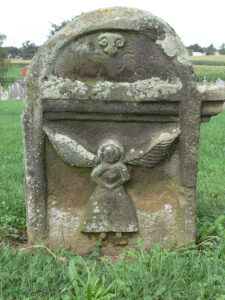
The Tulpehocken Carver made this angel figure, complete with colonial attire, in 1752. It stands in the old cemetery at Christ Evangelical Lutheran Church in Stouchsburg, Berks County.
Photo, Patrick J. Donmoyer
Among roughly a dozen gravestones produced from the 1740s through the 1760s by the early Tulpehocken Carver are those featuring skulls and crossbones, hourglasses, and winged angelic heads — classic funerary imagery of the Gothic style carved in deep relief. One monument for Catherina Becker (1705–45) bears a crowned angelic head rising from crossbones offset against a background of earth and sky. These rich, traditional images were deeply meaningful for the communities that mourned by the graveside. Serving as reminders of the fragility of life that was all too familiar in the early settlement, the images also provided some measure of comfort in depictions of resurrection. Notably absent in the Pennsylvania Dutch gravestones of this era is the image of the cross — a symbol shunned by many early Protestants as being too Catholic, which was only later adopted for widespread use in the second half of the 19th century.
The Tulpehocken Carver’s most celebrated work is the 1751 headstone for an unknown woman featuring a full-bodied female figure in 18th-century attire, wearing a dress, shoes and a head-covering, with wings extending from her shoulders. Setting the stage for other carvers to follow, the Tulpehocken Carver’s work is an early example of a rich cultural legacy of funerary monuments produced throughout the first wave of settlement in the cultural hearth region of the Pennsylvania Dutch.
In swaths extending through what is today Montgomery, Berks, Lancaster, Lebanon and Dauphin counties to the south and Bucks, Northampton, Lehigh and Schuylkill to the north, elaborately carved sandstone grave markers became the norm throughout the 18th century. Largely produced by first-generation immigrants whose techniques built upon those established by the long-standing European guild system in what is today southwestern Germany, these early American gravestones have outlasted most of their antecedents across the Atlantic, where, as a matter of scarcity of space, early graveyards have been systematically replaced by modern cemeteries. This makes the early American gravestones produced in the Pennsylvania Dutch settlements all the more significant as some of the last remaining traces of transatlantic immigrant funerary folk culture of the period.
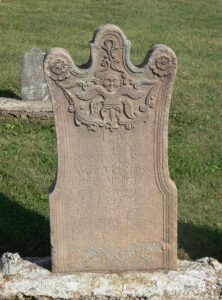
Inscribed for Susanna Miller, who died in 1794, this elaborate gravestone was made by the Baroque Carver of Lancaster. The stone is in the cemetery at Emanuel Lutheran Church in Brickerville, Lancaster County.
Photo, Patrick J. Donmoyer
These traditions blossomed in early communities throughout eastern Pennsylvania wherever stonecarvers settled and plied their trade to memorialize the departed. Only rarely are these early carvers identified, but the works of prolific and accomplished carvers are celebrated expressions of Pennsylvania Dutch material culture.
One particularly notable anonymous 18th-century carver working in the city of Lancaster produced dozens of elaborate stones with embellishments akin to baroque furniture. Rather than the classic rounded lunette shape favored by other carvers of the era, this carver’s works feature elaborate arched crests of scroll work and floral medallions similar to those adorning late baroque tall-case clocks and highboy chests of drawers. Delicate curves of scrollwork produced with a hand drill descend from the crest and encircle classic images of mortality and resurrection — an hourglass evoking the sacred hours of life alternating with the winged visage of an angel, often sporting the ringlets of a powdered wig. The Baroque Carver produced inscriptions in plain Latin or calligraphic German fraktur blackletter and frequently carved both sides of the stones including the biblical funeral text or a hymn sung at the graveside on the back.
The sophistication of the Baroque Carver of Lancaster is perhaps only paralleled by the artistry of the stoneworker formerly known only as the “Northampton County Carver,” whose works on sandstone from the late 1760s through the early 1780s extend from northern Lehigh through Northampton counties and across the Delaware River into Warren County, New Jersey. With the highest concentrations of works in Hellertown and Kreidersville, the Northampton Carver’s signature works feature images of urns bursting with diverse floral patterns — one of the most popular funerary symbols of resurrection employed by early Pennsylvania carvers. Crowned with a rosette or a face, and sometimes flanked with birds or spirals, the stones are framed within panels, columns and borders of detailed textures including stipple, crosshatch and radiating lines. Although notably concise in the wording of gravestone inscriptions, the Northampton Carver’s clean Roman lettering provides a poetic tribute to Veronia Armbrust (1728– 75), buried at Emmanel’s Union Church, Emmanuelsville, Northampton County:
FRONICA / ARMBRUSTIN / IST GA 1728 / MEIN MAD / ER LEIB SCHL / AFFT IN DER ERD /
EN ER SCHLAFFT / BIS IHN MEIN FRE / IND ER WECKT DIE / ASCHE WIRD ZUR / SONE WURDEN OB / SIE GLEICH FINSTER / NACHT IETZT DECKT / ER WIRD MIT FREUD / EN AUFERSTEHN M / IT MIR VEREINT ZUR / HOCHZEIT GEHN / GESTORWEN DEN 11 / IENNER 1775
Veronica / Armbrust / was born 1728 / My weary / body sleeps / in the earth. / It sleeps / until my friend, / shall wake it. / The ashes will be / like the sun, if / she were cloaked / in darkest night. / It will in bliss / be resurrected, / united with me / as though for marriage. / She died the 11th of / January 1775.
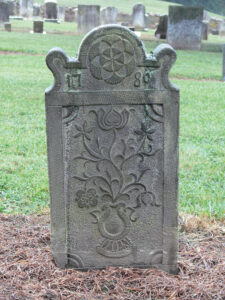
This is the reverse side of a well-preserved headstone in the Old Lower Saucon Cemetery in Hellertown, Northampton County, by Jacob Motz, formerly known as the Northampton Carver.
Photo, Patrick J. Donmoyer
The reverse of the stone reads: “F. IST GETRAUT MIT MARTIN HERBSTER 1753” (“Veronica was united in marriage with Martin Herbster 1753”). The widower Martin was likely the one to lovingly commission the stone for his beloved Veronica, but if he was buried next to her, no permanent headstone remains to tell his story.
Although the identity of the Northampton Carver had been forgotten long ago, Richard Mammana found a record of payment for £25 to “Jacob Motz for a Tombstone” in the estate settlement of Johan Friderick Frutschie (1724–81), whose gravestone in Lower Saucon is the unmistakable work of the Northampton Carver. Jacob Motz (1738–1812) and his family were immigrants from Lampertsloch in the German-speaking region of Alsace, France, who came to Pennsylvania in 1768. Motz appears on the tax list in Moore Township, Northampton County, in 1781 and later appears on the 1790 U.S. census in Washington County, Maryland, where Mammana discovered two sandstone examples of Motz’s work dating from 1790 in Sharpsburg and Leitersburg, Maryland.
Jacob Motz was neither the first nor the last funerary craftsperson to acclimate in a distinctly Pennsylvania Dutch community before heading south into areas of secondary settlement. Joseph Clodfelter (1800–74) of Davidson County, North Carolina, descended from a family of cabinetmakers and coffin makers who made their way from Pennsylvania to North Carolina. Joseph’s grandfather Felix Glatfelder (1727–1814) emigrated with his extended family from Glattfelden, Switzerland, to Pennsylvania in 1743, settling first in York before moving south to Abbotts Creek, North Carolina, in 1767.
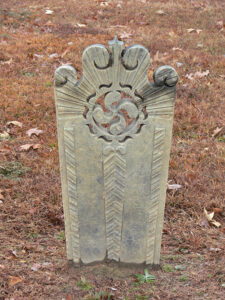
Carved for Kezia Jones, who died in 1828, this gravestone in the Primitive Baptist Cemetery in Abbott’s Creek, North Carolina, exhibits the elaborate pierced stonework of Joseph Clodfelter with classic motifs common in the Pennsylvania Dutch diaspora. Clodfelter was the grandson of Swiss immigrant Felix Glatfelder and son of the celebrated cabinetmaker Jacob Clodfelter, whose family first settled in York County before relocating to the North Carolina Piedmont.
Photo, Patrick J. Donmoyer
Among the earliest examples of the distinctive “pierced” soapstone gravestones of the region, Felix’s gravestone is attributed to his son Jacob Clodfelter (1770–1837), who is considered the progenitor of the Swisegood School of cabinetmaking. Although Jacob was a woodworker, many features of these early gravestones show molding profiles, finials and toothing details of a skilled cabinetmaker. His son Joseph Clodfelter (1800–74) carried on a family tradition making coffins, like great-great-uncle Casper Clodfelter (1709–75), while still living in York. Joseph’s expertise, however, was in producing pierced soapstone gravestones of unparalleled sophistication. In only one instance Joseph signed his work. On the verso of a gravestone likely carved decades after the death of 6-year-old Josiah Spurgin (1798–1802), he included his signature “Maid by the hand of Joseph Clodfelter.”
Craftspeople and their traditions not only spread out of Pennsylvania but also flowed into areas of early settlement from other parts of North America. The formerly Swedish Lutheran, later Episcopal, Church of St. Gabriel’s established at Morlatton, in present-day Douglassville, Berks County, contains some of the earliest gravestones in the region, several of which are strikingly similar to the gravestones of New England, and were possibly imported to the region because of a lack of established specialized trades in the early settlement.
At St. Gabriel’s, the headstone and footstone of Scottish-born Andrew Robeson (1654–1720), chief justice of Pennsylvania, is the earliest marked grave in the county. Carved from serpentine stone and crowned with a winged bust wearing a formal wig, the headstone is flanked on either side by a border of urns and flowers. A center console provides the English inscription “Here lyeth ye body of Andrew Robeson who died Feb Ye 19th 1719/20 Aged 66 Years.” The headstone provides the year of his death according to the old (Julian) calendar, foreshadowing the change of the English calendar that occurred in 1754. An epitaph on the back of the headstone reads: “Removed from noise and care, this silent place I chose, when death should end my years, to take a sweet repose. Here in a peaceful place, my ashes must remain; my savior shall me keep and raise me up again.” The footstone reads “Remember Death,” topped by a crown of rays above a skull resting on an overturned hourglass and crossbones, flanked by the initials of the deceased.
A few stones by the same carver appear in Greater Philadelphia at Gloria Dei (Old Swedes’) Episcopal Church cemetery. Another stone carved for James Bingham and dated 1714 stands nearby at the entrance of Christ Church. The English baroque quality of the carver’s work bears some resemblance to gravestone traditions in early Presbyterian cemeteries, such as those at Great Conewago in Straban Township, Adams County, and Chestnut Level in Quarryville, Lancaster County. The distinctive styles of Anglo-American carvers stand in contrast to the Gothic style of the earliest German-language stones in the region, especially those produced from sandstone along the South Mountain ridge, which bisects the Pennsylvania Dutch region of early settlement.
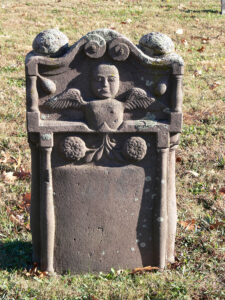
An elaborate winged angel head peers out from the pediment of this red sandstone gravemarker at Muddy Creek Lutheran Church in Denver. This undated example is among the many “blank” gravestones that once featured painted inscriptions at this cemetery.
Photo, Patrick J. Donmoyer
Just below South Mountain in the Cocalico Valley of Lancaster County, a particularly notable early carver utilized the rich deposits of brown and red sandstone for producing elaborate monuments featuring a unique blend of figural and architectural elements carved in deep relief. With examples at the historic graveyards of the formerly union churches at Muddy Creek Lutheran in Denver and Swamp Church in Reinholds, as well as Bergstrasse Lutheran Church in Ephrata, this unknown Cocalico carver is best known for producing stones featuring the bust of the deceased in profile on one side of the stone, with an image of a winged angel on the opposite side. These angels, depicted with wings instead of arms and often with the inclusion of a belly button, suggest the ascension of the human soul after death, and in at least one example, two blossoms spring forth from the belly of the angel. Architectural elements, such as Doric columns, pediments and spiral scrollwork, anchor these gravestones firmly within the stonemason’s architectural trade.
Beyond the rich imagery characterizing the works of this Cocalico carver, however, is the remarkable lack of carved inscriptions. Below the elaborately executed pediments, the carver deliberately left convex consoles entirely blank. Although this absence of text has puzzled visitors to these cemeteries for generations, evidence still visible at Muddy Creek suggests that these stones were part of a long-forgotten funerary practice of gravestone painting.
Three gravestones in the cemetery show traces of paint still clinging to the surface. One notable example includes the ghostly remnants of pale white German calligraphy in narrow lettering that is no longer legible. This stone was originally painted white with lettering in a contrasting color. As the top layers of paint gradually wore away, the white background protected under the black lettering was gradually revealed.
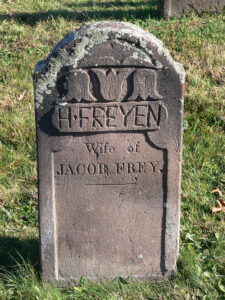
The red sandstone gravemarker for Hanna Frey at Muddy Creek Lutheran Church Cemetery in Denver shows evidence of a painted inscription, as well as a later carved inscription in English.
Photo, Patrick J. Donmoyer
A gravestone for Hannah Frey (1769–1809) features an elaborate carved inscription with paint still clinging to the carved German lettering on the back, while the front bears a blank space that was later carved with a modern English inscription: “Wife of Jacob Frey.” Both the front and the back show remnants of white paint at the bottom and along the edges, suggesting that the stone had been painted a solid color, perhaps as a basecoat for lettering or other embellishments in a contrasting color. This latter example suggests that painting and carving were once complimentary techniques for inscribing and decorating gravestones, and that in some cases, after painting was no longer widely practiced, some carved inscriptions were added later for clarification of the formerly painted empty spaces.
This evidence provides the much-needed context for interpreting other stones in local cemeteries that show a puzzling juxtaposition of blank spaces with carved elements. In one case, a crowned circular cartouche stands conspicuously empty where a painted inscription would have completed the memorial. In another instance, an otherwise blank stone with a finely carved border is punctuated by a lonely urn at the very bottom of a large bare space that once likely included painted floral elements emerging from the urn.
Evidence of painted stones in two cemeteries in nearby Brickerville, Lancaster County, as well as others in Birdsboro, Berks County, and Hummelstown, Dauphin County, suggest that painted stones may have once been the norm throughout the Pennsylvania Dutch cultural region in areas of early settlement.
This tradition was also carried to other parts of North America with the diaspora of German-speaking communities, such as the Moravians who settled in North Carolina. Archaeologist Bradford L. Rauschenberg discovered physical evidence of painted stones in Abbot’s Creek, North Carolina, as well as a remarkable entry in the records of Old Salem: “In regard to the gravestones, we think that the Brethren and Sisters may choose the type of lettering they prefer, and the color of the paint.” Rauschenberg theorized that the annual Moravian tradition of cleaning gravestones on Good Friday in Salem still carried on to this day was an extension of the upkeep required to maintain customarily painted stones. Evidence of a painted stone at Old Whaler’s Presbyterian Church in Sag Harbor, Long Island, New York, suggests the same might be true in early English settlements.
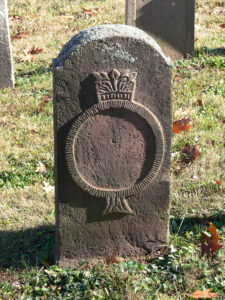
Among the “blank” gravestones at Muddy Creek Lutheran Cemetery is this one with an elaborate carving of the Crown and Ring that likely had a painted inscription in its center.
Photo, Patrick J. Donmoyer
Although some remain skeptical about the practice, this evidence serves as one of many nuanced reminders that although historic cemeteries are largely composed of seemingly permanent stone, their appearance and structure is far from static and part of a continually changing landscape shaped by continued human interactions and the ever-shifting sands of time. In many of the earliest local cemeteries associated with church congregations, graves show a visible progression that corresponds to the gradual expansion and continued use of the graveyard. Although there are some exceptions, the oldest graves in most historic cemeteries are typically situated closest to the original location of the church. If the cemetery was used consistently over many years, the plots farthest from the church are often the latest graves, and this progression is reflected in the materials of choice and format of grave markers.
In contrast to the broader Pennsylvania Dutch community, whose upright gravestones were often clustered by family, Moravian and Quaker cemeteries traditionally laid memorial stones flat on the ground, and the Moravians typically numbered the stones and arranged them in order of burial by gender.
Early graves throughout the region may be marked with stones showing a wide range of expression — everything from uninscribed headstones and footstones defining the parameters of the grave to professionally produced formal gravestones. Many early cemeteries feature substantial groups of early gravestones, and frequently there are also conspicuously vacant areas adjacent to the earliest plots. Although some assume this is because graves were either not present or stones were removed, another less-obvious explanation could be to illuminate the presence of unmarked graves.
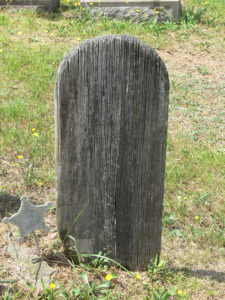
The oldest and last surviving wooden gravemarker in the Pennsylvania Dutch cultural region was formerly located at Bern Cemetery and Historic Graveyard in Bern Township, Berks County. The gravemarker was placed in the late 19th century and stood until 2020, when it was donated to the Pennsylvania German Cultural Heritage Center at Kutztown University. Students and staff made a white wooden gravemarker to replace the original.
Photos, Patrick J. Donmoyer
It was once customary to wait one full year before placing a permanent stone, and wooden markers were used extensively throughout the 18th and 19th centuries. Although this was certainly a practical concern, as the interim year allowed the ground to settle after burial, old beliefs concerning the dead also played a significant role in perpetuating this tradition. Folklorist Edwin Miller Fogel (1874–1949) documented the once-common belief that erecting a gravestone prior to the close of one full year after burial would portend another death in the family. This tradition of placing wooden markers in the first year is still a common sight in the Rhineland Pfalz today, where wooden markers indicate a recent burial. Although some of the wooden markers in Pennsylvania were likewise only temporary and later replaced with more permanent formal gravestones, others that featured painted inscriptions were clearly intended to last far longer, and many likely stood for more than a century or more before rotting away.
One such wooden grave marker was erected sometime in the late 19th century at Bern Cemetery and Historic Graveyard in Bern Township, Berks County. The wooden marker, heavily weathered beyond legibility, stood for more than 125 years until late 2020, when it was donated by the cemetery trustees to the Pennsylvania German Cultural Heritage Center at Kutztown University, where it has been preserved as part of the museum’s cultural collections. In turn, Heritage Center staff and students carefully constructed a replacement marker of hand-planed clear white pine to match the original, which was dedicated on November 1, 2023 — All Saints’ Day — an auspicious date in the folk cultural religious calendar when graves were typically tended and tidied before the coming of winter.
Only just a step beyond the handling and treatment of wooden markers are the preponderance of inexpensive fieldstone markers carved and lettered in varying degrees of skill, offering a wide range of inscriptions — everything from a simple pair of initials, with perhaps a date, to lengthy biographies including vital statistics even the occasional epitaph. Although some of these were produced by stonemasons better suited to utilitarian jobs, others demonstrate the breadth of work that early stonecarvers produced for their communities, including datestones for houses and barns, thresholds, windowsills and mantles, fence posts and steps, grindstones for millers and painters, and even kitchen sinks.
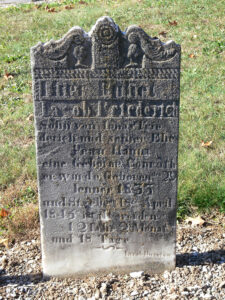
Stonecarver Jacob Hirneisen was a first-generation immigrant to Pennsylvania from Hochdorf, Germany, who settled in the Cocalico Valley. He carved and signed this stone for Jacob Friederich, 1833–45, which stands at Swamp Church in Reinholds, Lancaster County.
Photo, Patrick J. Donmoyer
Throughout the 19th century, new waves of German immigrants continued to arrive in Pennsylvania. Among them were professional stonecarvers specializing in marble, which had become the new standard among the Pennsylvania Dutch. Johann Jacob Hirneisen (b. 1777) of Hochdorf in Baden-Württemberg, arrived in Pennsylvania in 1819 and settled in the Cocalico Valley with his family. Hirneisen’s distinctive and highly detailed work in marble at Muddy Creek and Swamp Church combines inscriptions of raised and inset text in bold Latin lettering, accompanied by floral motifs, busts of the deceased, and delicate lace borders. Hirneisen’s work is recognizable not only by his distinctive stonecarving but also by his clear signature on the lower right, as well as a numbering system that he used to track the amount of stones he carved. Hirnesisen produced gravestones in red sandstone, and in marble.
By the end of the 18th century, however, with the establishment of regional commercial stone manufactories in urban centers, the quality, standardization and regional distribution of marble changed the face of cemeteries throughout southeastern Pennsylvania. The largest and longest running was the company of John Frederick Moers of Reading, established in 1790 and operated for more than a century by three generations of the family until J.F. Moers III retired in 1904. The Moers Marble Works began as a millstone business and later transitioned to carving gravestones from marble quarried in Montgomery County that was sawed into slabs by convicts in the Eastern State Penitentiary in Philadelphia and then shipped up the Schuylkill River to Reading. The Moers stone company sold marble headstones and footstones to customers throughout eastern Pennsylvania with costs calculated by the inch for a variety of grades of marble, making headstones not only affordable but also part of an efficient process.
The Moers company worked directly with ministers, cemetery wardens and schoolmasters who assisted in making funeral arrangements for the deceased. Between September 19, 1840, and June 21, 1841, J.F. Moers II indicated in his ledger that William Schubert, schoolmaster at Dunkel’s Church in Greenwich Township, Berks County, ordered first one headstone and footstone pair, followed by two orders for multiple headstones and footstones bought by the inch totaling 88 feet, 1 inch.
In some cases, schoolmasters were not only responsible wardens of the cemetery but also actual carvers themselves, such as Absalom Bixler, celebrated Lancaster County redware potter, farmer, justice of the peace, printer and one-time schoolmaster in Earl Township, whose stones along with those of his brother David Bixler appear at Muddy Creek and other locations in Lancaster County. In at least one case, at the New Hanover Lutheran Church in Montgomery County, the schoolmaster, Theodore Storb, was not only the cemetery warden but was also permitted to set up a stonecarving shop on the church grounds. This is in keeping with the idea that schoolmasters were relied upon by local people for assistance with literary matters, even gravestone inscriptions.
One extreme example of an early gravemarker that would have been outside the realm of interpretation for most Pennsylvanians without literary assistance is that of Henry Melchoir Muhlenberg (1711–87), organizer of the Lutheran denomination in America: “Qualis et quantus fuerit Non ignorabunt sine lapide Futura saecula” (“Future generations will not be ignorant of what sort and how great he was”). With the exception of church datestones, Muhlenberg’s massive marble ledger stone covering the length of his grave is one of very few Latin-language inscriptions in the region. The fact that few people can read the inscription today or in previous generations is an irony that was perhaps not lost on Muhlenberg himself, who remained culturally separate from his parishioners.
In contrast, generations later, community schoolmaster, prolific calligraphy artist, stonecarver, farmer and instrument maker Jacob W. Gross (1807–1900) inscribed several gravestones associated with the Deep Run East Mennonite Congregation in Bucks County, where his father Christian Gross (d. 1865) served as the minister. Gross is best known for being the last of a school of celebrated Mennonite fraktur calligraphers who embellished bookplates for shape-note hymnals, bibles and prayer books. Gross carved at least two gravestones in highly embellished fraktur lettering and likely painted the decorated date board for his 1832 farmhouse, all of which bear striking similarity to his manuscript arts. Gross may have carved more gravestones, but the soft shale stone used by carvers throughout the Mennonite community in Bucks County, while easily carved, was prone to delamination and many did not survive.
Although the Pennsylvania Dutch cultural region gradually embraced the standardization of gravestone materials and techniques used throughout the United States, perhaps most remarkable about these communities was their persistence in using German language for gravestone inscriptions. While some areas of central Pennsylvania would shift to using English-language stones by the first few decades of the 19th century, other areas in southeastern Pennsylvania continued creating German-language gravestones as a reflection of their continued use of High German in the church into the 20th century, alongside the oral use of Pennsylvania Dutch as the language of the home. Bilingual stones in Berks, Lehigh, Schuylkill and adjacent counties as far north as Luzerne would later serve as the bridge between the generations and were some of the final expressions to distinguish Pennsylvania Dutch gravestones from those of broader American society.
Early gravestone research in New England, identifying and classifying carvers and their works, has been robust for generations. The Pennsylvania Dutch, however, are among the many unique American communities whose cemeteries and funerary traditions have received only marginal attention—but there has been a resurgence of interest in recent years. Genealogists, historians, stonemasons, dowsers and artists are among those working to document, interpret and preserve the ancestral burial grounds and stories of Pennsylvania’s diverse communities for future generations. Like seeds planted long ago, the arts, languages and traditions of Pennsylvania still bloom in the cemeteries of the commonwealth.
Further Reading
Barba, Preston. Pennsylvania German Tombstones: A Study in Folk Art. Allentown: Pennsylvania German Folklore Society, 1954. / Hamilton, J. Taylor. “The Confusion at Tulpehocken.” Transactions of the Moravian Historical Society 4, no. 5 (1895): 237–73. / Lucas, June. “Piedmont North Carolina’s Swisegood School of Cabinetmaking: Expanding the Narrative, 1770–1858.” Journal of Early Southern Decorative Arts 36 (2015). / McDonald, Frank E. “Pennsylvania German Tombstone Art of Lebanon County, Pennsylvania.” Pennsylvania Folklife, 25, no. 1 (Autumn 1975): 2–19. / Messimer, Claire. Known by the Work of His Hands. Kutztown: Pennsylvania German Society, 2000. / Rauschenberg, Bradford L. “A Study of Baroque and Gothic-Style Gravestones in Davidson County, North Carolina.” Journal of Early Southern Decorative Arts 3, no. 2 (November 1977): 24–50.
Patrick J. Donmoyer is the director of the Pennsylvania German Cultural Heritage Center at Kutztown University. He is the author of several books, including Powwowing in Pennsylvania: Braucherei and the Ritual of Everyday Life and Hex Signs: Myth and Meaning in Pennsylvania Dutch Barn Stars.
Michael B. Emery is the administrator of Cornwall Iron Furnace and coauthor of several books with Irwin Richman, including Heritage Gardens, Heirloom Seeds: Melded Cultures with a Pennsylvania German Accent and Yesterday’s Farm Tools & Equipment.