
Caroline Burnham Kilgore, Legal Crusader
Written by Alli Davis in the Marking Time category and the Summer 2025 issue Topics in this article: Carrie Burnham Kilgore, Pennsylvania Historical Marker Program, Philadelphia, Supreme Court of Pennsylvania, University of Pennsylvania Law School, women's rights movement, women's suffrage movement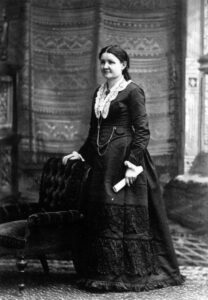
Caroline Kilgore, first woman admitted to the bar in Pennsylvania.
University Archives and Records Center, University of Pennsylvania
Caroline “Carrie” Burnham Kilgore (1838–1909) was a trailblazer in the fight for women’s rights in the legal profession, but she was not alone. Many women in Pennsylvania faced the same barriers she did, struggling for decades against systemic exclusion from law schools and the bar. Kilgore’s success in 1885, when she became the first woman admitted to the bar in Pennsylvania, was part of a larger battle waged by determined women who refused to accept the legal status quo.
Born in Craftsbury, Vermont, in 1838, Carrie Burnham faced hardship at an early age. After her father’s death, she left school at 12 to work in the family’s woolen mill while assisting with household duties. Despite these challenges, she pursued education whenever possible, eventually teaching subjects ranging from Latin and Greek to higher mathematics. Following a bout with typhoid fever, she moved to Wisconsin, where she continued teaching before turning her attention to medicine. In 1863 she moved to New York City to study at the Hygeio-Therapeutic Medical College, earning an M.D. with the goal of teaching rather than practicing medicine. She was the first woman to receive a medical degree in the state of New York.
By 1865 Burnham had settled in Philadelphia, where she operated a finishing school before deciding to study law. In 1871 she applied to the University of Pennsylvania Law School but was denied admission. At the time, there were only five women practicing law in the entire country, and the idea of a female lawyer was met with resistance. Undeterred, she attempted to vote in a Philadelphia election the same year. Election officials rejected her ballot, prompting her to challenge the decision in court. Her case reached the Pennsylvania Supreme Court, which heard arguments en banc, signaling its importance; however, the justices ruled against her.
Burnham argued that women, as citizens, were entitled to the same legal rights as men. She believed that excluding women from voting and legal practice reinforced their economic and social dependence. Although she lost her case, she remained a vocal advocate, working with organizations such as the National Woman Suffrage Association and the International Workingmen’s Association to push for broader legal reforms.
In 1876 she married Damon Kilgore, and together they signed a prenuptial agreement aimed at eliminating the legal barriers imposed on married women. Her persistence eventually paid off and she was admitted to the University of Pennsylvania Law School in 1881. She graduated in 1883 as the first woman to complete the school’s three-year law program. Initially, she was only permitted to practice before the Orphans’ Court of Philadelphia, but she and other supporters petitioned the state legislature to expand women’s legal rights. Their efforts led to the passage of Act 1885, No. 102, which allowed women to practice before the Pennsylvania Supreme Court and, by extension, all state courts.
Carrie Kilgore continued breaking barriers. In 1886 she became the first woman appointed master in chancery, a significant judicial role, and in 1890 she became the fourth woman admitted to practice before the U.S. Supreme Court. She built a successful legal career, handling probate cases, patent disputes, and contract law. Later in life, she developed an interest in hot-air ballooning and survived an accident in 1908. She passed away in 1909, but her contributions to the legal profession and women’s rights endure as part of a larger movement that changed the course of history.
The Pennsylvania Historical Marker for Caroline Burnham Kilgore was installed at 1301 Baltimore Pike in Springfield, near her former home on Walnut Lane. It was dedicated on September 26, 2024.Carrie Kilgore continued breaking barriers.
Alli Davis is the coordinator of the Pennsylvania Historical Marker Program.