
Bark Peelers’ Festival 50
Written by Joshua Roth, Jennifer Haines and Joshua Fox in the Trailheads category and the Summer 2025 issue Topics in this article: Allegheny Plateau, Bark Peelers' Festival (Bark Peelers' Convention), eastern hemlock, Independence Day, log birling, lumber, maple sugaring, Pennsylvania Lumber Museum, Pennsylvania Lumber Museum Associates, Pennsylvania Trails of History, Potter County, tanneries and tanning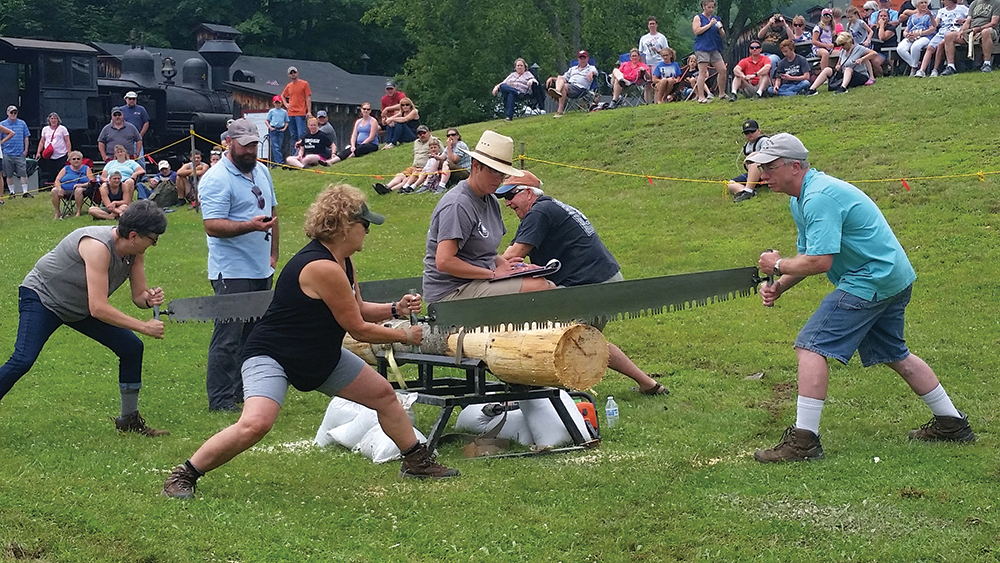
Men and women, young and old, novice and experienced competitors are encouraged to sign-up for the crosscut saw event; but the winning time is generally less than 30 seconds.
Pennsylvania Lumber Museum, PHMC
The Pennsylvania Lumber Museum’s Bark Peelers’ Festival event celebrates its 50th occurrence in July 2025. Referred to as the “Bark Peelers’ Convention” from its inception in 1974 through the 2014 iteration, the festival is the museum’s largest and most well-known yearly special event. Attendance has fluctuated over the years, from a high of approximately 4,000 to 5,000 people during the 1980s to the current average attendance of about 2,000 over the course of the two-day event. Attendees experience the museum at its best, with the year’s widest variety of educational and entertainment opportunities in the form of demonstrations, displays, contests, live music, vendors, food and crafts. Museum staff and volunteers wistfully wish that they could bring the activities of the Bark Peelers’ Festival to day-to-day visitors, but the event requires the help and support of 50 to 60 active volunteers, so it is kept to once a year.
The name and timing of the festival traces its roots to the rhythms of the historic lumber industry in Pennsylvania. Bark peelers were woods-workers who stripped the bark from felled eastern hemlock (Tsuga canadensis) trees, a species of conifer native to eastern North America that was especially prevalent within the old-growth forests of the Allegheny Plateau physiographic province across the commonwealth. Accounts from early European American settlers to the region surrounding the museum in Potter County suggest that local old-growth forest composition might have included up to 70 to 80 percent hemlock.
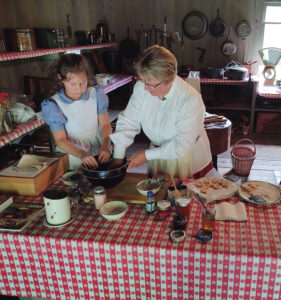
Costumed volunteers use the museum’s cast-iron cookstove to make recipes from the past for visitors to sample.
Pennsylvania Lumber Museum, PHMC
The bark of the hemlock tree is especially rich in naturally occurring chemical compounds known as tannins. Within the bark they serve to protect the tree from being infected by bacteria and fungi. People have used tannins derived from various plants for millennia to transform animal hides into leather. The large molecules in the tannins readily bind with the proteins in the animal hides making them insoluble and resistant to decomposition.
Because of the prevalence of hemlock trees in Pennsylvania’s forest, along with the numerous mountain streams available to provide the copious amounts of water needed for the tanning process, and the extensive railroad transportation network created by Pennsylvania entrepreneurs, the commonwealth became the leading producer of “rough-tanned” leather goods in the world by the 1890s. The state held its position as a global leader in leather production and a national leader in lumber production into the early 20th century, and in 1931 the eastern hemlock was selected as the official State Tree of Pennsylvania because of its importance to the commonwealth’s economy.
The peeling of hemlock bark was best accomplished during the same yearly season as maple sugaring. The sap within the hemlocks began to move more vigorously through the tree in the early spring when the cold nights and warm days caused the start of the freeze-thaw cycle. The sap continued to move within the tree until the heat of summer set in during late June to early July. The bark of the tree was easy to peel while the sap was running but peeling became more difficult when it stopped.
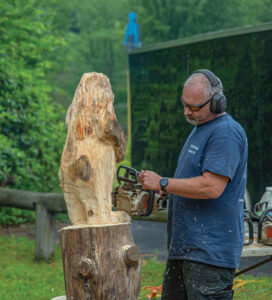
Each year a different chain-saw carver is invited to demonstrate their craft and sell their artwork to visitors.
Pennsylvania Lumber Museum, PHMC
Independence Day was one of the few holidays that were observed in historic Pennsylvania lumber camps, and it marked the practical and ceremonial end of the hemlock bark peeling season. The bark peelers worked diligently to have all the bark peeled from hemlock trees that were felled during the previous winter and spring by July 4. The national holiday marked the end of the bark harvest and was cause for a large celebration. The woodsmen were paid and would then leave their lumber camps for days or weeks, returning only when they ran out of money.
The annual Bark Peelers’ Festival is always held over the first full weekend in July to commemorate this tradition. The museum’s “friends group,” the Pennsylvania Lumber Museum Associates (PALMA), filed their articles of incorporation in 1973 and initiated the first Bark Peelers’ Convention two years later in 1975 as “a craft show, living history experience and major fundraising event.”
Although some event activities have come and gone, much of what is included in this event description from 1987 is still done at the modern festival: “During the Bark Peelers’ Convention, visitors are invited to share in the daring adventures of typical woodhick contests, such as log birling in the sawmill log holding pond, or tobacco-spitting at a hot pot-bellied stove, or to discover the skills needed in axe throwing, bark peeling, blacksmithing, chopping, sawfitting, and log skidding.”
Some past activities, like men having their whiskers shaved with an axe, the tobacco spitting contest, a fiddling contest, and a chili cook-off, have fallen off the schedule. But new activities, like the beard and moustache competition and the kids’ seed spitting contest conducted during the 2023 and 2024 festivals, keep the event fresh and exciting for repeat attendees.
The various competitions, open to public participation, have always been the highlight of the festival activities. Young visitors can sign up for the frog jumping contest and encourage frogs, provided by the museum, to hop down a 6-foot-long runway and cross the finish line first.
For visitors 16 years and older, competitions include the greased pole, log rolling, crosscut saw, and birling contests. During the greased pole contest, participants straddle an 8-inch-wide horizontal wooden pole covered in cooking shortening and try to remain seated while swinging pillows at their opponent to see who will be knocked off into a pile of sawdust.
The log rolling contest involves a team of contestants using logging tools called “peavys” to push a 12-foot-long, 12-inch-diameter log a distance of 60 feet back and forth across the ground in the fastest time. Another team event, the crosscut saw contest, has a pair of contestants try for the fastest time at sawing through a 12-inch-diameter log.
Perhaps the most popular of the competitions, the birling contest, involves contestants running in place at opposite ends of a floating 16-foot-long white pine log trying to not fall in the water.

The log pond where the birling event takes place is fed by Commissioner Run, a Class-A wild trout stream. The water is very clean, but also very cold, even in July.
Pennsylvania Lumber Museum, PHMC
Placing first through fourth in these contests gains the winners cash prizes as well as points that count toward the Grand Champion Bark Peeler title, which is awarded at the end of the weekend.
Join us this summer and see if you have what it takes to be crowned this year’s Grand Champion!
Joshua Roth, Jennifer Haines and Joshua Fox work at the Pennsylvania Lumber Museum. Roth is site administrator, Haines is museum educator, and Fox is museum curator.