
Autocar: Master of Load and Road
Written by Tyler Stump in the Picturing PA category and the Winter 2025 issue Topics in this article: Ardmore, Autocar Company, automobiles, John Clarke, Louis Clarke, Pennsylvania State Archives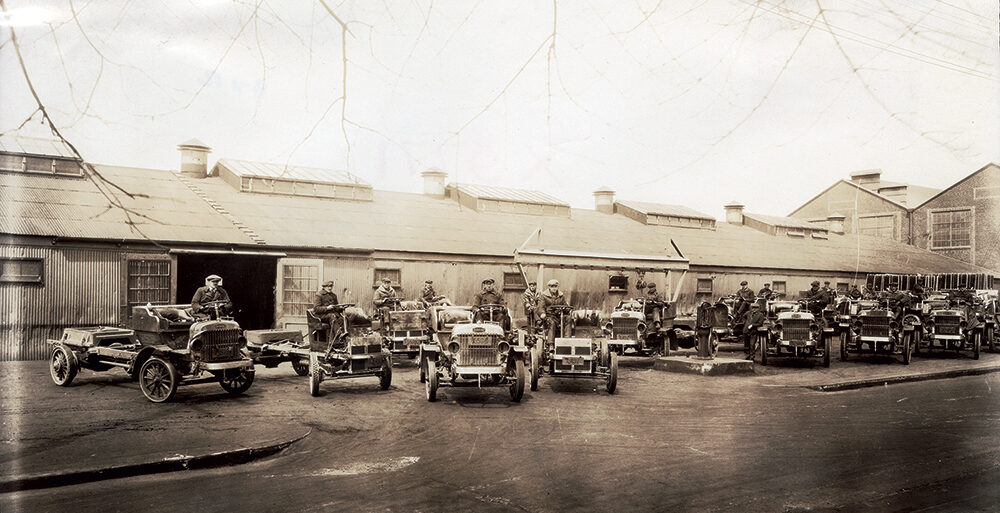
These Autocar trucks, manufactured in 1923, were taken on road tests at the Autocar factory in Ardmore before the driver’s cab and final coat of paint was applied.
Pennsylvania State Archives, MG-19
THE PENNZOIL AUTOCAR LORRY MADE HISTORY ON ITS FIRST TRIP <STOP> CARRIED 5964 GALLONS GROSS LOAD 65000 LBS OVER SIXTY MILES OF HILLS AND MOUNTAINS FROM ROUSEVILLE TO ERIE IN TWO HOURS FIFTY NINE MINUTES <STOP> ONE HOUR AND SIX MINUTES BETTER THAN PREVIOUS BEST RECORD TIME BY ANY BULK HAUL UNIT <STOP> RETURN TRIP IN ONE HOUR AND FIFTY THREE MINUTES
In 1932 the Autocar Company of Ardmore, Delaware County, received this telegram from an impressed Pennzoil employee from the company’s headquarters in Oil City, Venango County. This was not uncommon, Autocar claimed in newspaper ads; their office was flooded with testimonials and letters like these from thousands of companies.
The Autocar Company represents an interesting slice of automotive history in Pennsylvania. It was one of the earliest American automobile manufacturers, originally incorporated as the Pittsburgh Motor Vehicle Co. in 1897 by brothers Louis and John Clarke. That year Louis Clarke (1866–1957) built the company’s first vehicle, a gasoline-powered tricycle named “Autocar No. 1,” out of store-bought bicycle parts. Its frame included bike pedals and a chain that allowed the rider to start the engine, and in case of emergencies, pedal the contraption around. Soon after, they began building runabout automobiles — an early style of car that resembled a horse-driven carriage.
In 1899 the company moved across the state to Ardmore and built a factory along the Lancaster Pike. With the move, the Clarke brothers also changed their company name to Autocar.
Before there was a market for mass produced vehicles in the early 20th century, most cars were luxury purchases built by small manufacturers. Autocar stood out from competitors with its precision-built parts, including a unique porcelain spark plug and the first shaft-driven vehicle (an improvement over the typical chain-driven vehicles of the day) and became a popular choice for wealthy Pennsylvanians. Sales of Autocars helped make automobiles a much more common sight in cities across the state.
In 1899 a Scranton newspaper declared, “automobiles are coming much into favor in this city, and some six or eight may be daily seen flitting up and down the asphalt. They have become so common that people no longer stop and stretch their necks out of place watching them disappear in the distance.”
Autocar used their innovations to produce a series of heavy commercial trucks that were so successful the company shifted all production into them by 1911. Autocar trucks quickly acquired a reputation for reliability and sturdiness that appealed to companies that had previously used horse and wagon to move goods and materials. Autocar ads emphasized these qualities showing trucks navigating muddy streets, narrow alleys, and rugged rural roads. After an ice storm struck Philadelphia in 1915, an Autocar ad featured a testimonial from a merchant who was still able to get a shipment of eggs to market: “Slippery for horses, as it naturally would be, but there was no trouble with the Autocar.”
The following year more than 4,000 businesses nationwide used Autocar trucks. In Philadelphia alone there were about 1,800 Autocars traveling city streets from businesses like Horn & Hardart, Sunoco, Wanamaker’s, Strawbridge & Clothier, and H.J. Heinz.
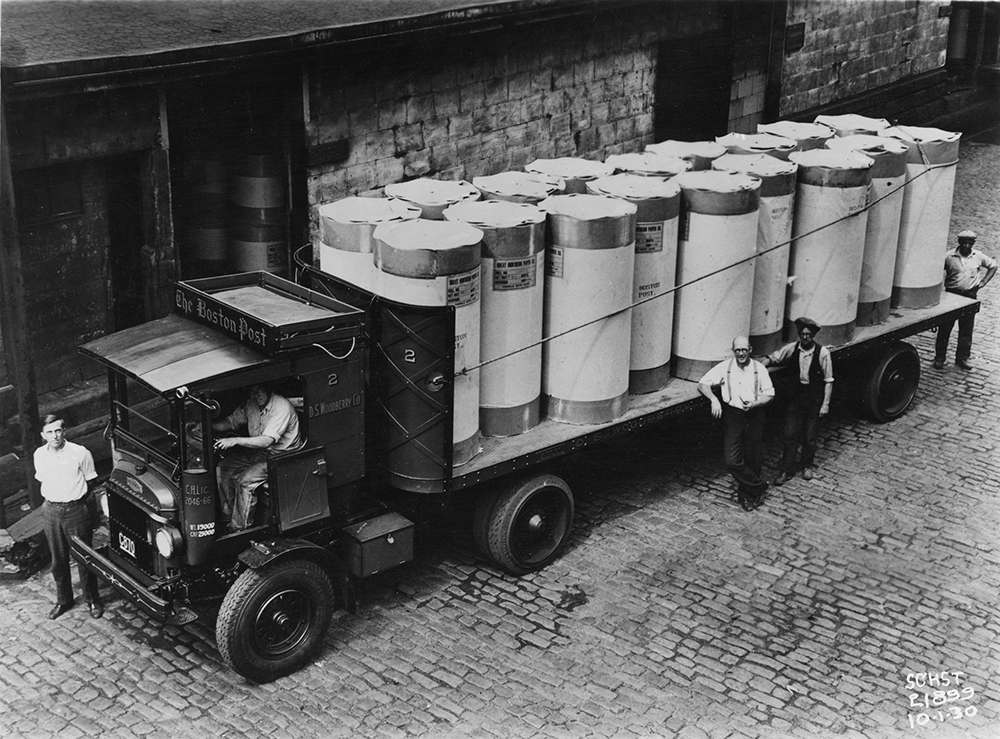
A 20-ton load of paper being hauled by an 8-ton, 6-cylinder Autocar Model SHST in 1930.
Pennsylvania State Archives, MG-19
This specialization helped Autocar stay in business when the national automotive industry shrank dramatically that decade. As major manufacturers like Ford and General Motors squeezed hundreds of small car companies out of business, Autocar survived and thrived.
Autocar trucks were so durable and easy to repair that many remained in service for decades and were, as a Bonhams antique car auction listing recently described, “an essential part of the urban scene for two or more generations.”
The Autocar Company remained independent and a favorite of the trucking industry until the 1950s. Since then, the company and brand have been bought and moved around the United States by several other firms. While you won’t see Autocars as frequently now as you would a century ago, their legacy and powerful impact on American business and the automotive industry remains to this day.
Materials pertaining to the Autocar Company can be found in the Pennsylvania State Archives in RG-13: Records of the Pennsylvania Historical & Museum Commission and MG-219: Philadelphia Commercial Museum Photograph Collection. A 1905 Autocar Type 10 Roadster can be seen in The State Museum of Pennsylvania’s Transportation & Industry gallery.
Tyler Stump is an archivist at the Pennsylvania State Archives.