
Anna Elizabeth Dickinson, Famed Orator of the Civil War Era
Written by Alli Davis in the Marking Time category and the Spring 2025 issue Topics in this article: abolitionism, American Civil War, Anna Elizabeth Dickinson, Lucretia Mott, orators, Pennsylvania Historical Marker Program, Philadelphia, William Lloyd Garrison, women's rights movement, writers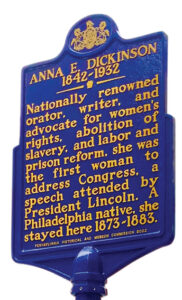 In the annals of 19th-century America, few figures burned as brightly — and as briefly — as Anna Elizabeth Dickinson (1842–1932). She was born into a Quaker family in Philadelphia, a background that shaped her deep commitment to abolitionism and women’s rights. Raised in a household that mingled with leading abolitionists, Dickinson became an activist at an early age. When she was just 13, she published an antislavery essay in William Lloyd Garrison’s famous abolitionist newspaper, The Liberator, denouncing those who waited passively for change. Her father, a fervent antislavery advocate, had died when she was only 2, leaving her mother, three brothers and sister in financial hardship.
After a short education at the Friends Select School, Dickinson was forced to find employment to support her family. She worked as a copyist and teacher and later, in 1861, became one of the federal government’s first women employees working at the U.S. Mint in Philadelphia.
In 1857 Dickinson began speaking publicly on abolition of slavery and temperance, and her eloquence and fierce convictions caught the attention of prominent figures such as Garrison and Lucretia Mott, who arranged speaking engagements for her.
Dickinson quickly gained fame as a teenage prodigy on the antislavery lecture circuit, where her stirring oratory filled venues, inspiring support for the Union during the Civil War and enthusiasm for emancipation. Known as America’s Joan of Arc, she captivated audiences with her commanding stage presence, intellect and biting wit, often speaking extemporaneously for hours. Her public criticism of Union Gen. George B. McClellan after his defeat at Ball’s Bluff, however, led to her dismissal from her job at the U.S. Mint.
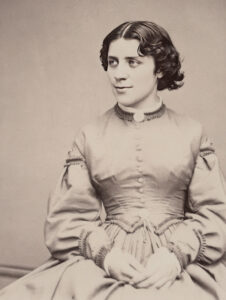
Carte de visite of Anna Elizabeth Dickinson, circa 1860.
Library of Congress, Prints and Photographs Division
In 1864, at the invitation of Republican legislators, Dickinson delivered an address to Congress in the U.S. Capitol on the floor of the House of Representatives, the first woman ever to do so. Notable military leaders, cabinet members and President Abraham Lincoln himself were also in attendance.
Dickinson’s post–Civil War career took her across the lyceum circuit, where she spoke on topics such as Reconstruction, economic justice, and equality for women and African Americans. Her oratory appeal was so strong that her paid lectures earned her about $20,000 a year, the equivalent of nearly $386,900 in 2024 — a staggering sum for any speaker, let alone a young woman in the 19th century.
Dickinson also became an author, publishing What Answer? (1868), a controversial novel sympathetic to interracial marriage. Unafraid of breaking gender norms, she even performed as Hamlet on Broadway and became one of the first women to climb Pike’s Peak in Colorado. Despite many suitors, Dickinson never married.
But fame came at a price. Later in life, Dickinson became embroiled in legal battles, suffered from paranoia, and was briefly committed to an asylum. She spent her final years in obscurity, passing away in 1932 at age 90, forgotten by a nation she once inspired.
The Pennsylvania Historical Marker for Anna E. Dickinson was installed at 1326 Arch Street in Philadelphia, near her childhood home on Locust Street, and was dedicated on March 23, 2022.
Alli Davis is the coordinator of the Pennsylvania Historical Marker Program.