
An Appeal for “Smoke Control”: Lois Bainbridge on the 1948 Donora Smog
Written by Richard Saylor in the Our Documentary Heritage category and the Fall 2023 issue Topics in this article: American Steel and Wire, Donora, Donora Zinc Works, James H. Duff, Lois Bainbridge, Monongahela River, Pennsylvania State Archives, pollution, Washington County, Webster, Westmoreland County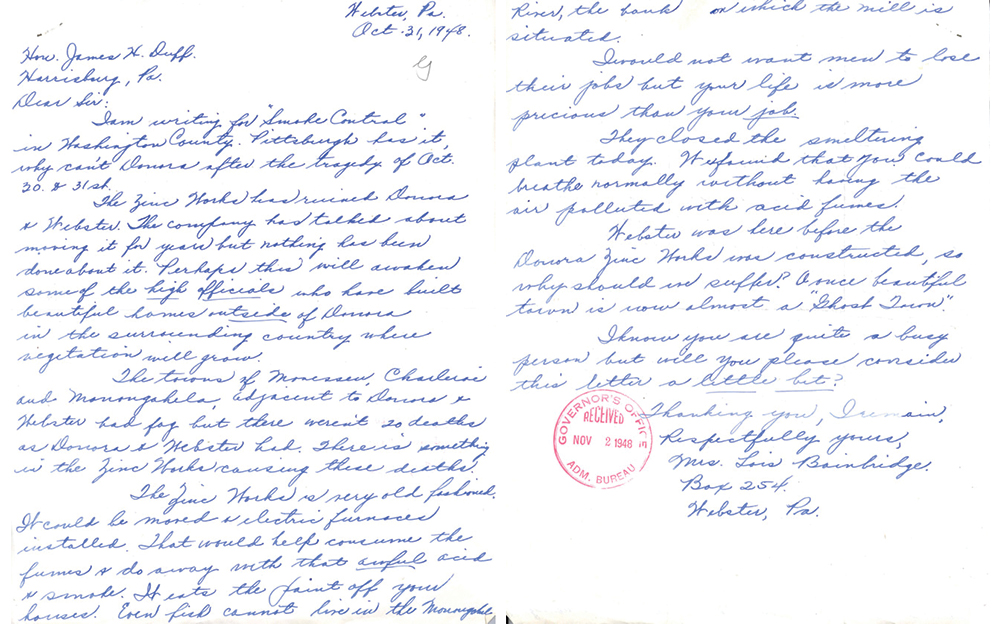
“The zinc works has ruined Donora & Webster,” wrote Lois Bainbridge to Gov. James Duff on October 31, 1948. “There is something in the Zinc Works causing these deaths. . . . [The] awful acid & smoke . . . eats the paint off your houses. Even fish can’t live in the Monongahela River, the bank on which the mill is situated.”
Lois Bainbridge was a resident of Webster, a town in Rostraver Township in Pennsylvania’s Westmoreland County. The Zinc Works she refers to was located across the Monongahela in the borough of Donora, a mill town in Washington County.
Smog enveloped Donora on October 26, 1948 (see “Gasping for Air: The Donora Smog Disaster”). A weather pattern known as a temperature inversion trapped polluted smoke — produced by the Zinc Works and the American Steel & Wire plant — close to the ground.
By the time Bainbridge had mailed her letter to the governor, 20 people in the area had died as a direct result of exposure to the poisonous smog. In addition, more than 6,000 people had become ill, nearly half of the population.
Before the disaster, people in Donora and Webster had become used to the smoke that belched from the stacks of the zinc and steel plants. The poisonous combination of gasses, heavy metals, and small particulate matter that polluted the air killed plant life and compromised the health of area residents and wildlife. This went on for decades, but the manufacturing plants were the chief employers in the area. In her plea for “smoke control,” Bainbridge wrote, “I would not want men to lose their jobs, but your life is more precious than your job.” She reasoned, “Webster was here before the Donora Zinc Works was constructed, so why should we suffer? A beautiful town is now almost a ‘Ghost Town.’”
In 1949, in response to the Donora smog event, Pennsylvania established the Division of Air Pollution Control to monitor industrial emissions more closely. Awareness of the disaster helped propel environmental studies and the conversation regarding the cost of industrial pollution on human health, and subsequent state and federal laws to improve air quality were enacted.
The Donora Zinc Works closed in 1957 and the steel plant followed a few years later. Today, Donora has a population of around 4,500 people, about a third of the population that the town had at the time of the smog disaster.
The letter of Mrs. Lois Bainbridge is preserved in the Pennsylvania State Archives in Manuscript Group 190: James H. Duff Papers.
Richard C. Saylor is an archivist for the Pennsylvania State Archives and author of the award-winning book Soldiers to Governors and numerous articles on military, political and sports history.