
A Radical Shift: Pennsylvania’s Constitution of 1776
Written by Lorett Treese in the Features category and the Summer 2026 issue Topics in this article: Associators, Benjamin Franklin, Benjamin Rush, Carpenters' Hall, Charles Thomson, Charter of Privileges, Committee for Observation and Inspection, Committee of Safety, Common Sense, Declaration of Independence, George Bryan, Independence Hall, James Wilson, John Dickinson, John Penn (governor), Pennsylvania Constitution of 1776, Pennsylvania Provincial Conference, Robert Whitehall, Second Continental Congress, Timothy Matlack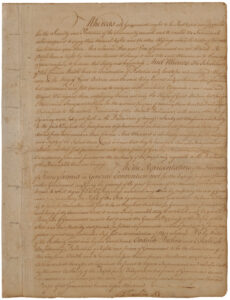
The Pennsylvania Constitution of 1776 featured such radical provisions as an annually elected unicameral legislature, a 12-member executive council, and a judiciary appointed to seven-year terms by the legislature. The document’s first page is reproduced here.
Pennsylvania State Archives, RG-26
“Our form of government still continues, but I think it cannot last long,” John Penn (1729–95) wrote to his family in England in October of 1775. The grandson of William Penn, John Penn was serving as governor of Pennsylvania. For some time, he had been observing changes in the attitudes of Pennsylvania residents regarding their relationship with the mother country. In June of 1774, he had expressed his hope that the first Continental Congress, soon to meet in Philadelphia, would “state the rights & represent the Grievances of America to the Throne & to agree upon such measures as may be thought most likely to relieve Boston & restore harmony between England & America.” He had since heard that some Americans were already considering independence.
By the autumn of 1776, Pennsylvanians would have two revolutionary documents to contemplate. One was the Declaration of Independence adopted by the Second Continental Congress. The other was a new constitution for Pennsylvania. It had been written not by the Quaker and Anglican merchants who had so long dominated Philadelphia society and politics, nor by the proprietary Penn family, but rather the city’s artisans and mechanics in alliance with farmers on Pennsylvania’s western frontier.
***
Since 1701 Pennsylvania had been governed under a constitution known as the Charter of Privileges. William Penn had drafted this document establishing an Assembly of elected representatives empowered to initiate legislation that might be approved or vetoed by a governor. The Penn family appointed the governor who was advised by an appointed council. The 1701 charter also guaranteed religious freedom protected from state interference.
In 1681 England’s King Charles II had established Pennsylvania as a proprietary colony controlled by William Penn and his descendants. The Penn family had absolute ownership of the land, which they could sell, lease or grant as they saw fit. They also held mining rights and controlled use of the colony’s waterways. Pennsylvania’s proprietors represented the British crown in their colony. They were required to uphold the crown’s privileges as well as British trade regulations.
The death of William Penn in 1718 caused his descendants by his first and second wives to debate which branch of his family would inherit the proprietorship. It was not until 1727 that the British Court of Chancery decided that the sons of his second wife, Hannah Penn, would inherit this very valuable asset.
While this issue was being disputed, many Pennsylvania settlers failed to pay their quitrents, annual fees that confirmed their land titles and acknowledged their proprietors’ overlordship. Squatters withheld all payments for the land they arbitrarily occupied. In 1732 William Penn’s son Thomas arrived in Philadelphia primarily to work with the land office to see that procedures were followed and money collected. He remained until 1741, leaving the interests of the Penn family in the hands of their appointed governors.
The members of Pennsylvania’s Assembly were elected every year in Philadelphia’s wards and Pennsylvania’s townships. To vote, a man had to be a legitimate owner of property worth at least 50 pounds. Provincial civil officers and Assembly members had to take an oath or affirmation acknowledging the sovereignty of the British king.
From time to time, Pennsylvania was troubled by political friction, including charges that peace-loving Quakers were soft on defense. There were attempts to convert Pennsylvania into a royal colony rather than a proprietary colony. Through it all, the Penn family continued to regard the government of Pennsylvania and the ownership of its land as two separate issues, which may explain their relative passivity as patriotic spirit claimed the American Colonies.
Pennsylvania’s earliest settlers came from England and other English colonies. By the middle of the 18th century, they dominated Philadelphia, Bucks and Chester counties in the colony’s southeastern corner. They were mostly Quakers and Anglicans, with a minority of Baptists and Methodists.
William Penn’s policy of religious toleration attracted migrants from Europe’s oppressed religious sects. Many were German-speakers, and they settled farther west in Berks, Northampton and Lancaster counties. Most were Lutheran and Reformed, but others were divided among various sects, including Moravians, Brethren (Dunkers), Mennonites, Amish, Schwenkfelders and smaller groups. Their religious diversity made it difficult for them to organize for effective political representation, compounded by the fact that many of them could not read English.
Pennsylvania’s Scots Irish migrated in the latter half of the 18th century and pushed west to the frontier. They were predominately Presbyterian.
In the 1770s it could be estimated that Pennsylvania’s population was one-third English and one-third German, with the remaining third predominately Scots Irish. This meant that the majority of Pennsylvania residents had no particular allegiance to or love for the British crown.
By the mid-18th century, it had become a tradition for dissenting sects or other groups to form committees to petition governing bodies to redress their grievances. Committees were not illegal; they were extralegal. In Philadelphia, resistance committees had been formed to oppose the widely unpopular Stamp Act.
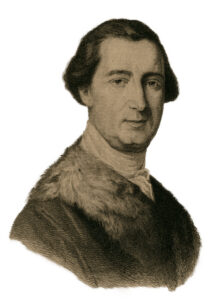
John Penn, the grandson of William Penn, was governor of Pennsylvania when the 1776 Pennsylvania Constitution was written.
New York Public Library
When Parliament passed the Tea Act in 1773, neither Gov. John Penn nor most members of the Assembly saw much reason for concern. Others viewed the legislation as yet another way to get Americans to accept taxation by Parliament without American representation. In Philadelphia, those in opposition, who were beginning to call themselves Whigs, formed a committee and pressured those merchants preparing to sell the East India Company’s tea to resign their commissions. When a ship bearing East India Company tea arrived in December, committee leaders informed the captain that no one would receive the tea or pay its freight. The tea ship left peacefully without being unloaded — a significant contrast to all the brouhaha in Boston.
The committee movement gave new men, perhaps lacking inherited wealth or family status, a voice in Pennsylvania politics. Charles Thomson (1729–1824) was among the emerging leaders. Born in Ireland, he had arrived penniless in Delaware after his father died aboard ship on their voyage to America. Initially cared for by a blacksmith, he got an education and became a tutor in Latin at a school that would become the University of Pennsylvania.
John Dickinson (1732–1808) was born on a Maryland plantation, the great-grandson of an indentured servant. He studied law in Philadelphia and became a barrister and solicitor. By the 1770s he was well known to American Whigs as the author of a series of opinion pieces first published in the Pennsylvania Chronicle collectively titled “Letters from a Farmer in Pennsylvania.” Protesting the Townshend Duties of 1767, he convincingly argued that Parliament had the right to regulate American commerce but not to tax American citizens. His work was widely reprinted in other American newspapers.
In May 1774, Paul Revere arrived in Philadelphia bearing letters from Boston requesting support in opposing the Boston Port Bill, which closed the port of Boston in retaliation for the Boston Tea Party. Thomson and Dickinson attended a meeting at the City Tavern where Dickinson proposed that the governor be petitioned to call the Assembly into session. He advocated the creation of a committee of correspondence to express moral support for Boston.
John Penn first declined to call the Assembly but later acquiesced, writing his family in England, “Every step will be taken that can to keep things in as moderate a state as possible.”
In June, Dickinson presided over a public meeting in the State House Yard where Whigs declared it was unconstitutional to close the port of Boston and that Americans must convene a Continental Congress to strategize and unify their resistance efforts. In July, representatives from Pennsylvania county committees met in Carpenters’ Hall with their Philadelphia counterparts. Charles Thomson acted as clerk. They advocated support for Boston and requested that Pennsylvania’s Assembly members name delegates to the upcoming Continental Congress.
When the congressional delegates began to arrive in Philadelphia that August and September, many of them had read Dickinson’s “Farmer’s Letters.” They wanted to meet Dickinson as well as the men they had already corresponded with. They chose Carpenters’ Hall as their meeting place and elected Charles Thomson as secretary. They adopted a plan of non-importation: an American boycott of British goods to continue until America’s grievances were heard.
Following Pennsylvania’s annual election, the new Assembly members appointed delegates, including Dickinson, to a second Continental Congress to be convened the following year. The Whigs of Philadelphia formally organized themselves into Philadelphia’s Committee of Observation and Inspection to enforce the non-importation agreement by inspecting incoming ships and supervising all commercial activity. Committee board members would meet weekly in the meeting place of the American Philosophical Society.
The following spring brought the alarming news that the British government had declared Massachusetts in a state of rebellion. British troops had been ordered into Boston, and on April 18 they began marching toward Concord to seize gunpowder stored there. Alerted Massachusetts militia men began firing on them at Lexington. After the soldiers found nothing in Concord, militia companies turned their march back to Boston into a retreat.
John Penn wrote his family in England, “Miserable I am that I can only wish for Peace & harmony without being able to do anything toward their reestablishment: however nothing in my power will be wanting for this purpose.”
Many Pennsylvanians decided that the colony had better prepare for war. On April 25, 1775, thousands gathered in the State House Yard for a meeting that had probably been organized by the City’s Committee of Observation and Inspection to establish militia units in Pennsylvania. Calling themselves “associators,” citizens formed companies, began military exercises, and asked the Assembly for financial support. Pennsylvania had no history of compulsory military service and the associators were all volunteers. They would later ask that those who chose not to join them in bearing arms pay a tax.
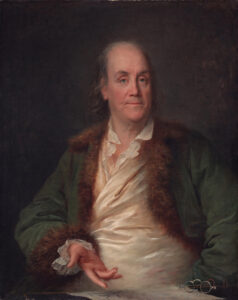
Benjamin Franklin served as president of the convention that drafted the 1776 Pennsylvania Constitution. Anne-Rosalie Bocquet Filleul painted Franklin’s portrait in France, circa 1778.
Philadelphia Museum of Art (Gift of the Honorable Walter H. Annenberg and Leonore Annenberg and the Annenberg Foundation, 2007)
Pennsylvania’s Assembly convened in May and added some names to their roster of delegates for the second Continental Congress. Benjamin Franklin (1706–90), recently returned from England after having been dismissed from his position as deputy postmaster for the American Colonies, would be one of them. James Wilson (1742–98) would also join the delegation. Wilson had been born in Scotland. Having studied under John Dickinson, he practiced law in Reading. Dickinson drew up instructions for Pennsylvania’s congressional delegates.
In June, the Assembly appointed a Committee of Safety to take charge of Pennsylvania’s militia units and defend the colony in case of invasion. The committee had members from every Pennsylvania county, and they effectively distanced John Penn from his intended role in defending the province.
When the 1775 Continental Congress met in Philadelphia, its members also made preparations for war. On June 14, they created the Continental Army to coordinate military operations among the American Colonies. The army would be supplemented by the local militias and commanded by George Washington.
That summer, John Dickinson would join his fellow Congressional delegates in promoting reconciliation with the mother country. Franklin had earlier written Charles Thomson his opinion that petitions were useless, but Congress adopted the respectful petition Dickinson recommended.
That summer they also discussed whether some of the existing royal colonial governments had become obsolete. Perhaps Massachusetts needed a new constitution? Samuel Adams observed that the time was near when “the most timid will see the absolute Necessity of every one of the Colonies setting up a Government within itself.”
In January 1776, in a pamphlet titled Common Sense, recent immigrant Thomas Paine (1737–1809) proposed that rather than seeking reconciliation, Americans declare their independence. Written in clear, persuasive language, the text was widely distributed and convinced many that “there is something absurd, in supposing a Continent to be perpetually governed by an island.”
While Pennsylvania’s aristocracy, its Quakers, its wealthy merchants, and its Penn family appointees, wanted to maintain the status quo, Paine’s Common Sense divided the Whigs into two camps. Moderates like Dickinson, Thomson and Wilson wanted to preserve Penn’s Charter of Privileges, nor would they support independence until all hope of reconciliation was exhausted. More radical Whigs, including the Scots Irish in outlying areas, were ready to deny the authority of Great Britain even if it meant overthrowing Pennsylvania’s charter government.
When the Assembly met in February, moderates dominated. They were willing to fund the province’s military associations and prepare to defend Pennsylvania if it became necessary, but they denied more radical demands. In response to allegations that the Assembly no longer represented the people of Pennsylvania, they arranged for a special election to be held on May 1 that would admit 17 new members to the Assembly. If the radical Whigs had hoped to take control of this body, they were disappointed with the special election’s results. Moderates retained control by a very small majority.
Pennsylvania’s radicals found common cause with like-minded members of the Continental Congress who also favored American independence. However, Pennsylvania’s congressional delegates were still operating under instructions from the Assembly directing them not to vote for independence.
On May 15, John Adams proposed that all governments deriving their authority from the British crown be replaced. Congress passed a resolution suggesting that the colonies “where no government sufficient to the exigencies of their affairs hath been hitherto established, to adopt such government as shall in the opinions of the representatives of the people best conduce to the happiness and safety of their constituents in particular, and America in general.”
Between the special election on May 1 and the congressional resolution on May 15, current events significantly altered public sentiment in Philadelphia. And together with greater willingness to accept independence came greater willingness to overthrow the proprietary government of Pennsylvania.
On the afternoon of May 7, two British warships that had been on patrol at the mouth of the Delaware Bay began sailing upriver. Philadelphia’s newspaper accounts differed in their intentions. Their commanders might have been simply seeking to take on fresh water. Or they might have been sounding the channel for military purposes. Or they might have been on their way to attack the city. Those in charge of the city’s defense ordered out boats that had been armed to protect the city. Following a skirmish and exchange of fire lasting into a second day, the Americans forced the British back downriver to New Castle.
Philadelphians heard the sounds of battle and warnings of imminent attack. Around the same time, news reached the city that Great Britain was sending foreign mercenaries to quell the growing unrest in the colonies. Citizens feared that these foreigners would have little respect for American property or persons. It became clear that there would be war in America, and Pennsylvania would need to join with the other colonies for her own defense.
The Committee for Observation and Inspection issued a call for a public meeting advertised by broadsides printed in English and German. On May 20 an estimated 4,000 to 5,000 people gathered at the State House in the rain. Col. Daniel Roberdeau (1727–95), a merchant and militia leader, was appointed to chair the meeting. The May 15 resolution of Congress was read, and the people were informed that America had received no response to her respectful petition. Instead, their mother country was sending over hired mercenaries. Next the Assembly’s instructions to Pennsylvania’s Congressional delegates were read, with the suggestion that such instructions had “a dangerous tendency to withdraw the province from that happy union with the other colonies.”
The meeting’s leaders and attendees resolved that Pennsylvania’s current government was indeed not “sufficient to the exigencies” of the times, nor was the current Assembly empowered to form a new government. To execute the Congressional resolution, a provincial convention would be needed, its representatives chosen by the people. The Committee of Observation and Inspection would join with counterparts from the counties to convene a provincial conference to determine how to elect delegates to a convention that would write a new constitution for Pennsylvania.
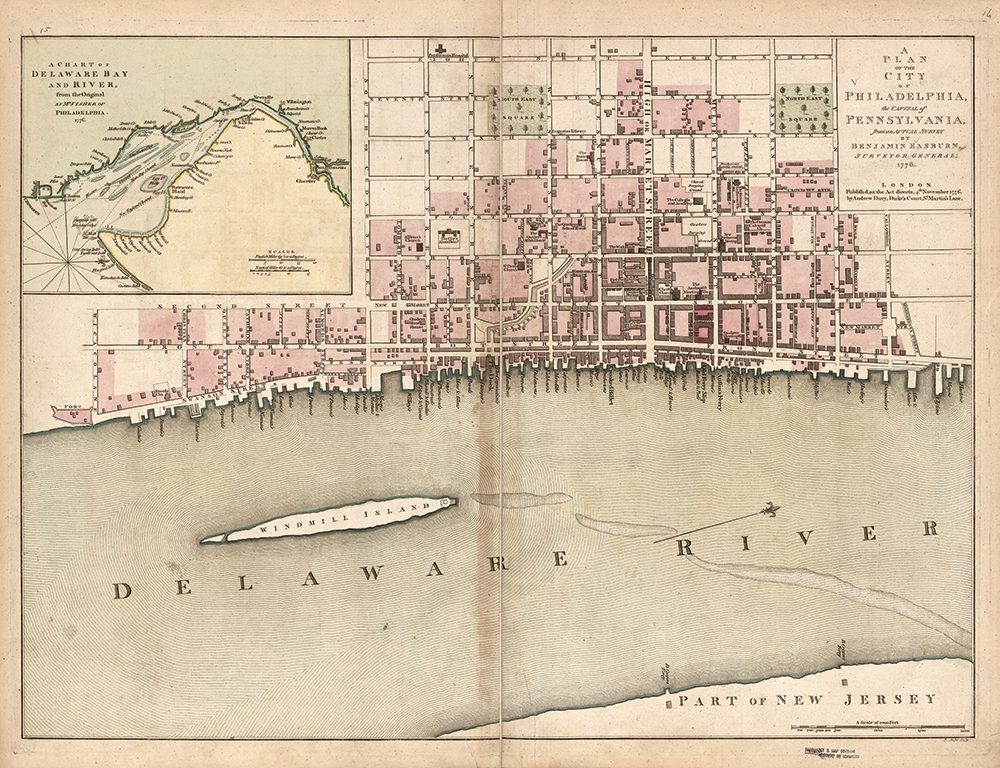
This map of Philadelphia, published in London by Andrew Dury in 1776, shows the downtown neighborhood where revolutionary documents were drafted and signed.
Library of Congress Prints and Photographs Division
The meeting’s resolutions were presented and read to the Assembly the following day. Public meetings were soon held throughout Pennsylvania, many of them drafting memorials to the Assembly favoring independence, though one document signed by some 6,000 citizens demanded that Pennsylvania’s Charter of Privileges be retained.
In what might have been a wait-and-see delaying tactic, Dickinson led the Assembly in writing new instructions for Pennsylvania’s congressional delegates that did not prohibit them from voting for independence, nor did it compel them to do so. The new instructions passed by a vote of 31 to 12 on June 8, 1776.
It was not long before the provincial conference delegates convened on June 18. According to their records, they met at Carpenters’ Hall because there was not sufficient space at the State House where the Continental Congress was in session. Among the representatives were Benjamin Franklin and Thomas McKean (1734–1817), a lawyer and representative to the Continental Congress from Delaware who was named chairman. Most of the 108 delegates already favored independence, but few of them had ever taken part in Pennsylvania politics or government before.
On the first full day of the conference, Congress’ May 15 resolution was read and unanimously approved. The delegates declared that “the present government of this province is not competent to the exigencies of our affairs,” thus making necessary an election for a constitutional convention.
The delegates’ most consequential decision determined who was going to vote in this proposed election. They eliminated the old 50-pound property qualification. It seemed undeniable that the military associators who were willing to defend the province should vote, so the delegates extended the franchise to associators over 21 who had lived in Pennsylvania for at least a year and paid provincial or county taxes. The conference members also resolved that before any elected convention delegate could take his seat, he would need to take an oath denying allegiance to the king and swearing to promote the creation of a new Pennsylvania government based on the authority of the people alone.
July 8 was chosen for the election. Pennsylvania’s counties and the city of Philadelphia would each elect eight delegates. This was hardly proportional to population, but a proper census would have been impractical.
Before they adjourned on June 25, the delegates recommended that the existing Committee of Safety be replaced by a Council of Safety, assuming all executive powers of government relating to the province’s defense. Following a banquet at the Indian Queen Tavern, the delegates returned home.
Before the election was held, another dramatic event took place in Philadelphia. Pennsylvania’s congressional delegation had previously voted against declaring independence and so had other Middle Atlantic colonies’ delegations. However, the provincial conference had urged Pennsylvania’s delegates to concur with any congressional vote for independence, and popular sentiment was rapidly changing in Maryland and New Jersey after the British fleet had been seen off the Jersey coast on June 30.
On July 1, four out of seven Pennsylvania delegates still voted against declaring independence. Benjamin Franklin is credited with proposing a graceful, face-saving solution. On July 2, two anti-independence delegates, John Dickinson and Philadelphia merchant Robert Morris (1734–1806), absented themselves from Congress. This left three Pennsylvania delegates in favor of independence and only two opposed. Pennsylvania cast her vote for independence.
That same day, Ceasar Rodney, the third delegate from Delaware, arrived after riding overnight in a rainstorm to break a tie vote in Delaware’s congressional delegation. On July 4, the text of the Declaration of Independence was formally adopted unanimously by the Second Continental Congress.
The declaration was read to the public assembled in the State House Yard on July 8, which was also election day in Pennsylvania. The provisions put in place by the Provincial Conference meant that more conservative citizens still wary of independence did not vote, nor were any conservative or moderate leaders on the ballot. Those elected to the Constitutional Convention were mostly farmers and artisans, many with militia experience. Honest and well-meaning as they may have been, most of them had no legal education or prior experience in government. One exception was Benjamin Franklin, who was chosen by the convention as its president when sessions opened on July 15 in the West Room of the State House. Despite his title, Franklin was often absent because he was simultaneously serving as a member of Congress. It remains unknown how much he contributed to the creation of a new state constitution.
The members laid some down-to-earth ground rules for debate, such as not interrupting another speaker, and no use of indecent language.
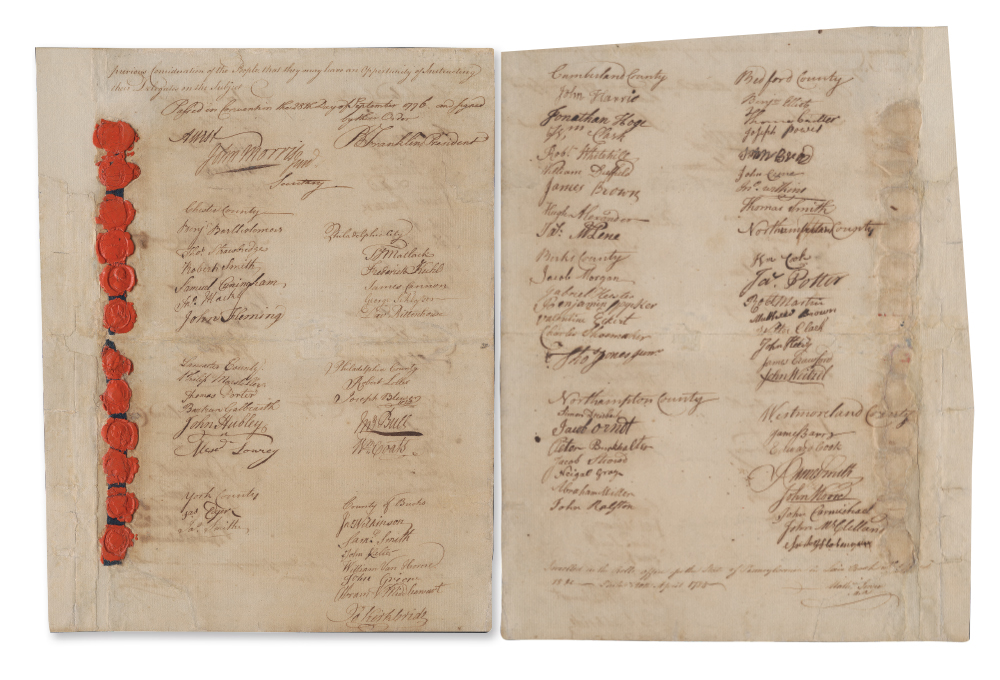
Delegates of the 11 counties of Pennsylvania signed the last two pages of the Constitution of 1776.
Pennsylvania State Archives, RG-26
Before taking up the task that they had been elected to do, convention members issued orders for the province’s defense. As the Provincial Conference had suggested and Franklin approved, they appointed a Council of Safety. Following directions from Congress, they issued orders for troop movements of Pennsylvania’s militia associators. They recognized and considered requests from committees in outlying counties for military funding and equipment.
They also named a new delegation to Congress, exhorting them to constant and punctual attendance and instructing them to cultivate and strengthen “by every means in your power, the present happy Union of these States.”
Work on the new constitution continued until early September. Among its authors were men like Robert Whitehall (1735–1813) of Cumberland County, a farmer who strongly favored local government; Timothy Matlack (1736–1829), a Philadelphia brewer, militia associator and disowned Quaker; and George Bryan (1731–91), a Presbyterian born in Dublin who would later propose legislation to gradually abolish slavery. James Cannon (1740–1782), a mathematician born and educated in Edinburgh, is acknowledged as the constitution’s principal draftsman. He also drafted the instructions for Pennsylvania’s new Congressional delegates. On September 10 the document was published in folio form, and its text appeared in newspapers by the following week. Before most citizens had a chance to read it, let alone consider and vote on it, the convention adopted the constitution on September 28 and adjourned.
While the convention had remained in session, the Assembly had trouble reaching a quorum. As their final official act, they voted to pay all public officers, including John Penn, before they also adjourned for the final time.
The new constitution had a bill of rights similar to Virginia’s Declaration of Rights penned by George Mason the previous May. It stated that all men were born equally free and independent, possessing inalienable rights including life, liberty and property, and that all governmental power was derived from the people. Like Penn’s Charter of Privileges, it guaranteed religious freedom. It also granted other rights familiar to American citizens today including freedom of speech, freedom of the press, and the right to bear arms.
The constitution retained Pennsylvania’s one-chamber legislature, its members to be elected annually. Suffrage was broadly granted to male residents but required them to take an oath to accept and uphold the new constitution. Initially, each county would elect six members to the new legislature, but a census was planned, and representation would thereafter be proportional to the population.
The constitution stipulated that all bills introduced by the legislature would be printed for public review and not passed until the following legislative session. This was intended to allow people living in outlying areas to read the proposed legislation and make their opinions known.
The constitution made no provision for a governor with veto power over the legislature. Pennsylvania would have an elected Executive Council to see that the province’s laws were executed. The council would be made up of one member from each county and one from the city of Philadelphia, each serving a three-year term. A Council president would be chosen annually by the council members and legislators. Council members would appoint all non-elected government officers as well as the judges of Pennsylvania’s supreme court. The legislature retained the power to establish lower courts. Perhaps because many settlers had always resented the fees and quitrents collected by the proprietors, there would be no public role for the Penn family.
It would not be easy to change the new constitution. Amendments could be made only once every seven years by a Council of Censors elected from each county. These censors would determine whether the government was operating according to the constitution’s terms, with no one assuming unwarranted powers. The censors could propose amendments and convene a new constitutional convention.
The Pennsylvania constitution was finalized around the time the British army landed in Manhattan and began their occupation of New York, a time when a revolution was already underway. The convention was reported to have passed the constitution unanimously but whether it had the full support of all convention members cannot be known. Not every member signed the document. It is possible that those with objections simply absented themselves when the final vote was taken, like Pennsylvania’s congressional delegates.
Pennsylvania soon had two new political parties: constitutionalists and anti-constitutionalists. In opposition were moderate Whigs, men of property, Quakers, and other pietists. Anti-constitutionalists criticized the lack of checks on the unicameral legislature. There was no upper legislative body, and the Executive Council lacked veto power over legislation. There were no courts of appeal. The Council of Censors, with its equal vote by county, gave too much power to less-populated rural and frontier areas, and they were authorized to meet too infrequently, meaning it would take too long to amend the constitution.
Organized opposition began that October. Following a plenary session in Philosophical Hall, a town meeting was held in the State House Yard on October 21 with about 1,500 people attending. Some speakers supported the new constitution; those opposing included John Dickinson and Thomas McKean. The meeting’s resolutions stated that the new constitution deviated too much from Pennsylvania’s former government, as well as the governments of other American states.
A few days before the next scheduled election in November, more anti-constitutionalists met in Philosophical Hall to draw up an opposition ticket. Even though many Quakers refused to take the oath needed to vote, when the votes were counted, the constitutionalists lost in Philadelphia. Pennsylvania’s first new legislature had many members opposed to its constitution. When they met, they elected a speaker and treasurer but lacked the votes to call a new constitutional convention, so some anti-constitutionalists walked out, making it difficult to maintain a quorum. This left the old Council of Safety in charge, raising the question of how the new government could effectively operate.
Former governor John Penn never mentioned the new constitution in his surviving letters to his family in England. A letter from John Penn’s brother-in-law to his aunt, Lady Juliana Penn, written the following spring from British-occupied New York, stated that, “When the frenzy of the people became to[o] high to be opposed, & they had thrown off all allegiance to his Majesty, [John Penn] thought it proper to retire to his house over Schuylkill, where he has lived in the most private manner.”
In November 1776, Congress issued an urgent demand that Pennsylvania’s Council of Safety call out associators from Philadelphia and the surrounding area. British Gen. William Howe was marching his army across New Jersey, apparently intent on capturing Philadelphia. A lukewarm response caused Congress to issue a second call in December for armed and supplied troops to support Washington’s army. Many Philadelphians made hasty plans to leave town. Washington’s surprise attack and victory at Trenton briefly calmed the city down, allowing party strife to once again dominate public affairs.
Sometime during 1777, Benjamin Rush (1746–1813), a prominent physician and Pennsylvania delegate to Congress, wrote a pamphlet titled Observations upon the Present Government of Pennsylvania. Organized as a series of four letters, he argued against Pennsylvania’s unicameral legislature and promoted instead the checks and balances of a government with effective legislative, executive and judicial branches. The solution for Pennsylvania? “The way of duty is plain,” Rush wrote, “Let a convention be chosen, to alter and amend the government. This measure alone will restore vigor and union to Pennsylvania. Say not, my dear countrymen THIS IS NOT THE TIME, THE ENEMY ARE AT OUR GATES, LET US FIRST REPEL THEM.”
The enemy was indeed coming closer. During the summer of 1777, the British fleet was sighted off Delaware Bay. An invasion of Philadelphia again seemed imminent. John Penn, still keeping a low profile, received a visit from armed men asking him to sign a parole: a written promise that he would take no action against the United States, and provide no intelligence to the approaching British army. He hesitated to attach his name to a document that might brand himself and the Penn family British traitors. After all, in 1777, there was no guarantee that the American rebels would win the war. When Howe landed at the head of the Elk River in Maryland, John Penn was ordered out of the city, but he was exiled only as far as a farm his wife’s family owned in New Jersey. His wife, Anne Allen Penn, remained in Philadelphia.
The British army arrived in town on September 26, 1777, encountering no opposition as they occupied the city. By that time the most ardent patriots had fled, and so had Congress, reconvening first in Lancaster, then in York. The British remained until the following spring while Washington’s army spent the winter of 1777–78 at their encampment at Valley Forge.
Once the theatre of battle moved away, the election of 1778 gave Pennsylvania a new legislature, which required its citizens to pledge allegiance to the Commonwealth of Pennsylvania and swear that they had given no aid to the British since July 4, 1776. Those who refused were barred from participation in politics.
John Penn moved back to his country house to wait out the war. He heard unpleasant rumors that the constitutionalists planned to seize the Penn family’s millions of acres of vacant, unsold land in Pennsylvania. There was also talk of confiscating the private property of loyalists, but this failed to gain momentum among Americans who considered private property sacrosanct. No doubt in an effort to protect the family holdings, John Penn finally took a loyalty oath with the full support of the Penn family.
In March of 1779, Pennsylvania’s legislature debated the justice of leaving so much land in the hands of the Penn family. In September, legislators passed “An ACT for vesting the estates of the late Proprietaries of Pennsylvania in this Commonwealth.” It divested the Penns of approximately 24 million acres of unsold land and formally abolished quitrents. It allowed the Penns to retain personal estates and manors surveyed prior to July 4, 1776. It reimbursed them with a cash settlement of 130,000 pounds, payable after the war was over. The Divestment Act reduced the Penn family from proprietors to private landowners.
By 1780 a counterrevolution was brewing, and the constitutionalists began losing their grip on Pennsylvania’s government. In 1782 John Dickinson was elected to the Executive Council and named its president, giving him the title president of Pennsylvania, which he held until 1785, when Benjamin Franklin was elected to serve out his unexpired term. In 1787 Dickinson became a delegate to the Federal Constitutional Convention.
As soon as Pennsylvania ratified the new United States Constitution, those who had long opposed the 1776 Pennsylvania Constitution began pointing out the inconsistencies between these frames of government. In November 1789, a convention held in Philadelphia’s State House addressed the shortcomings of the 1776 state constitution. A committee of convention members drafted a new frame of state government that would give Pennsylvania a bicameral legislature and a single executive with veto power, as well as an independent judiciary. The new constitution retained a bill of rights and guaranteed broad suffrage with no property qualification. Following the convention’s adjournment in February 1790, the document drew general satisfaction from the public. Although there were new versions in 1838, 1874 and, most recently, 1968, which itself has been amended several times, the constitution remains largely intact today.
Pennsylvania’s experiment with a purer form of democracy was over. But it had been Pennsylvania’s own 1776 revolution that gave many citizens a vote and a new voice in government and motivated Pennsylvania to unify with other North American colonies to declare and fight for independence from the British Empire.
Sidebar: The Rooms Where It Happened
Carpenters’ Hall
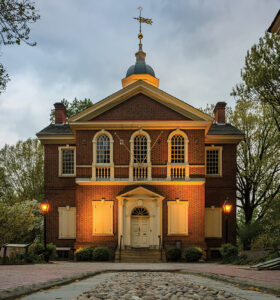
Carpenters’ Hall
Wikimedia Commons / Photo, Peter B. James / CC BY-SA 4.0
Located east of the State House, Carpenters’ Hall was constructed by the members of America’s oldest craft guild: the Carpenters’ Company of the City and County of Philadelphia. The guild acquired their building lot in 1768. Their hall was intended to be an income-producing rental space, and it can still be rented for events. It was also intended to be a showcase for the skills of the guild members, and it is acknowledged today as one of America’s finest examples of late Georgian public architecture. It is a square building with cutouts on each side, giving it the shape of a Greek cross.
When the First Continental Congress arrived in 1774, the building was mostly completed but lacked some finishing architectural touches. John Adams recorded in his diary that his fellow delegates had inspected and approved the venue. By that time the Library Company had moved to Carpenters’ Hall, another benefit for the Congressional delegates. In September and October of 1774, the Congressional delegates were received at the State House by the Assembly for a “grand entertainment” in their honor, presumably in the Long Room.
Like their use of the State House, the British also occupied Carpenters’ Hall in 1777 and used it as a hospital.
In 1982 the Pennsylvania Historical & Museum Commission officially recognized Carpenters’ Hall as the “Birthplace of the Commonwealth of Pennsylvania,” honoring the building’s use by the Provincial Conference in 1776.
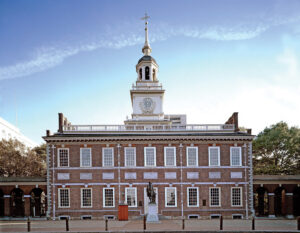
The State House (Independence Hall)
Carol M. Highsmith Archive, Library of Congress Prints and Photographs Division
The State House
The building that John Penn and his contemporaries called the State House is now known throughout America as Independence Hall. It is famous as the place where both the Declaration of Independence and the U.S. Constitution were adopted and signed. It is now the centerpiece of Independence National Historical Park, its interior carefully restored to its 18th-century appearance.
When the Second Continental Congress arrived there in 1775, the State House was already well known as the official government building of Pennsylvania. Plans for its construction date to 1729, when the Pennsylvania Assembly committed funds to build themselves a dedicated meeting place. Before that the legislators had been meeting in rented properties or sometimes in Philadelphia’s original City Hall at Second and Market Streets. In 1730 designated trustees purchased building lots on what was then the outskirts of town. The large building was completed in phases between 1732 and 1753 as funding became available, but by 1735 the building was sufficiently finished for the Assembly to begin meeting there.
The Assembly Room, which became Congress’ meeting room, was one of two large chambers on the building’s ground floor, located on the east side of a central hall. The room on the west side housed Pennsylvania’s Supreme Court.
Upstairs were two smaller chambers. The Governor’s Council Chamber was on the west, and on the east was a room used as the Assembly’s committee chamber. Pennsylvania’s Assembly moved up there when they relinquished their Assembly Room to the Continental Congress in 1775.
Extending the entire length of the second floor on the Chestnut Street side was a gallery intended for public entertainments. In the 18th century it was known as the Long Room.
Since Congress continued to meet in the Assembly Room until 1783, more space was made for the state legislators by removing a wall between their small room upstairs and part of the Long Room.
The State House was constructed with two wings joined to the main building by covered walkways. For a time, Philadelphia’s Library Company deposited its collections on the upper floor of the west wing. During the building’s early years, visiting Native American delegations were sometimes housed in one of the wings.
When 18th-century documents refer to the State House Yard, they do not mean modern-day Independence Mall. The State House Yard was the area south of the building, or the remainder of the city block between Chestnut and Walnut streets, now called Independence Square.
The British made use of the State House when they occupied Philadelphia. They quartered troops there and used the Long Room as a hospital. After the British evacuated, returning Philadelphians recorded that they had left the place “in a most filthy condition.”
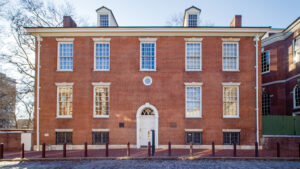
Philosophical Hall
Wikimedia Commons / American Philosophical Society / CC BY 2.0
Philosophical Hall
The building known today as Philosophical Hall stands just south of Independence Hall on Fifth Street. It is the headquarters of the American Philosophical Society, the oldest learned and scientific society in America. Initially proposed as an organization “for promoting useful knowledge,” by Benjamin Franklin in 1743, it merged in 1768 with the American Society, a club with the same mission descended from Franklin’s Junto, which had been established for the mutual improvement of members of various trades.
In 1769 the society asked the Assembly for a plot of ground in the State House Yard where they could construct a building. However, the Assembly did not vote to accommodate them until 1785, and Philosophical Hall was not completed until 1789. So, when documents refer to meetings in “Philosophical Hall” in 1774 and 1776, exactly where were these meetings? According to advertisements for the fortnightly meetings of the American Philosophical Society, the members were then meeting in Christ Church School on Second Street.
While there is no such building on Second Street today, a history of Christ Church published by the Rev. Benjamin Dorr in 1841, mentions a church school established in 1718 when the bishop of London sent Philadelphia a school master. In 1766, church records note that the schoolhouse was then vacant, its lower floor to be used as a meeting place for the church vestry. Presumably this chamber was also the meeting place of the American Philosophical Society, whose members applied the name “Philosophical Hall” when they gathered there. Only later was “Philosophical Hall” adopted as the name of the society’s headquarters building.
Further Reading
Bockelman, Wayne L., and Owen Ireland. “The Internal Revolution of Pennsylvania: An Ethnic-Religious Interpretation.” Pennsylvania History 41, no.2 (April 1974): 124–159. / Brunhouse, Robert L. The Counter Revolution in Pennsylvania: 1776–1790. Harrisburg, PA: Pennsylvania Historical & Museum Commission, 1971. / Ryerson, Richard Alan. The Revolution Is Now Begun: The Radical Committees of Philadelphia, 1765–1776. Philadelphia: University of Pennsylvania Press, 1978. / Selsam, J. Paul. The Pennsylvania Constitution of 1776: A Study in Revolutionary Democracy. New York: DaCapo Press. 1971.
Lorett Treese is a regional historian living in Chester County. She is the author of many articles and books on Pennsylvania history including The Storm Gathering: The Penn Family and the American Revolution and Valley Forge: Making and Remaking a National Symbol. Her most recent works deal with railroad history including her latest book Railroads of the Eastern Shore.