
A Quarter-Millennium of Charcoal Burning at Hopewell Furnace
Written by Thomas Straka in the Hands-On History category and the Spring 2025 issue Topics in this article: charcoal, colliers, Elmer Kohl, French Creek State Park, Harker Long, Henry Houck, Hopewell Furnace National Historic Site, iron plantations, Lafayette Houck, living history, Ted Ziegler, Uriah Kohl, Wayne Ramer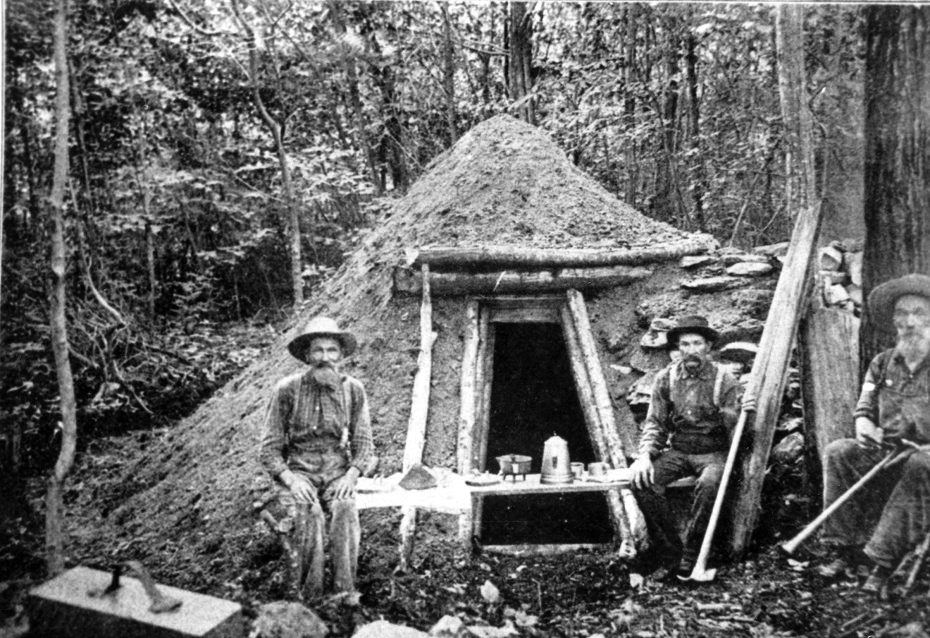
Three charcoal burners, or colliers, rest in front of the hut they shared near the charcoal pits in a photo from the late 19th century.
From Report of the Pennsylvania Department of Forestry for the Years 1905 and 1906 (Harrisburg, PA: Harrisburg Publishing Co., 1907)
Twice a year, in May and August, volunteer colliers, or charcoal makers, burn a charcoal pit at Hopewell Furnace National Historic Site as part of a living history demonstration that can be traced back to 1936. In 19th-century parlance, the colliers would be called “charcoal burners.” Charcoal burning at Hopewell Furnace itself can be traced back to 1771, the year ironmaster Mark Bird’s Hopewell Furnace in the Schuylkill Valley of Berks County went into blast, charcoal being the necessary fuel.
Hopewell Furnace was a significant component of Pennsylvania’s iron industry. It was one of the National Park Service’s earliest sites to showcase industrial history, especially in terms of highlighting the cultural landscape of industrialization in the 19th century.
Iron plantations were industrial complexes established in rural areas and operated as self-sufficient communities with the single purpose of iron production. They had large augmenting labor forces providing support for iron production employees. An ironmaster would rule, living in a mansion, or “Big House.” Food for employees would be produced on surrounding lands and supporting services would be available to them, such as a general store, a blacksmith shop, a church, tenant houses, and even an apple orchard. At Hopewell Furnace, many of the original buildings and the blast furnace still exist and are used to demonstrate iron casting and related activities.
Wood was an unsuitable fuel for an iron furnace. Charcoal produced greater, more concentrated heat, necessary for iron smelting, and it burned more evenly and uniformly than wood. Until about 1840 most iron production occurred on large iron plantations, and charcoal was nearly the sole iron furnace fuel in Pennsylvania. After 1840 anthracite or bituminous coal and coke became available, and charcoal use declined. By the 1870s charcoal was no longer the dominant fuel. Hopewell Furnace would stay in blast until 1883. Several other large charcoal iron plantations in Pennsylvania operated into the 1890s.
Hopewell Furnace survived as a national historic site as a positive consequence of a 1930s New Deal program to counter the economic impact of the Great Depression. Marginal agricultural land, better suited to uses other than farming, was purchased by the federal government for development into 46 Recreational Demonstration Areas scattered across the country. One of these was the French Creek Recreational Demonstration Area, which would evolve into Hopewell Furnace National Historic Site and French Creek State Park. The charcoal iron plantation and the thousands of acres of woodlands that produced the charcoal survive today as an amalgam of the two parks.
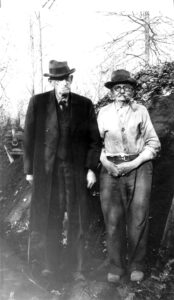
Standing left to right are Harker Long, final furnace manager of Hopewell Furnace, and Lafayette Houck, Hopewell’s last collier who began the charcoal making demonstrations in 1936.
Hopewell Furnace National Historic Site
The Charcoal Operations
The charcoal production operation was an essential element of a charcoal iron plantation. Woodchoppers, the most common laborers at the furnace, supplied the wood used in charcoal making. Colliers, the second most common laborers, did the “charcoal burning.” Teamsters transported the charcoal to the furnace in charcoal wagons.
The charcoal operation accounted for roughly 40 percent of the work hours at Hopewell Furnace. Today, one of the restored buildings at the furnace is a large charcoal house filled with charcoal, and in the attached cooling shed is a loaded charcoal wagon. The cooling shed was important in ensuring all charcoal was totally extinguished before going into the charcoal house, which contained as much as 30,000 bushels of charcoal.
Most charcoal in Pennsylvania was made in charcoal pits. The term “pit” can be deceiving, as the charcoal was made on level ground. Pits are used in some parts of the world for charcoal burning, but most American charcoal burning occurred aboveground.
A charcoal pit begins in the forest with a 30- to 40-foot circular space being raked clean of vegetation and then leveled and hardened to form a hearth. At the center of the hearth, a triangular chimney is constructed using small pieces of wood. Billets, 4-foot lengths of wood, are brought in from the forest on a wooden sled and are tightly stacked upright around the chimney to form a circular tier, with two or three tiers forming the wood pile. At Hopewell, this is commonly called the “pile.” The wood is stacked at a slight incline and the pile takes on the shape of a mound.
Charcoal is produced when wood is burned in a “smothered” environment, or one lacking oxygen. This partial combustion is called carbonization, where the water and volatile gases are baked out of wood leaving nearly pure carbon (charcoal). To create an airtight environment for charcoal burning, a layer of leaves is laid down over the inclined mound, and then a layer of earth is added to seal the pile — the leaves keeping the soil from the wood. An opening is left at the chimney on top.
Kindling is placed in the top of the chimney as a charge, and the pile is ignited using hot coals from the campfire. An actual fire is allowed to burn initially to begin combustion; then the top of the pile is completely sealed with a slab of wood or several billets (called a “bridgen”). If necessary for proper ignition, the chimney can be recharged with kindling.
The collier judges the progress of the burn by the amount and color of the smoke and the heat generated. Small vent holes may be inserted at the bottom in areas of the pile when the burning is inadequate or uneven. At first, the “smoke” actually will be steam from water baked out of the wood, then a bluish smoke will dominate. When the entire pile has burned through, usually taking a week, it is completely sealed and allowed to cool. Once the collier is sure the burn is completely extinguished, the charcoal is raked out of the pile for transportation to the charcoal house for use at the iron furnace. A collier, with his helpers, would often manage a group of charcoal piles simultaneously.
Henry Houck came to Hopewell Furnace in 1818 as a master collier and served as head collier for nearly a quarter-century. He could average 39 bushels of charcoal to the cord of wood, an excellent yield and something expected of a master collier. The collier was critical to early iron plantations, as his skills impacted not only the yield of charcoal from a cord of wood but also the quality of the charcoal going into the furnace.
Charcoal burning occurred from spring until early fall, and the collier would spend most of that time in the woodlands working on it. In winter, many colliers became woodchoppers to earn income, but Houck was also a master wheelwright, so he repaired wagons at that time of year. His family lived in a tenant house near the furnace and was given a garden plot and pasture for several animals, plus the privilege of gathering firewood from areas cutover by the woodchoppers, with the admonition that young trees and spouts be left to grow into wood for future charcoal making. Every few days the collier’s family would bring food and supplies out to the charcoal piles.
Since the charcoal pile needed constant supervision, the collier and his helpers constructed a hut near the charcoal piles as temporary shelter during the operations. A collier’s hut had a distinctive teepee or conical shape. It was built using long poles stacked upright around a circular base to form the outside shell, which was then covered with leaves and dirt. The door was on the “pile side” of the hut, and a fireplace was used to keep out dampness. Collier huts were once scattered in the woodlands around Hopewell Furnace. The collier and his helper could shift watch duties, while the other slept on a cot in the hut.
Charcoal Burning as a Demonstration
In the fall of 1935 Uriah Kohl lived on Welch Mountain (actually more of a long ridge) just south of the Berks County line below Morgantown. The Reading Eagle identified him as a “veteran Welch Mountain farmer, and ‘The Last of the Mohicans’ of the old-fashioned charcoal burning tribe.” He was described as a “hillbilly” whose family, which included 25 children, lived without electricity, gas or other modern conveniences. The family’s income came from charcoal burning, and they sold charcoal to the Reading and Philadelphia markets. Uriah was the “sole remaining old-fashioned charcoal burner in those parts” but did pass the craft on to his sons, including Elmer. This would later impact charcoal burning at Hopewell Furnace.
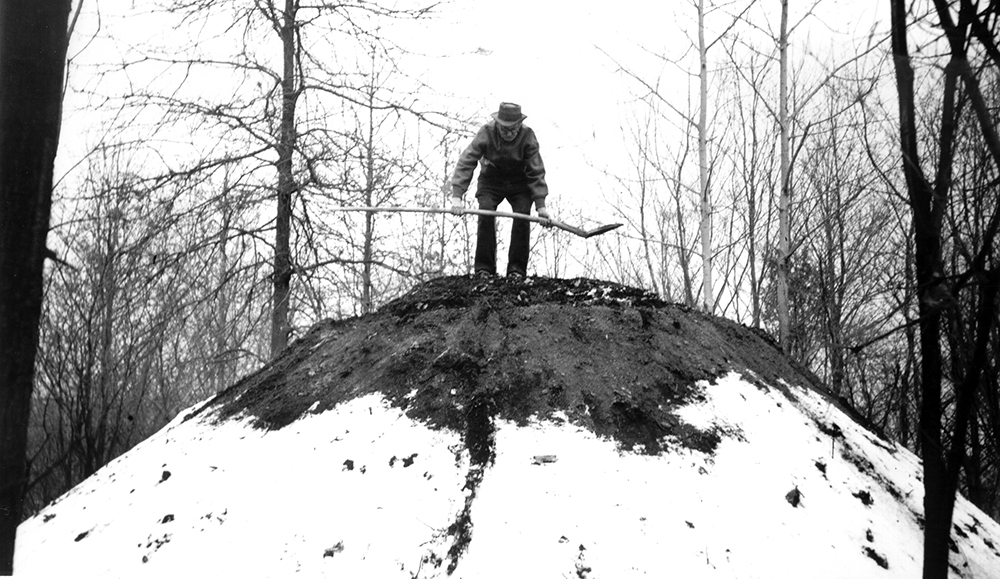
At early demonstrations, visitors might see a collier atop a charcoal pile “jumping the pit,” which involved jumping up and down on soft spots, or mulls, caused by shrinkage of the charring wood. This was considered a dangerous part of the job.
Hopewell Furnace National Historic Site
Soon after the federal government acquired Hopewell Furnace and the land around it, interest developed in documenting the charcoal burning operation that supported the furnace. The opinion of Harker Long, the final furnace manager at Hopewell, was sought to determine the best qualified of the surviving charcoal burners who had worked the furnace’s woodlands. Lafayette Houck, 82-year-old grandson of Henry Houck, was identified as the man and, fortunately, he was anxious to tell the story of the forgotten art of charcoal burning, agreeing in the winter of 1936 to present a demonstration of the entire process that went into charcoal burning at Hopewell Furnace.
The site chosen for the demonstration was an old charcoal hearth near the furnace and a charcoal burner’s hut was erected near the hearth. Houck and his son became permanent residents of the hut, which contained two bunks, a small table, and a wood stove. The two colliers worked 24-hour days throughout a burn. The process took three weeks from procuring the wood to raking out the charcoal, intended to illustrate the “life and skills of the collier.”
Charcoal burning required climbing to the top of the wood pile using a crude log ladder. Lafayette fell from the ladder, breaking several ribs, and had to be hospitalized partway through the demonstration, leaving his son to successfully complete the burn.
Interest in the charcoal burn was high, and the demonstration attracted a crowd of spectators. Many were local residents with ancestors who had worked at Hopewell, anxious to tell stories of life at the furnace. Lafayette seemed to enjoy the attention generated by the demonstration.
Jackson Kemper documented the charcoal burning process in American Charcoal Making in the Era of the Cold-Blast Furnace, which is considered to be one of the best sources on the forgotten art of charcoal making. Most of the historic photographs of charcoal making at Hopewell were taken by Kemper with Houck as the collier. After that, there would be no charcoal burning demonstrations at Hopewell Furnace for more than 20 years.
Starting in 1958 the decision was made to include a traditional charcoal burning demonstration as part of Establishment Day at Hopewell Furnace, which would become a regular part of the annual event. This was intended to be a living history demonstration illustrating the craft of charcoal making and providing connections to the fuel that was so important for ironmaking and to the immense woodlands (ranging 4,000 to 8,000 acres and mostly forested) required for charcoal production. Serendipitously, the charcoal would supply fuel for the small furnace that melted metal for the molding and casting demonstration.
A collier was identified, Elmer Kohl, who still burned charcoal and lived secluded in the mountains. He was the subject of a book on vanishing crafts, with a chapter on charcoal burning, which suggested he might be “the last full-time, real-life charcoal burner in America.” Kohl was a reluctant collier at first but eventually was persuaded to take a full-time position as a “Laborer-Collier,” where he did general labor most of the year when he was not burning charcoal. His impact was not limited to Hopewell Furnace. He performed a demonstration charcoal burn at Catoctin
Mountain Park in Maryland and built the mountain whiskey still that is on display along a trail in the park. Kohl passed away in 1980 after a series of health problems.
Propitiously, one of the maintenance workers, Ted Ziegler, had an interest in charcoal making and had become Kohl’s informal apprentice. In 1972, when Kohl’s health declined, Ziegler took over the charcoal burning demonstration on Establishment Day and for other special events. As master collier he supervised other park staff who assisted with the burns. Visitor interest in the charcoal burning demonstration remained high and aspirations were for four burns a year, but two burns a year were more common. A collier’s hut has been part of the demonstration from the beginning to add authenticity and to show what a collier’s life was like. The current reincarnation of the collier’s hut at the furnace was built in 2006 by an Eagle Scout as a service project. He used 81 cedar trees, 15 tons of dirt, and 43 pieces of sod to construct the hut.
Volunteer Colliers
By the beginning of the 1990s the longterm sustainability of the charcoal burning demonstration was a concern. The two-week burns were labor intensive and a heavy burden on a limited park staff. Another major concern was securing a fully qualified collier to ensure the traditional practice was properly demonstrated. The national historic site had become, by default, the custodian of a traditional practice that needed to be sustained within the park system. The process of maintaining a collier for demonstrations began with procuring the service of a traditional practitioner (Houck and Kohl) and evolved into a system that utilized a staff master collier and additional staff, via skills passed down over successive burns, with limited volunteers participating. The continuity issue was resolved with the creation of an apprentice program in 1991. The apprentices would be volunteers schooled and trained in the technical and historical facets of charcoal burning. The volunteers needed the historical background of both the furnace and the charcoal burning to answer the many questions of site visitors.
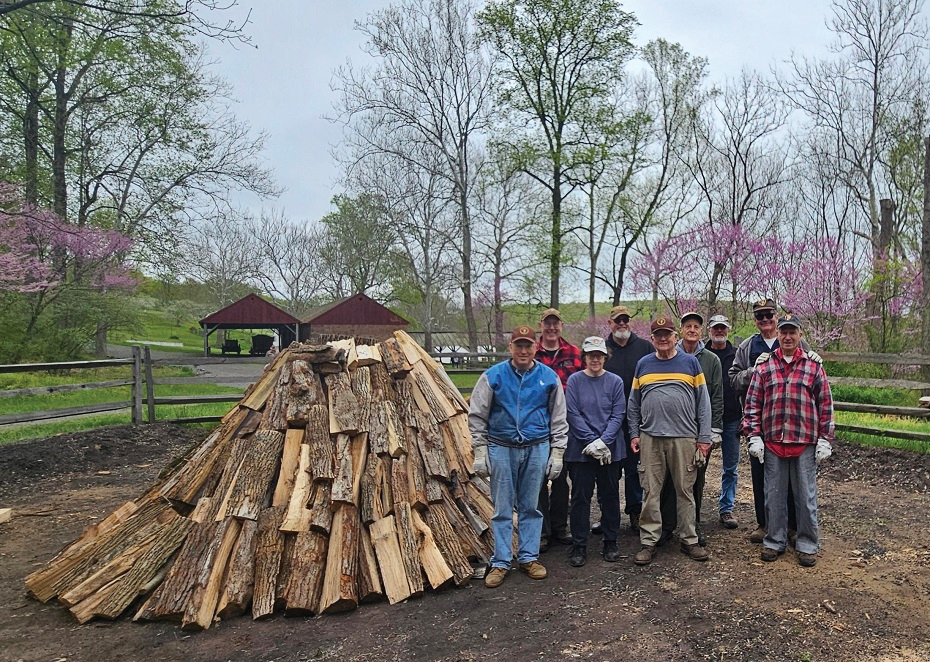
The three hard chores of charcoal making are building the wood pile, dusting the pile (putting leaves and earth on the sides), and raking out the charcoal at the end (if you don’t count cutting and splitting the wood). These chores require a small group of volunteers. Once the pile is burning, only two volunteers are needed, but they must be there 24 hours a day.
Photo, Suzanne Reisser
The volunteer program proved to be another fortuitously timed development for the demonstration. In the fall of 1993 Ted Ziegler died unexpectedly, leaving the program without a master collier. The apprentices had progressed in their skill levels enough to fill some of the gaps, but a master collier was needed. Dick Lahey, who worked as the site’s farmer, had worked with Ziegler for a few years and was pressed into service as the master collier. This was the beginning of a slow transition of charcoal burning duties towards the volunteers. Lahey transferred to a different park location in 2001 and Ray French, a maintenance mechanic at the site, became master collier. When Ray French retired in 2005, the impact of the slow transition towards a larger and larger role for the volunteers became apparent, and after much discussion by the site’s staff and the volunteers, the decision was made to select a master collier from the ranks of the volunteers.
Wayne Ramer, a retired field engineer, was selected to be the first master collier and he took over supervision of the charcoal burns in the spring of 2006. Thus, evolved the current charcoal burning demonstration framework at Hopewell Furnace.
There are usually two burns a year, one that begins in early May on Sheep Shearing Day and one in early August on Establishment Day. Both occur on a Saturday, with the lighting of the charcoal pile occurring midmorning. The burn is timed to end the following Saturday, with the charcoal pile uncovered and the fresh charcoal raked out.
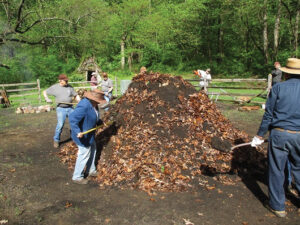
Leaves and then dirt are used to cover the wood pile
before igniting it.
Photo, Thomas J. Straka
There are nearly three dozen volunteer colliers, so something about charcoal making must be appealing. It does have challenges. The work hours involved are much more than is apparent to most observers. The casual observer sees two or sometimes a few colliers carefully watching the charcoal pile and occasionally jumping into action to seal a smoking crack in the pile’s thin skin. But there is some “heavy lifting” that goes into the process.
First, the wood must come from somewhere. In this case, the staff collects wood from park operations as trees are salvaged or debris develops, with staff and volunteers splitting the wood later. On a Saturday before the official charcoal burning day, on a hearth that has been cleaned by the staff, the volunteers build a chimney in the center of the hearth, and a huge wood pile is constructed in the traditional mound shape. This is definitely strenuous and requires a large portion of the volunteers and a large portion of a Saturday.
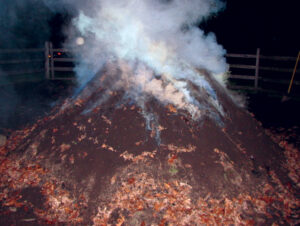
A charcoal pit burns, requiring no attention, as smoke is a normal part of the process. The colliers watch for unusual smoke indicating a breach in the covering.
Photo, Suzanne Reisser
On the official charcoal burning Saturday, with the mound of wood mysteriously already in the center of the hearth, most of the volunteers again arrive to lay down a layer of leaves on the pile and then the final layer of earth. The chimney is filled with kindling and a major event of the day is the lighting, often performed by a local dignitary. Once the master collier is assured the controlled fire is properly progressing, the pile is sealed, and sentinel duty begins for the rest of the week. Colliers must be highly skilled sentinels, knowing just what the size and color of smoke coming off the pile indicates. When the smoke shows a “crack,” the collier jumps into action to reseal the pile. Inaction could quickly result in the pile being reduced to ashes.
One of the subtle, but large, responsibilities for the colliers involves the requirement that the charcoal pile must be monitored seven days a week, 24 hours a day. The group has a coordinator who handles scheduling for various shifts and in conjunction with the master collier plans for supplies. One complicating necessity is for shifts to include the half-day of darkness. Currently, one team of volunteers, two sisters and a brother, watch during night for the entire burn, from twilight’s last gleaming to dawn’s early light. The collier’s hut serves to remind the visitors that charcoal burning was an intensive work environment, without the luxury of going home at the end of a workday.
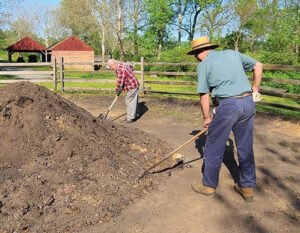
Colliers tend the pile, patching cracks as they develop.
Photo, Suzanne Reisser
At the end of a week, the wood pile has burned through and is allowed to cool. Saturday midmorning, the covering of earth and leaves is carefully raked off and the charcoal is spread out into circular rings around the pile, allowing for further cooling and close observation for any tendency to reignite. This is a rather labor-intensive part of the burn, and a large portion of the colliers return to handle it. When the master collier determines the charcoal will not reignite, it is hauled to the charcoal house for storage. Visitors can view the large pile of charcoal in the charcoal house and a full charcoal wagon in the attached cooling shed.
The volunteer colliers have the usual motivations to contribute, learn and develop social relationships. Learning is a leading motivation for colliers, and they tend to express that as an “interest in the charcoal burning process” and to “preserve the skill of making charcoal.” The demonstration provides an opportunity to pass the learning on to an interested public, sometimes leading to new volunteers, and is a valued experience for many of the colliers. The colliers are an outdoor community, and camaraderie plays a role in retaining volunteers. Of course, just the fact it occurs outdoors attracts many of the colliers.
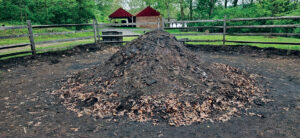
This charcoal pile is fully burned and cooled. The earth and leaves are then raked out, exposing the charcoal.
Photo, Suzzane Reisser
An interesting aside is the remnants of two charcoal kilns between the charcoal pile demonstration site and the charcoal house. Charcoal kilns operate like charcoal pits but allow for more controlled conditions with stone or brick sides and small vent holes around the bottom for control of air flow. Unlike many other states, only a few charcoal iron furnaces in Pennsylvania utilized kilns. Charcoal kilns could be conical, round or rectangular. These rectangular kilns were constructed of brick in the mid-19th century, with a base of approximately 15 by 40 feet. The added control that kilns offered was expected to add economy and efficiency to the charcoal operation; however, they proved not to be practical and were soon abandoned. Just the base still exists, with the vent holes still visible.
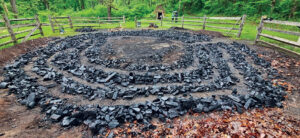
The final product, charcoal, has cooled and is ready for transport to the charcoal house.
Photo, Suzanne Reisser
In 2021 master collier Wayne Ramer became master collier emeritus, still an active collier, but no longer the one in charge, and the charcoal shovel was passed to Cory Putt. The master collier needs to be a workhorse and a leader, organizing and guiding the wood procurement and cutting, building the pile, and supervising the week-long burns. Suzanne Reisser serves as volunteer collier coordinator, handling logistics and scheduling. Today there are around 33 collier volunteers; unlike the earlier male paid colliers, women make up roughly a quarter. As you’d expect, most volunteers are local, ranging out 25 to 30 miles, but some come from as far away as South Carolina and Utah, and most are adult-aged. Probably the most common volunteer traits are enthusiasm, eagerness to learn, and love of forging collier relationships. The Hopewell Furnace volunteers represent the best of Pennsylvania heritage.
Thomas J. Straka is a professor emeritus of forestry at Clemson University in South Carolina. One of his research interests is forest history, particularly the impact of the charcoal industry on forest resources. He and his wife, Patricia, have been volunteer colliers at Hopewell Furnace National Historic Site for more than 15 years, having trained under the eminent master collier Wayne Ramer.