
A Quaker Epistle: Pacifism and the American Revolution
Written by Richard Saylor in the Our Documentary Heritage category and the Winter 2026 issue Topics in this article: American Revolution, John Pemberton, pacifism, Pennsylvania State Archives, Philadelphia, Quakers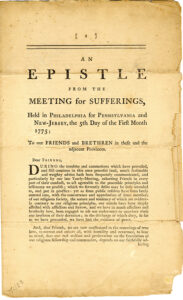 A 1775 document preserved in the Pennsylvania State Archives, “An Epistle from the Meeting for Sufferings,” offers insight into the beliefs, practices and morals of the Society of Friends, or Quakers, during the great social upheaval of the Revolutionary War period. The Meeting for Sufferings was a standing committee that addressed matters concerning the wider Quaker community during times of turmoil. The epistle gives advice to Quakers living in Pennsylvania and New Jersey, instructing them to abstain from involvement with any revolutionary activity. Maintaining their pacifism was of paramount importance.
John Pemberton (1727–95), the author of the epistle, was born in Philadelphia into a devout Quaker family. He was a successful merchant in Pennsylvania in the years before the Revolution. A Quaker minister and firm believer in the principle of pacifism, he refused to support the war. In the epistle, Pemberton wrote on behalf of the Meeting for Sufferings: “As divers members of our religious society, some of them without their consent or knowledge, have been lately nominated to attend on and engage in some public affairs, which they cannot undertake, without deviating from these our religious principles; we therefore earnestly beseech and advise them . . . to consider the end and purpose of every measure to which they are desired to become parties, with great circumspection and care to guard against joining in any for the asserting and maintaining our rights and liberties.”
One year later, Pemberton wrote another epistle that states clearly that Quakers should not engage in any actions or writings that disparage the king of England, reminding them that the monarchy had provided their ancestors with a refuge in Pennsylvania when they were scorned in Europe. The strongest advice then was to pray for the king and a peaceable reconciliation between England and America.
As the Quakers’ desire for peace and reconciliation with the king stood in direct contrast to the prevailing sentiment of the leaders of the revolutionary movement in Philadelphia, many Americans blamed them for setbacks in the war and were suspicious of their loyalty. The Quakers’ refusal to help prepare for the defense of Philadelphia from British attack in 1777, donate blankets or clothing to the Continental Army, or accept continental currency as a method of payment made them a target for violence and led to accusations that they were Loyalists.
Some revolutionaries dismissed the idea that Quakers were advocating for peace between England and America because of their moral convictions and religious belief in pacifism. They accused Quakers of merely trying to hold onto the political and mercantile power that they had enjoyed in Philadelphia for nearly a century.
Because of the Quakers’ reluctance to side with the Patriots during the war, their freedoms were limited during the conflict. Those who refused to take an oath of allegiance to the revolutionary government and pay wartime taxes had their voting rights removed and suffered military confiscations and property seizures. On September 11, 1777, 20 men, most of the Quaker leaders, including Pemberton and two of his brothers, were escorted out of Philadelphia and sent to the frontier in Winchester, Virginia. There they would remain for nearly eight months, never having been charged or convicted of any crimes. Following the British occupation of Philadelphia, from September 1777 to June 1778, Pennsylvania governmental leaders charged various Quakers of treason for aiding and abetting the British. In September 1778, two Quaker men, Abraham Carlisle and John Roberts, were tried and convicted of treason. They were executed by hanging on November 4, 1778. Some critics believed that the harsh sentence was intended as a warning to other potential collaborators with the British.
“An Epistle from the Meeting for Sufferings, Held in Philadelphia for Pennsylvania and New Jersey, January 5, 1775” is located in Manuscript Group 7.1, Military Manuscripts Collection, at the Pennsylvania State Archives.
Richard C. Saylor is an archivist for the Pennsylvania State Archives and author of the award-winning book Soldiers to Governors and numerous articles on military, political and sports history.