
A Beacon of Liberty for the Enslaved: 250 Years of the Pennsylvania Abolition Society
Written by Peter Durantine in the Features category and the Spring 2025 issue Topics in this article: abolitionism, African Americans, American Colonization Society, American Convention of Delegates from Abolition Societies, Anthony Benezet, Benjamin Franklin, Dina Nevil, Germantown, Germantown Quaker Petition Against Slavery (1688), John Woolman, Mary Ann Shadd, Pennsylvania Abolition Society, Philadelphia, Quakers, Rising Sun Tavern, Robert Purvis, Underground Railroad, William Still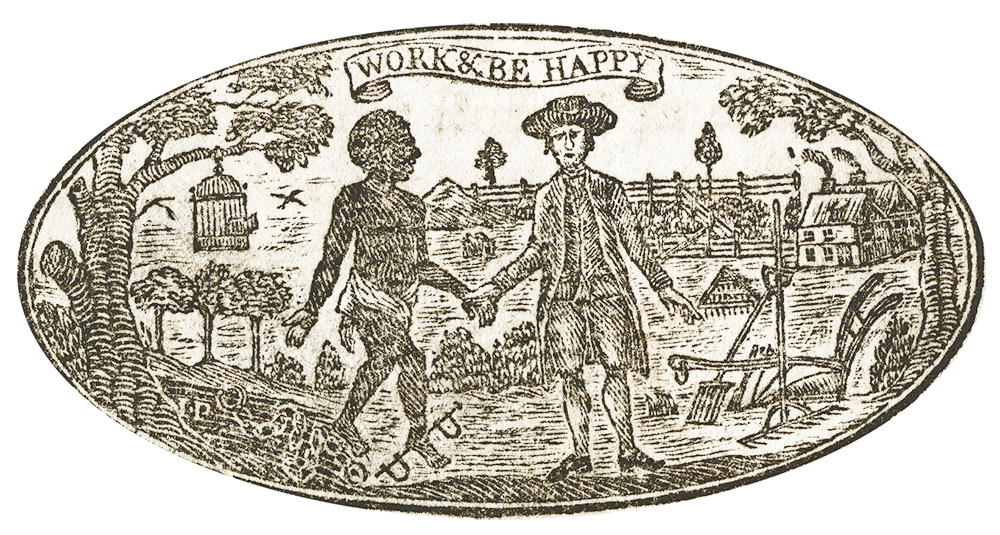
The seal of the Pennsylvania Society for Promoting the Abolition of Slavery.
Collection of the Historical Society of Pennsylvania
By the early 1700s, French Protestants — largely Calvinists known as Huguenots — suffered in their country from severe religious persecution, among them a boy, Antoine Bénézet (1720–72), and his parents. When their property was seized unless they renounced their faith, they departed their country, making their way to London, where they joined a welcoming group that stood for tolerance, the Religious Society of Friends (Quakers).
In 1731, having tasted the freedom of choosing to worship as they believed, Jean-Étienne de Bénézet, his wife Judith de la Méjanelle, and their now 18-year-old son decided to immigrate to the American colonies. They settled in the Quaker-founded city of Philadelphia, Pennsylvania, where they anglicized their surname to Benezet, and the father and son changed their Christian names: Jean-Étienne became John Stephen and Antoine became Anthony.
That same year, Anthony became one of the earliest abolitionists in the American colonies. He was influenced by John Woolman, a merchant and Quaker preacher who determined at a young age that slaveholding conflicted with his faith. Forty-four years later, in 1775, Benezet helped to start the Society for the Relief of Free Negroes Unlawfully Held in Bondage, the first American abolitionist society, which continues to exist today and is known as the Pennsylvania Abolition Society.
Before enslaved African Americans of the South reached their freedom through the Underground Railroad, there was the Pennsylvania Abolition Society, organized on April 14, 1775, by 24 white men, 17 of whom were Quakers such as Benezet, men with high standing in Philadelphia. The society’s mission was to advocate for social and racial justice and end the institution of slavery, not only in what would soon become their newly formed country, the United States, but also around the world.
Today, as the Pennsylvania Abolition Society prepares to recognize its Semiquincentennial, how has it endured for a quarter of a millennium, even after the United States ended slavery 160 years ago?
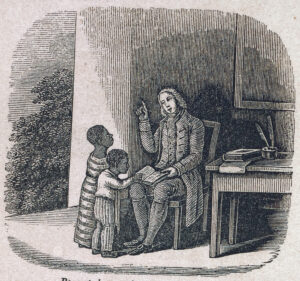
Teacher, author and fervent abolitionist, Anthony Benezet was a key founder of the Society for the Relief of Free Negroes Unlawfully Held in Bondage in 1775. In 1770 he had established the Benezet School for Black children in Philadelphia, where he was an instructor, as illustrated in this 1850 engraving.
The New York Public Library Digital Collections
Origins of the Movement
In the mid-1600s, decades before Anthony Benezet arrived in the city, Philadelphia was a busy slave-trading port; however, nearby in Germantown (an independent municipality until 1854), an early flicker of the abolitionist movement was sparked when Francis Daniel Pastorius (1651–c.1720) penned the 1688 Germantown Quaker Petition Against Slavery and signed it with three other German Quakers on behalf of their Germantown Meeting. Presented by the four men at the monthly meeting at Dublin, the petition made its case for the abolition of slavery within the meeting and advocated human rights based on the Golden Rule. Although the petition was passed up through the higher Quaker meeting structure and then disappeared without any action taken, support for abolition grew throughout Philadelphia.
In the late 1700s, Benezet, now a schoolteacher in Germantown, was helping to keep the movement alive, teaching enslaved children in his home, opening the first public school for girls, and, in 1773, establishing the Negro School in Philadelphia. A well-known activist, he published antislavery tracts and pamphlets with his own money. That year, among efforts to thwart slavery, Benezet, John Woolman and other like-minded Quakers petitioned the Pennsylvania Assembly to impose a £20 duty on slaves entering Philadelphia’s port. The duty was enacted, but another issue arose in 1773 that would ostensibly lead to the establishment of the society.
A Virginia man purchased an American Indian woman with four children from a New Jersey slaveholder and had them delivered to Philadelphia. When Dina Nevil and her children arrived, she proclaimed publicly that she and her children were free. She apparently garnered sympathetic support, as the mayor sent Nevil and her family to a home for indigents to await hearings. The Quakers filed a lawsuit to vacate the Virginian’s claim, but in 1775, after two years of legal battles, the court declared that Nevil and her children were slaves.
Over this period, Woolman and Benezet’s constant “exhortations . . . convinced many Friends that the egalitarian and humanitarian doctrines of the Quaker must be extended to include the enslaved black man,” according to Jeffrey Bumbrey in his “Historical Sketch” in A Guide to the Microfilm Publication of the Papers of the Pennsylvania Abolition Society at the Historical Society of Pennsylvania. “It was Quaker conscience, rather than civic consciousness, that led Friends to form an abolition society in 1775.”
The 24 local leaders who gathered in Philadelphia’s Rising Sun Tavern in 1775 organized the Society for the Relief of Free Negroes Unlawfully Held in Bondage to intervene in cases in which Blacks and American Indians were illegally enslaved. This group subsequently met three more times and then disbanded, but before they did, they tried unsuccessfully in the courts to win the Nevil family’s freedom.
According to Bumbrey, the group dissolved “because sixteen of the original twenty-four members were Quakers [and] the Society decided that Quaker pacifism might discredit or render ineffective the Society’s anti-slavery testimony. . . . After [the Revolutionary War Battles of] Lexington and Concord, few could comprehend or respect the peace testimony of the Quaker minority.” Fearing dire consequences, “most Friends withdrew from all public service,” and the society languished.
In 1784, the year Benezet died, 18 Philadelphia men reorganized the society as the Pennsylvania Society for Promoting the Abolition of Slavery, which became known as the Pennsylvania Abolition Society (PAS).
“Roughly a decade after it first gathered in 1775 at the Rising Sun Tavern, the PAS made Philadelphia the worldwide capital of the burgeoning abolitionist movement,” writes Richard S. Newman in a 2005 article for Pennsylvania Legacies.
A few years later, around 1787, Benjamin Franklin (1706–90) was elected the organization’s president, which in hindsight looks problematic. From around 1735 until 1790, Franklin owned six slaves that included a family — Peter, his wife Jemima and their son Othello — and three men, George, John and King.
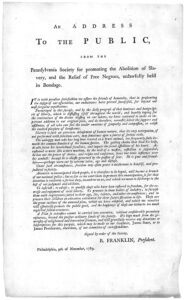
Benjamin Franklin was elected president of the Pennsylvania Abolition Society around 1787. On November 9, 1789, he delivered this address to the public and had it printed as a broadside.
Library of Congress
A (Somewhat) Enlightened Franklin
At the point of its reorganization, PAS opened its membership to non-Quakers. In addition to Franklin, the new members, who according to Bumbrey “brought not only credibility but a new, more pragmatic program to the Society,” included political philosopher Thomas Paine, physician and educator Benjamin Rush, statesman John Jay, and French Revolutionary War general Marquis de Lafayette.
Changes in Franklin’s racial views were apparently influenced by educators of Black children like Benezet and eminent thinkers such as British writer Samuel Johnson, whose view well before the heyday of the abolitionist movement in England was that slavery was simply immoral. Franklin initially believed people of dark skin were inferior to white Europeans and could not be educated. His thinking began to change in the 1760s, even as he continued advertising the sale of slaves and posting notices of runaways in his newspaper, The Pennsylvania Gazette. However, he also ran antislavery ads from the Quakers.
A seemingly enlightened 81-year-old when he became PAS’s president, which was just three years before his death in 1790, Franklin took various actions to support abolition. Before the Constitutional Convention in 1787 began, he signed a public antislavery appeal that stated, “the Creator of the world” made “of one flesh, all the children of men.”
According to BenjaminFranklinHouse.org, “It was believed that Franklin, like many Revolutionary leaders, supported the idea that a nation built on the promise of inalienable rights acquired at birth could not remain true while enabling slavery.”
At best, many historians say Franklin had a complicated relationship with slavery and the antislavery movement. In his 2005 book, Runaway America: Benjamin Franklin, Slavery, and the American Revolution, history professor David Waldstreicher contends that Franklin’s views changed for political considerations. “He had heard all the important arguments against slavery decades before, so his revealing silences and careful interventions reflected much more than the personal enlightenment he began to confess, at times quite strategically, to antislavery friends and activists,” Waldstreicher writes. “Antislavery had less and less to do with conscience and more and more to do with politics.”
In 1789 Franklin wrote and published essays arguing for the abolition of slavery, and on November 9 of that year, he delivered an address to the public, calling slavery an “atrocious debasement of human nature” and, speaking to the mission of PAS, appealing for resources to support emancipated people in education and employment.
On PAS’s behalf, Franklin petitioned Congress to “cut slavery out of the body politic,” free enslaved Black people, and “promote mercy and justice toward this distressed Race.”
Introduced in the House and Senate in early February 1790, the petition was denounced by proslavery congressmen. Following heated debate, the lawmakers decided the Constitution restrained the Congress from such actions. Franklin died later that year. Through his last will and testament, he freed the remaining people he enslaved.
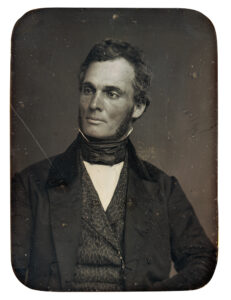
Robert Purvis cofounded the American Anti-Slavery Society with a group of Philadelphia abolitionists in 1838. He also joined the Pennsylvania Abolition Society in 1842 as its first Black member. The two organizations often worked in tandem on abolitionist efforts.
Boston Public Library
Into the Antebellum
Reorganized and re-energized, the Pennsylvania Abolition Society stepped up their efforts. According to Bumbrey, “The Society continued to work toward its objectives within the legal system in a quiet, persistent, orderly fashion.”
In their effort to improve the condition of African Americans, PAS focused on offering jobs and education to the local youth and to freedom seekers from the South. In 1790 the society appointed 24 members to the Committee for Improving the Condition of Free Blacks, which organized into subcommittees: Inspections, Education and Employ.
When PAS’s effort at fighting slavery in the courts and legislature failed, the Acting Committee, which formed a few years earlier, gathered information on the kidnapping of slaves, “alleged slave schooners,” and compliance with Pennsylvania’s Gradual Abolition Act of 1780 and its 1788 amendment that required enslaved African Americans to be registered.
As Philadelphia grew in those years, so did the city’s free Black population, including the poor and uneducated youth, prompting PAS to organize the Committee for Improving the Condition of Free Negroes, which replaced the Committee of Education. In 1794 the committee established a school for Black males and directed a census of the city’s Black population.
That same year, PAS sought to organize other societies around the country under a nationwide umbrella, the American Convention of Delegates from Abolition Societies. Members from nine societies gathered in Philadelphia, but the convention failed to fully engage all of the societies, as their local needs conflicted with those of a national organization.
Although the convention succeeded in many of its goals — every state north of Delaware enacted gradual emancipation laws or prohibited slavery in their constitutions — forces elsewhere — the cotton gin, reorganization of agriculture, and new lands in the Deep South and the West — acted against abolition and increased demand for slave labor.
In the early part of the 19th century, PAS focused on its Philadelphia constituents by opening another school, Clarkson Hall, on Cherry Street; conducting a second census of the Black population; and expanding education facilities for their children.
PAS’s manumission program, the effort at freeing enslaved Black people, was vigorous in the years leading up to the outbreak of the Civil War in 1861.
Meanwhile, African American leaders, notably Philadelphia abolitionist William Still (1819–1902), were guiding enslaved Black people to freedom through the Underground Railroad. Still was chairman of the Vigilance Committee of the Pennsylvania Anti-Slavery Society, founded in 1838 by Robert Purvis (1810–98), James and Lucretia Mott, and others. Known as the “Father of the Underground Railroad,” Still is believed to be responsible for helping at least 649 enslaved African Americans to freedom in the North.
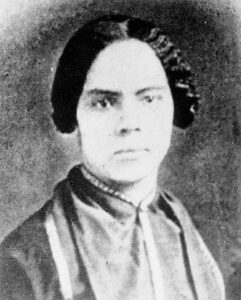
Once a resident and teacher in Pennsylvania, Mary Ann Shadd moved to Ontario and established the weekly newspaper Provincial Freeman in 1853. She worked with PAS as part of the Underground Railroad to help enslaved African Americans navigate the course to freedom.
Library and Archives Canada, Mary Ann Shadd Cary Collection, c029977
Establishing a North American Network
In 1842 the Pennsylvania Abolition Society admitted Purvis as its first Black member. A man of mixed race born in Charleston, South Carolina, Purvis was the grandson of a formerly enslaved woman and a Jewish American man from Charleston. His mother was born a free woman of color, and his father was a British immigrant. In 1845 Purvis became president of the Anti-Slavery Society.
In the decade before hostilities broke out between the free states of the North and the slave states of the South, the first Black woman publisher in North America, Mary Ann Shadd (1823–93), started an antislavery newspaper in Ontario, Canada, the Provincial Freeman. PAS established a relationship with Shadd in its effort to get the enslaved to freedom.
Born free in Wilmington, Delaware, where she was baptized a Catholic, Shadd was raised in a family that welcomed freedom seekers into their home. When the state made it unlawful to educate African American children, the family moved to Pennsylvania, where Shadd attended a Quaker boarding school. She went on to teach Black children in Pennsylvania and New York City. When Congress passed the Fugitive Slave Act of 1850, allowing for escaped slaves to be hunted down in Northern states and brought back to bondage, her family moved to Ontario.
With its slogan “Devoted to Antislavery, Temperance and General Literature,” the Provincial Freeman was published weekly and ran for four years before shutting down because of financial struggles. Nonetheless, the paper offered a powerful voice, and Shadd served in that network of getting the enslaved to freedom, working with the Underground Railroad.
PAS’s network spread across North America and extended to England and parts of the Caribbean. It also maintained a modest relationship with two colonies in western Africa, founded specifically for formerly enslaved and freeborn Blacks: Sierra Leone, established by the British in 1808, and Liberia, a project started in 1822 by the American Colonization Society. The Colonization Society was founded six years earlier by a group of white Northern and Southern men and was led by Robert Finley, a white Presbyterian minister from New Jersey, to encourage freeborn and emancipated Blacks to repatriate in Africa.
Paul Cuffe (1759–1817), an African American Quaker and shipbuilder from Massachusetts, had advocated resettling formerly enslaved and free Blacks in Sierra Leone. In 1816, with support from the British government, the U.S. Congress, and free Black American leaders, Cuffe sailed 38 Black Americans to the colony’s capital, Freetown. Some abolitionists such as James Forten (1766–1842), a freeborn Black businessman in Philadelphia, were appalled by the Colonization Society and its efforts. “We have no wish to separate from our present homes for any purpose whatever,” Forten wrote in 1817.
In 1849, as the U.S. Senate considered shipping free Black people to Liberia, Frederick Douglass, wrote this in his newspaper, The North Star: “For two hundred and twenty-eight years has the colored man toiled over the soil of America, under a burning sun and a driver’s lash—plowing, planting, reaping, that white men might roll in ease, their hands unhardened by labor, and their brows un-moistened by the waters of genial toil; and now that the moral sense of mankind is beginning to revolt at this system of foul treachery and cruel wrong, and is demanding its overthrow, the mean and cowardly oppressor is meditating plans to expel the colored man entirely from the country. Shame upon the guilty wretches that dare propose, and all that countenance such a proposition. We live here — have lived here — have a right to live here, and mean to live here.”
According to historian Marc Leepson in his 2014 book, What So Proudly We Hailed, “Colonization proved to be a giant failure, doing nothing to stem the forces that brought the nation to Civil War.” Out of millions of African Americans, only a few thousand emigrated to Liberia between 1821 and 1847.
The American Colonization Society challenged the Pennsylvania Abolition Society’s mission to assimilate free Blacks into American society. PAS opposed “the creation of a new social order,” Bumbrey writes. “The Society’s minutes show that although colonization proposals came before the membership, they were certainly not supported. Nor, unfortunately, do they appear to have been condemned.”
The Civil War Years
In the years immediately preceding the Civil War, the Pennsylvania Abolition Society, now with an increasing restoration of Quaker membership, kept a low profile because of Northern resentment of abolitionists. Membership declined rather sharply, and meetings were frequently canceled.
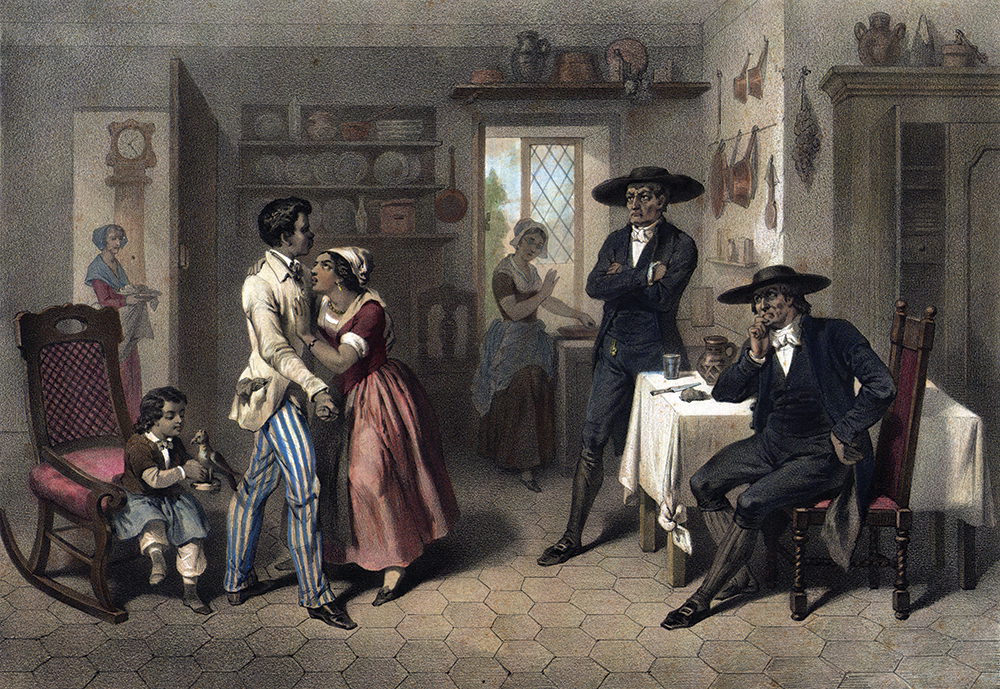
This lithograph of a scene from an illustrated edition of Uncle Tom’s Cabin shows a Black family finding refuge among Quakers during an escape to freedom.
Swarthmore College
Although remaining relatively quiet during the war, PAS members voted unanimously in 1863 to enter the complete text of President Abraham Lincoln’s Emancipation Proclamation into their official records.
PAS also worked with Black refugees pouring into Philadelphia as a result of the war. Municipal officials were doing little to help them, so in 1862 PAS created a Committee of Employment to secure jobs and homes. When this financial burden became too large an undertaking, PAS joined with
the Pennsylvania Freedman’s Association and two Quaker groups to form the Freedmen’s Employment Agency. It provided jobs for emancipated African Americans throughout eastern Pennsylvania until finally disbanding in 1867.
In those immediate postwar years, PAS membership remained active, campaigning against the exclusion of Blacks from Philadelphia streetcars, conducting a survey on whether discrimination existed in the public schools, and joining with the Pennsylvania Anti-Slavery Society to advocate for passage of the 15th Amendment grantingm African American men the right to vote.
By 1875, as PAS marked its 100-year anniversary, it was the only antislavery society still in existence. In the latter half of the 19th century through the 20th century PAS helped combat housing discrimination in Philadelphia from the 1940s to the 1970s. In the 21st century, PAS has maintained its mission for advancing social and racial justice.
An Enduring Institution
Today, the Pennsylvania Abolition Society is run by an eight-member Board of Managers, each of whom contributes $1 at every annual meeting, conducted the fourth Thursday of each year. At their spring meeting, they review and award grant proposals; in the fall, they take stock of the year.
“It has increasingly gotten to be a very small group,” says Cynthia Little, the interim president and treasurer.
Having an interest in African American history, Little became involved with PAS in the mid-1980s because it remains involved in antislavery issues around the world. “I like the cause,” she says. “It’s really been a meaningful part of my life.”
In recent years, PAS transferred its financial assets to the Philadelphia Foundation, which manages the organization’s resources, including an estimated $600,000 endowment that is used for the annual mission that today is mostly philanthropic, funding programs for racial and social justice and emphasizing the importance of Black history.
PAS sponsors National History Day in Philadelphia and ensures that their vast collection of papers and images, housed at the Historical Society of Pennsylvania since the 1940s, are exhibited and included in Black History programs.
“The collection is a very big part of our legacy,” Little says. “It’s a very large and old collection that needs a lot of care and feeding.”
For the 250th anniversary, PAS is planning to have additional events to showcase their collection through exhibitions and programs.
Further Reading
Bacon, Margaret Hope. “The Pennsylvania Abolition Society’s Mission for Black Education.” Pennsylvania Legacies 5, no.2 (November 2005): 21–26. / Blackett, R.J.M. Building an Antislavery Wall: Black Americans in the Atlantic Abolitionist Movement, 1830–1860. Baton Rouge: Louisiana State University Press, 2002. / Bumbrey, Jeffrey Nordlinger. “Historical Sketch.” In: A Guide to the Microfilm Publication of the Papers of the Pennsylvania Abolition Society at the Historical Society of Pennsylvania. Philadelphia: Pennsylvania Abolition Society and the Historical Society of Pennsylvania, 1976. / Celebration of the Ninetieth Anniversary of the Organization of the Pennsylvania Society for Promoting the Abolition of Slavery. Philadelphia: Merrihew & Sons, 1866. / Leepson, Marc. What So Proudly We Hailed: Francis Scott Key, a Life. New York: St. Martin’s Press, 2014. / Newman, Richard S. The Transformation of American Abolitionism: Fighting Slavery in the Early Republic. Chapel Hill: University of North Carolina Press, 2002. / Newman, Richard S. “The Pennsylvania Abolition Society: Restoring a Group to Glory.” Pennsylvania Legacies 5, no.2 (November 2005): 6–10. / Waldstreicher, David. Runaway America: Benjamin Franklin, Slavery, and the American Revolution. New York: Hill and Wang, 2004.
Peter Durantine, a writer and journalist for more than 30 years, lives in Hummelstown, Dauphin County. His previous features for Pennsylvania Heritage include “Gasping for Air: The Donora Smog Disaster” (Fall 2023) and “Quecreek: Remembering the Remarkable Mining Rescue 20 Years Later” (Summer 2022).