
1st Pennsylvania Regiment Flag and Banners of Liberty
Written by Curtis Miner in the PHMC Highlights category and the Summer 2025 issue Topics in this article: 1st Pennsylvania Regiment, battle flags, Edward Hand, Matthew S. Quay, Museum of the American Revolution, State Museum of Pennsylvania, Thomas Robinson, Washington Crossing, William Thompson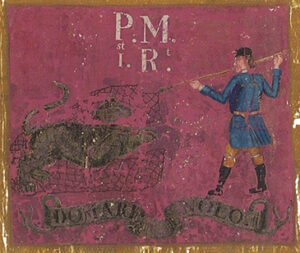 One of the most significant objects in the collection of The State Museum of Pennsylvania is currently being featured in Banners of Liberty, a special exhibition of rare and original Revolutionary War–era flags at the Museum of the American Revolution (MOAR) in Philadelphia. The 40-by-54-inch silk flag belonged to the 1st Pennsylvania Regiment of the Continental Line between 1776 and 1783. Over the years, it has also been referred to as the “Thompson Rifle Battalion Flag,” or just “Thompson Flag,” in recognition of the 1st Pennsylvania’s founding commander, Col. William Thompson of Carlisle, Cumberland County.
In a letter penned on March 8, 1776, Thompson’s successor, Lt. Col. Edward Hand, described the flag and its distinct design motif: “Our Standard is to be a deep green ground, the Device a Tyger partly enclosed by toils attempting the pass defended by a hunter armed with a spear in white, on crimson field the motto domari nolo.”
The inscription, which translates to “I refuse to be subjugated,” proved fitting for the regiment that carried the flag. The 1st Pennsylvania was there when Gen. George Washington crossed the Delaware River in 1776 and when British forces surrendered at Yorktown in 1781, as well as many other battles and engagements in between. At the conclusion of the war, the flag passed into the hands of a later commander of the regiment, Lt. Col Thomas Robinson.
Over the next century, the flag was cared for and passed down through Robinson’s heirs. The flag then caught the attention of Matthew Quay, Pennsylvania’s longtime Republican political boss, after it was displayed at the Centennial Exposition in Philadelphia in 1876. Records indicate that Quay personally purchased the flag from the Robinson family in 1879. By 1906 the flag was recorded as part of the collections being cared for by the recently formed State Museum of Pennsylvania.
Curators and conservators today understand how sensitive to light silk and other textiles are and how carefully these artifacts must be displayed and handled to avoid damage. Unfortunately, such protocols of care were not widely adopted by museums until the 1960s. By that time, decades of continuous public display had irreversibly faded the flag’s colors and damaged its fragile fabric and stitching. In 2004, following several attenuated efforts to repair the flag, professional conservators created a custom pressure mount to stabilize the textile and prevent further deterioration. As part of the terms of the loan with MOAR, the Thompson flag is currently being displayed on a special platform that allows visitors to view it while also protecting it.
After Banners of Liberty closes in August, the Thompson flag will be returned to Harrisburg to make one final public appearance this year in the run-up to the nation’s Semiquincentennial celebration in 2026. In late 2025 the flag will join several other Revolutionary War–related collections in a special exhibition at The State Museum designed to tell the story of Pennsylvania’s pivotal role in the struggle for American independence. When the exhibition closes in August 2026, this one-of-a-kind Revolutionary War flag will be returned to storage, where it will continue to be cared for and preserved for future generations.
Curtis Miner, Ph.D., is chief of interpretation at The State Museum of Pennsylvania.